Zing Forum

Reading

Semantic Book Recommendation System Based on Large Language Models

Explore how to leverage the semantic understanding capabilities of large language models to build an intelligent book recommendation system that surpasses traditional collaborative filtering.

大语言模型图书推荐语义搜索推荐系统LLM应用
Published 2026-05-09 13:41Recent activity 2026-05-09 13:52Estimated read 6 min
Semantic Book Recommendation System Based on Large Language Models
1

Section 01

Introduction: Core Exploration of Semantic Book Recommendation Systems Based on Large Language Models

This article focuses on building an intelligent book recommendation system using the semantic understanding capabilities of large language models (LLMs). It analyzes the evolutionary dilemmas of traditional recommendation systems, introduces the paradigm shifts brought by LLMs, project implementation ideas, technical key points, advantages/disadvantages, and application expansions, and discusses their significance for the development of recommendation systems.


2

Section 02

Background: Evolutionary Dilemmas of Traditional Book Recommendation Systems

Traditional book recommendation systems rely on two methods: content-based filtering and collaborative filtering. Content-based filtering recommends via metadata analysis but struggles to capture deep semantic connections; collaborative filtering discovers similarities based on user behavior data but faces cold start issues. More crucially, traditional methods find it hard to understand users' true intentions, such as the abstract concept of 'grand narrative'.

3

Section 03

Methodology: Paradigm Shifts in Recommendation Brought by LLMs

Large language models (LLMs) acquire rich semantic understanding through massive text pre-training, bringing three major shifts: breakthroughs in semantic understanding (identifying deep thematic connections, e.g., the dystopian themes of 1984 and Brave New World); zero-shot reasoning ability (recommending without domain-specific training data); natural language interaction (supporting complex natural language queries like "non-fiction works discussing AI ethics").

4

Section 04

Methodology: Core Implementation Architecture of the Project

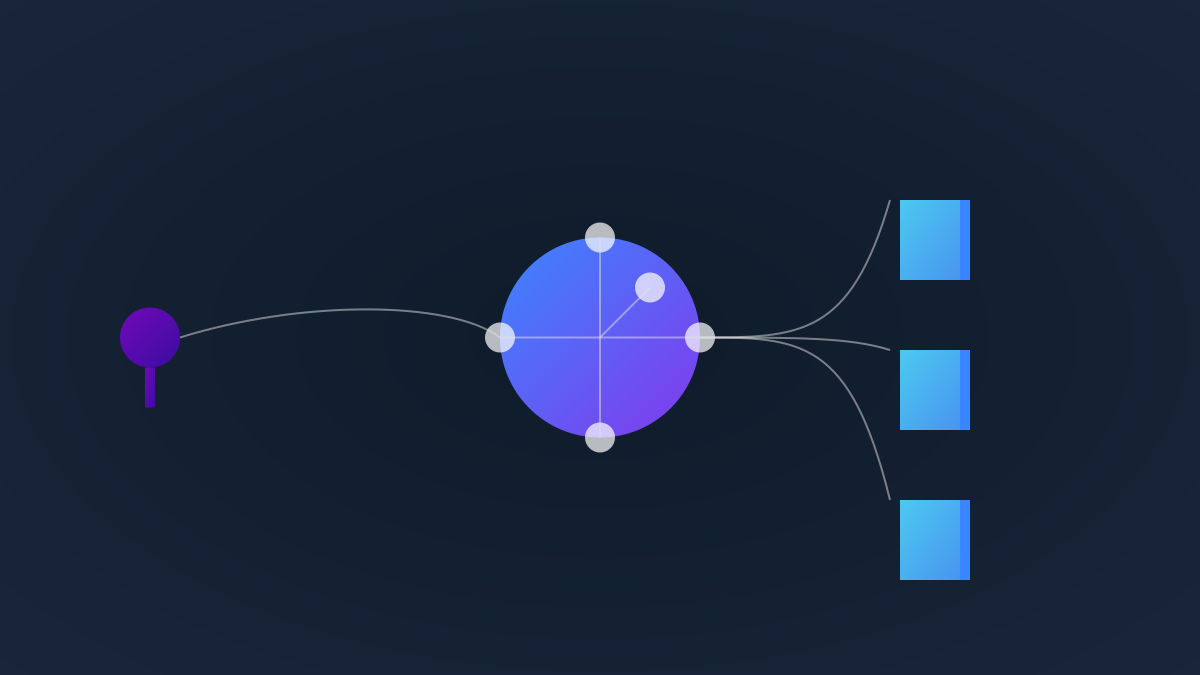
The project's core architecture consists of four parts: 1. Book semantic encoding: Using LLMs to encode book metadata (title, introduction, author, etc.) into high-dimensional semantic vectors; 2. User intent understanding: Parsing explicit needs, implicit preferences, and emotional tendencies; 3. Semantic matching and ranking: Encoding user queries into vectors and calculating similarity with book vectors; 4. Explanation generation: Generating natural language recommendation reasons.

5

Section 05

Methodology: Key Technical Implementation Points

Technical implementation requires attention to three points: 1. Embedding model selection: Such as OpenAI text-embedding, Sentence-BERT, etc., considering vector dimensions, semantic capabilities, etc.; 2. Vector databases: Such as Pinecone, Weaviate, etc., supporting efficient similarity search; 3. Prompt engineering: Designing effective prompts for book summaries, intent parsing, and recommendation reason generation.

6

Section 06

Analysis of Advantages and Limitations

Advantages: Deep semantic understanding, cold-start friendly (new books can be recommended as long as there is text), interpretability (generating natural language reasons), flexibility (supporting complex queries). Limitations: High computational cost, hallucination risk (generating inaccurate content), timeliness (knowledge has an expiration date), bias issues (inheriting biases from training data).

7

Section 07

Application Scenario Expansion

LLM-based semantic recommendation methods can be extended to scenarios such as film and television (understanding plot styles), music (capturing lyric emotions), courses (matching learning goals), and papers (discovering cross-research).

8

Section 08

Conclusion and Outlook

LLM-based semantic recommendation represents a new direction for recommendation systems, making up for the shortcomings of traditional methods and providing more natural human-computer interaction. With the advancement of LLM technology and cost reduction, it is expected to be applied in more scenarios, providing a 'understanding you' personalized experience.

