Zing Forum

Reading

Model Compression and Reasoning Consistency: Are Distilled Models Truly "Reasoning Correctly"?

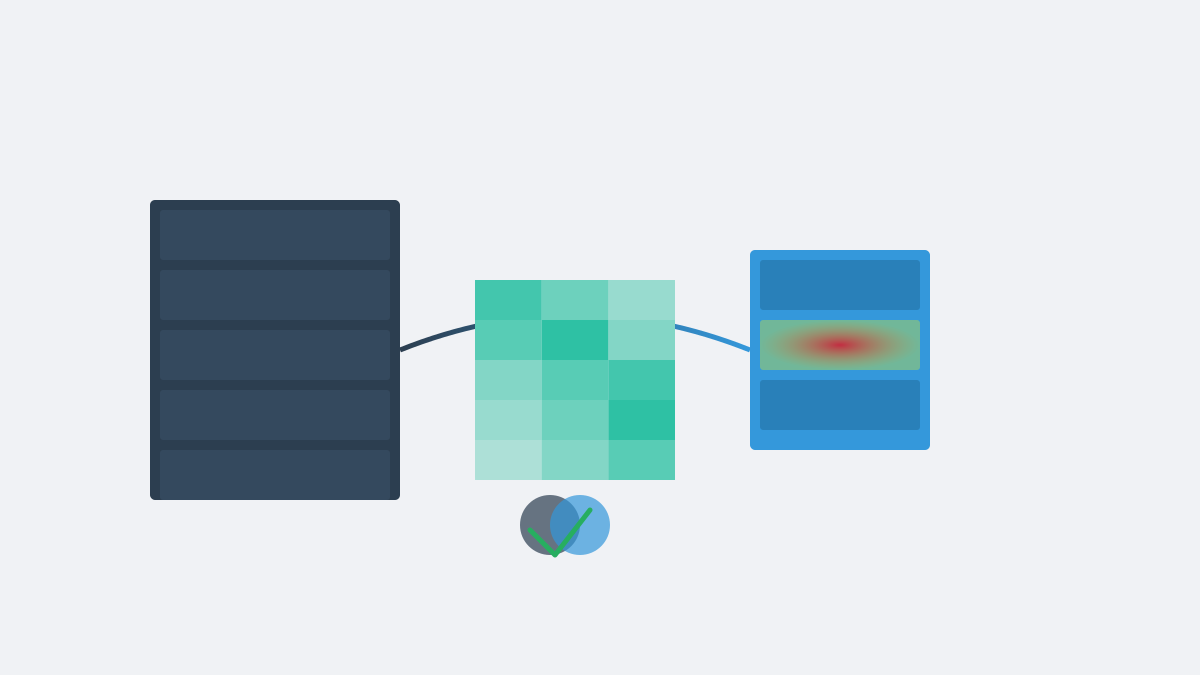
This study delves into the reasoning consistency issue of compressed models after knowledge distillation. Using methods like GradCAM, CKA, and calibration analysis, it evaluates whether compressed models truly understand the essence of problems or merely mimic the surface patterns of correct answers.

知识蒸馏模型压缩可解释AIGradCAMCKA模型校准推理一致性神经网络可视化
Published 2026-04-12 01:11Recent activity 2026-04-12 01:20Estimated read 7 min
Model Compression and Reasoning Consistency: Are Distilled Models Truly "Reasoning Correctly"?
1

Section 01

【Introduction】Model Compression and Reasoning Consistency: Do Distilled Models Truly "Reason Correctly"?

This study focuses on the reasoning consistency issue of compressed models after knowledge distillation, exploring whether compressed models truly understand the essence of problems when giving correct answers, rather than just mimicking surface patterns. Through multi-dimensional evaluation methods such as GradCAM (attention visualization), CKA (representational similarity analysis), and calibration analysis, it finds that test set accuracy cannot guarantee reasoning consistency, different distillation strategies have a significant impact on consistency, and puts forward practical suggestions for improving the distillation process and model selection, emphasizing the need to ensure model reasoning quality while improving efficiency.


2

Section 02

【Background】Why Focus on the Reasoning Consistency of Distilled Models?

Knowledge distillation technology for large language models can reduce inference costs while maintaining performance, but a core issue is often overlooked: do correct answers from compressed models stem from true understanding? In high-risk scenarios such as medical diagnosis and legal analysis, models need to make decisions based on correct logic and evidence. If they only "guess correctly" relying on surface features, it may lead to serious consequences. Therefore, reasoning consistency (correct answers with reasonable reasons) is a key consideration for the deployment of compressed models.

3

Section 03

【Research Methods】Multi-dimensional Evaluation Framework: GradCAM, CKA, and Calibration Analysis

The study constructs a systematic evaluation framework to analyze reasoning behavior from three dimensions:

  1. GradCAM: Compare the attention heatmaps of teacher and student models; if reasoning is consistent, the attention distribution will be similar;
  2. CKA: Measure the similarity of intermediate layer representations to evaluate whether the student model has internalized the teacher's abstract representations;
  3. Calibration Analysis: Check the matching degree between confidence and accuracy through reliability diagrams and ECE indicators; overconfidence is a signal of reasoning defects.
4

Section 04

【Key Findings】Accuracy ≠ Correct Reasoning; Distillation Strategies and Task Complexity Have Significant Impacts

Key findings include:

  1. Correct Answer ≠ Correct Reasoning: Some student models have accuracy comparable to the teacher model, but their attention distributions differ greatly, relying on spurious correlations or surface features;
  2. Impact of Distillation Strategies: Output matching easily leads to surface learning, while feature/relation distillation is more effective in maintaining reasoning consistency;
  3. Task Complexity Adjustment: Compressed models are more prone to "chain breaks" in complex reasoning tasks, requiring strict verification mechanisms.
5

Section 05

【Practical Recommendations】Improvements to Distillation Process and Model Selection Decision Framework

Improvement suggestions:

  1. Multi-objective Optimization: Combine output matching, feature alignment, and calibration constraints in the loss function;
  2. Layered Distillation: Design differentiated distillation strategies for each layer;
  3. Adversarial Verification: Test robustness using adversarial samples;
  4. Human-in-the-Loop: Manually review heatmaps of key samples.

Model selection framework: In addition to accuracy, check GradCAM heatmaps, calibration curves, and CKA representation alignment.

6

Section 06

【Limitations and Future Work】Current Research Limitations and Future Exploration Directions

Limitations: Focuses on visual and text classification tasks; reasoning consistency evaluation for generative tasks (such as translation and text generation) remains to be explored; interpretation tools (GradCAM/CKA) have limitations.

Future directions: Develop fine-grained reasoning path tracking tools, apply causal inference methods, and establish standardized reasoning consistency benchmark datasets.

7

Section 07

【Conclusion】Balance Efficiency and Reasoning Quality; Ensure Models "Think Correctly" Before Deployment

Model compression makes large models easier to deploy, but efficiency improvement should not come at the cost of reasoning quality. It is necessary to examine the model's "thinking process" and ensure that compressed models make correct judgments based on correct reasons before they can be safely deployed in real complex scenarios.

