Zing Forum

Reading

llm-formatter: A Practical Tool for Intelligently Formatting Codebases for Large Language Models

An open-source tool that automatically formats codebases into text blocks suitable for LLM analysis, intelligently recognizes .gitignore rules, and generates clean context.

llm-formatter代码格式化LLM工具代码审查GitHub开源工具AI辅助编程
Published 2026-03-28 17:45Recent activity 2026-03-28 17:47Estimated read 5 min
llm-formatter: A Practical Tool for Intelligently Formatting Codebases for Large Language Models
1

Section 01

Introduction: llm-formatter - A Code Formatting Tool for AI-Assisted Programming

In today's era of popularized AI-assisted programming, developers often need to submit codebases to Large Language Models (LLMs) for analysis, refactoring, or debugging. However, directly pasting raw code has pain points such as interference from irrelevant files, mixing of binary files, and leakage of sensitive information. llm-formatter is an open-source tool that can automatically format codebases into text blocks suitable for LLM analysis. It intelligently recognizes .gitignore rules to generate clean context, solving the inefficiency of manual organization and improving collaboration efficiency with LLMs.


2

Section 02

Project Background: The Need for Code Context Organization in AI-Assisted Programming

As the capabilities of large models like GPT-4 and Claude continue to enhance, developers integrate LLMs into daily workflows such as code review, architecture design, and bug diagnosis, which requires providing sufficient context. However, manually organizing code files is time-consuming and error-prone, especially when the project scale is large, making it difficult to quickly filter effective files. llm-formatter aims to automate this process, generating code snapshots suitable for LLM consumption with one click, balancing content completeness and readability.

3

Section 03

Core Features and Implementation Mechanism: Intelligent Filtering and Structured Output

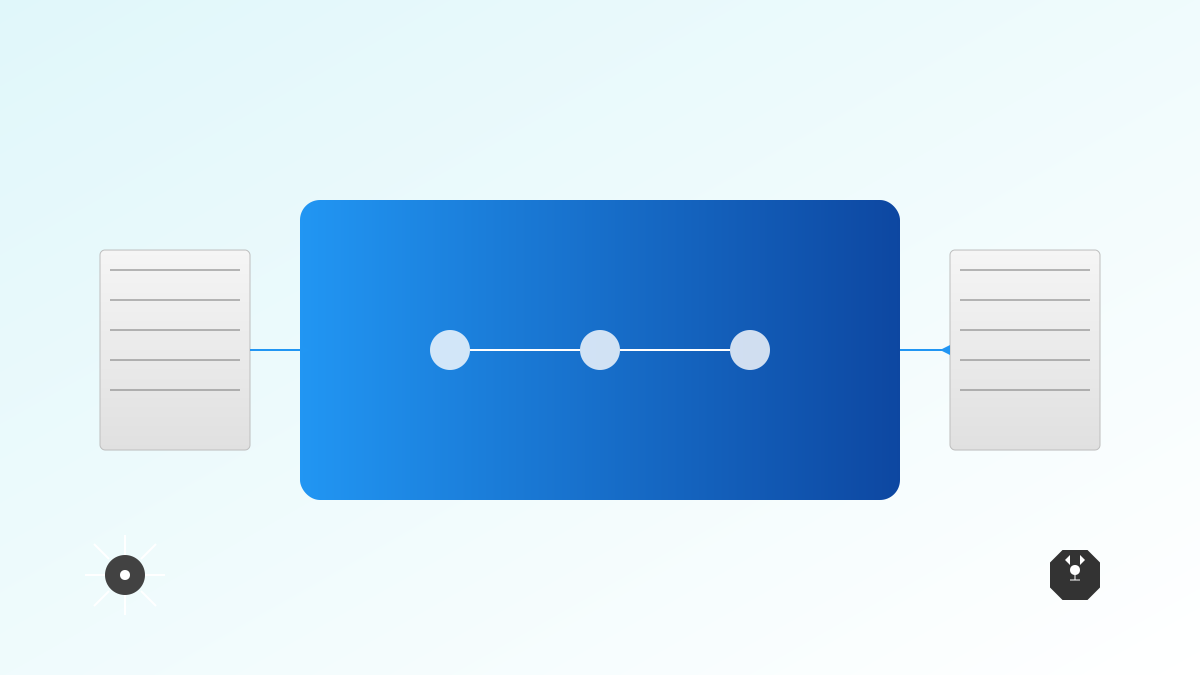
The core capabilities of the tool include: 1. Intelligent file filtering: deeply integrates .gitignore parsing to exclude irrelevant content such as node_modules, pycache, and compiled products; 2. Structured output: converts to a unified format of file path + language identifier + code content, helping LLMs understand code organization and module relationships; 3. Configurability: customize included/excluded directories, file size limits, etc. through command-line parameters or configuration files to adapt to different project requirements.

4

Section 04

Application Scenarios and Technical Highlights: Practical Value of the Tool

Typical application scenarios: code review preparation (generate clean snapshots to avoid interference), architecture discussion (provide complete structure for precise suggestions), bug diagnosis (format related modules to help locate problems), and document generation (automatically generate documents based on code). Technical highlights: concise and efficient architecture (scan directory → filter → process encoding and binary files); accurate .gitignore support (nested rule parsing, consistent with Git behavior). Community feedback: significantly improves collaboration efficiency, the CLI is intuitive and easy to use, and the documentation is detailed.

5

Section 05

Conclusion: A Practical Tool for AI-Native Workflows

llm-formatter focuses on solving practical pain points and is a microcosm of the developer tool ecosystem evolving towards AI-native workflows. It has targeted functions and precisely responds to emerging technology trends. For developers who frequently use LLMs for AI-assisted programming, it is worth including in their daily toolbox.

6

Section 06

Future Development Directions: Continuous Optimization and Deep Integration

Future improvement directions for the tool: support more output formats (JSON, XML); integrate code summary functions; provide an incremental update mode to handle frequently changing projects; and deeply integrate with mainstream AI programming assistants.

