Zing Forum

Reading

LLM-Driven Industrial Equipment Fault Diagnosis: An Intelligent Diagnostic Framework Combining FFT and Statistical Features

Exploring how to apply large language models (LLMs) to industrial machinery fault diagnosis, and realizing intelligent equipment health monitoring through FFT frequency domain analysis and statistical feature extraction.

故障诊断大语言模型FFT振动分析工业AI预测性维护信号处理
Published 2026-04-19 01:44Recent activity 2026-04-19 01:50Estimated read 5 min
LLM-Driven Industrial Equipment Fault Diagnosis: An Intelligent Diagnostic Framework Combining FFT and Statistical Features
1

Section 01

LLM-Driven Industrial Equipment Fault Diagnosis Framework: An Intelligent Solution Integrating FFT and Statistical Features

Predictive maintenance of industrial equipment is a core challenge in manufacturing. Traditional methods rely on expert experience and fixed rules, making it difficult to handle complex working conditions. This article proposes an LLM-driven intelligent diagnostic framework that combines FFT frequency domain analysis and statistical feature extraction, providing an innovative path for industrial equipment health monitoring. It integrates cutting-edge AI with traditional engineering technologies to help address pain points in fault diagnosis.


2

Section 02

Analysis of Practical Dilemmas in Industrial Fault Diagnosis

Rotating machinery (such as motors, bearings, gearboxes) is the core of industrial production, and their health status affects efficiency and safety. Traditional diagnosis has four major limitations: 1. Manual diagnosis relies on the experience of senior engineers; 2. Rule-based systems are rigid and difficult to cover all fault modes; 3. The utilization rate of massive vibration data is low; 4. The response speed from anomaly detection to fault location is slow.

3

Section 03

Core Technical Solutions of the Intelligent Diagnostic Framework

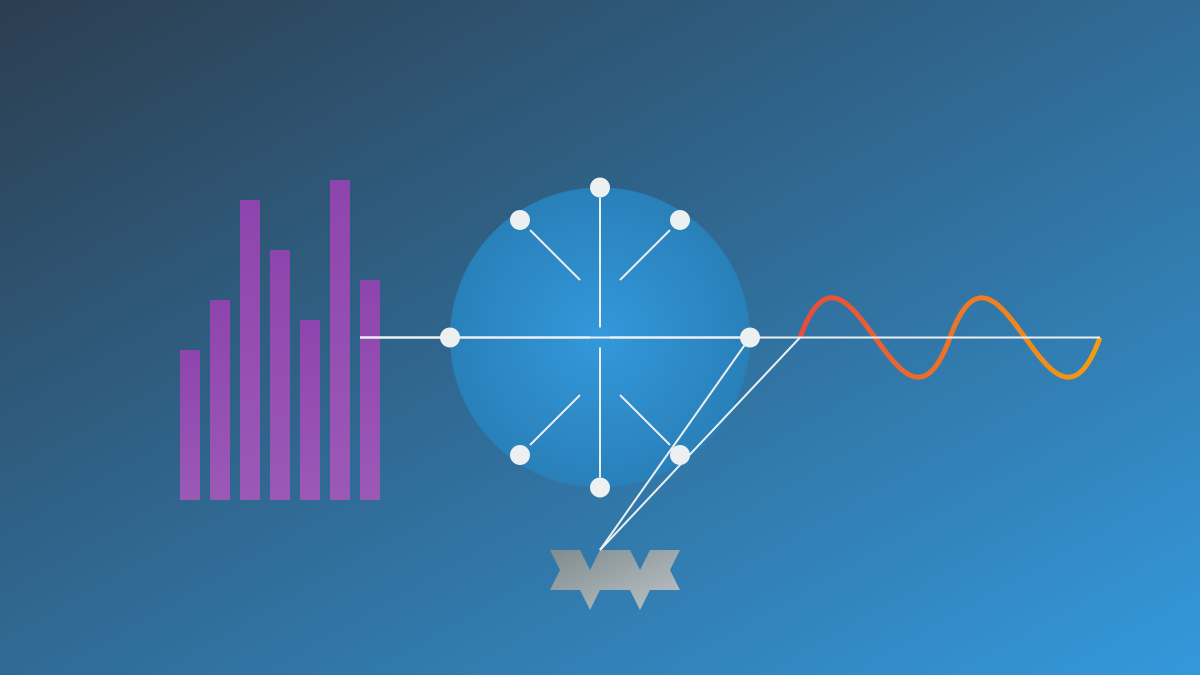
This framework deeply integrates LLM's semantic understanding capabilities with signal processing technologies: 1. FFT frequency domain analysis: Convert time-domain vibration signals to frequency domain, identify periodic components, separate fault source frequencies, and extract relevant spectral indicators; 2. Statistical feature extraction: Includes time-domain indicators (mean, variance, etc.), amplitude indicators (peak value, root mean square), and dimensionless indicators (waveform, peak, pulse indicators); 3. LLM integration innovations: Supports natural language interaction, integrates domain knowledge bases, provides interpretable outputs, and has continuous learning capabilities.

4

Section 04

Application Scenarios and Implementation Path Recommendations for the Framework

This framework is applicable to multiple scenarios: early warning for bearings/gearboxes of wind power equipment, real-time health assessment of motors in production lines, and online detection of bogies/wheelsets in rail transit. Implementation is recommended to adopt a progressive deployment approach: first pilot on key equipment, accumulate data to optimize the model, then gradually expand the coverage.

5

Section 05

Prospects and Unresolved Challenges of the LLM-Driven Diagnostic Framework

The combination of LLM and industrial Internet of Things (IIoT) is an important direction for intelligent manufacturing, but deployment needs to focus on: edge computing capabilities to meet real-time requirements, data privacy and security compliance, model generalization to adapt to specific working conditions, and integration with existing SCADA/MES systems. This framework provides a reference paradigm for industrial AI applications, demonstrating the organic combination of cutting-edge AI and traditional engineering.

