Zing Forum

Reading

From Rule Engine to LLM: Two Generations of Evolution Practice for Mental Health Chatbots

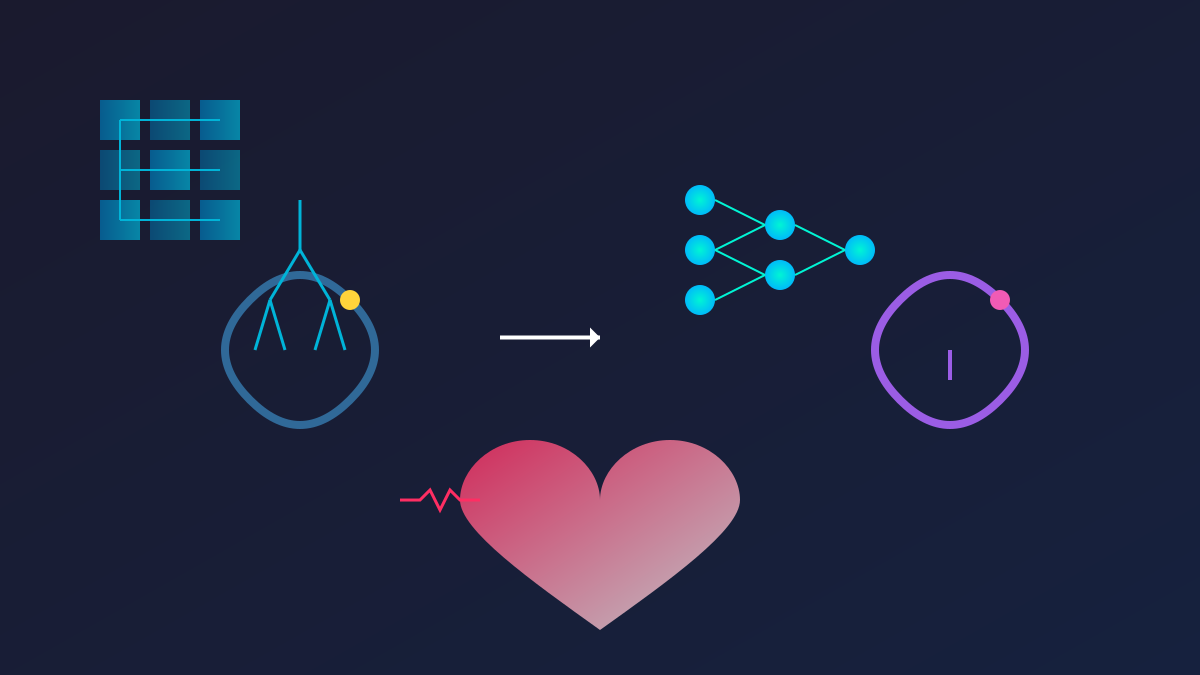
This article introduces the two-generation architectural evolution of an open-source mental health chatbot project—from an NLTK-based rule-based NLP system to an intelligent dialogue engine integrated with the Llama 3.3 large model, demonstrating the technical comparison and integrated application of traditional NLP and LLM in mental health support scenarios.

心理健康聊天机器人Llama 3.3NLTK大语言模型情感分析PythonAI应用
Published 2026-06-15 16:17Recent activity 2026-06-15 16:23Estimated read 8 min
From Rule Engine to LLM: Two Generations of Evolution Practice for Mental Health Chatbots
1

Section 01

[Introduction] Two Generations of Evolution of Mental Health Chatbots: The Practical Path from Rule Engine to LLM

This article introduces the two-generation architectural evolution of an open-source mental health chatbot project—from an NLTK-based rule-based NLP system to an intelligent dialogue engine integrated with the Llama 3.3 large model, demonstrating the technical comparison and integrated application of traditional NLP and LLM in mental health support scenarios. The original author/maintainer of the project is chethanraj429, the source platform is GitHub, original link: https://github.com/chethanraj429/mental-health-chat-bot-, release date: 2026-06-15.


2

Section 02

Project Background and Evolutionary Ideas

The mental health support field has extremely high requirements for response quality, emotional understanding, and privacy protection. Traditional chatbots are limited by fixed rule bases and struggle to handle complex user emotional expressions. Through the comparison of two generations of architectures, this project demonstrates the technical leap from 'preset rules' to 'intelligent understanding': the first generation emphasizes interpretability and local operation capabilities; the second generation introduces large language models, pursues natural dialogue experience and deep emotional understanding, and adopts a progressive strategy to retain technical accumulation and achieve capability improvement.

3

Section 03

First Generation: NLTK-based Rule-based Dialogue System

The first-generation system is built using Python's NLTK, with core components including:

  1. Text preprocessing pipeline: word segmentation, stopword filtering, stemming to reduce noise and normalize vocabulary;
  2. Structured knowledge base: preset intent categories (such as anxiety, depression, etc.) and response templates, judging user intent through keyword matching;
  3. Tkinter graphical interface: no additional dependencies, simple deployment suitable for local operation.

Advantages: controllable response, stable operation, low resource consumption; Limitations: unable to handle expressions outside the rules, lack of contextual coherence, emotional understanding stays at the keyword level.

4

Section 04

Second Generation: Llama3.3-based LLM-driven System

The second-generation system integrates Meta's open-source Llama 3.3 70B model, with core features:

  1. Large model integration architecture: accessed via Groq API, low latency and no need for local model deployment;
  2. Context-aware dialogue: maintains dialogue history, understands intent and emotion based on previous context, and provides coherent responses;
  3. Emotion analysis visualization: generates JSON-format emotion profiles, and uses Plotly to render radar charts to show emotion change trends.

Comparison of two generations of technology stacks:

Dimension First Generation (NLTK) Second Generation (LLM)
Core Technology Rule matching, keyword retrieval Large language model reasoning
Understanding Depth Literal keywords Semantics and context
Dialogue Coherence Stateless Stateful, context-aware
Resource Requirement Low (local CPU is sufficient) Medium (API-dependent)
Interpretability High (transparent rules) Low (black-box reasoning)
Content Boundary Strictly controllable Requires additional security mechanisms
5

Section 05

Practical Insights and Application Recommendations

Recommendations for mental health AI application developers:

  1. Progressive evolution strategy: start with a rule system, then introduce LLM after accumulating domain knowledge and user data;
  2. Hybrid architecture design: rule systems handle sensitive boundaries (such as crisis intervention), LLM handles open dialogue, balancing safety and intelligence;
  3. Importance of emotion computing: combine NLP technology with professional needs, such as emotion analysis visualization;
  4. Privacy and ethical considerations: choose local processing or trusted API service providers, clearly inform users of non-professional medical nature, and guide to professional channels in case of crisis.
6

Section 06

Summary and Outlook

This project demonstrates the evolution trajectory of AI in the mental health field from 'usable' to 'user-friendly': NLTK represents the interpretable and controllable traditional AI paradigm, while Llama3.3 represents the powerful but cautiously used modern large model paradigm. Developers should choose or integrate technical routes according to scenarios. In the future, technologies such as multimodal large models and personalized fine-tuning will bring breakthroughs, but technical ethics and user safety are always the bottom lines that must be upheld.

