Zing Forum

Reading

Distributed Large Language Model Inference: Technical Practices and Performance Trade-offs for Cross-Device LLM Deployment

Explore how the distributed Llama framework partitions large language model computations across multiple devices, implementing horizontal layer splitting, quantization, and cross-device synchronization to solve the single-device memory bottleneck problem.

分布式推理大语言模型LLM量化模型分区多设备部署Transformer推理优化
Published 2026-06-01 17:43Recent activity 2026-06-01 17:53Estimated read 8 min
Distributed Large Language Model Inference: Technical Practices and Performance Trade-offs for Cross-Device LLM Deployment
1

Section 01

Distributed Large Language Model Inference Technical Practices and Performance Trade-offs (Introduction)

Original Author & Source

Core Introduction

This article explores how the distributed Llama framework solves the single-device memory bottleneck problem of large language models (LLMs). Core technologies include cross-device model horizontal layer splitting, quantization compression, and communication optimization. By distributing model computations across multiple devices, it enables LLM inference in resource-constrained environments, and analyzes performance trade-offs and practical application scenarios.


2

Section 02

Background and Necessity of Distributed LLM Inference

The parameter scale of large language models (LLMs) continues to grow (from billions to hundreds of billions or even trillions). The memory of a single consumer-grade GPU often cannot accommodate the complete model weights, and even high-end data center GPUs need multi-machine collaboration to deploy the largest models. Distributed inference has become a key path to solve this bottleneck, which can distribute model computations across multiple devices and run powerful LLMs in resource-constrained environments.

3

Section 03

Core Architecture Design and Quantization Technology

Horizontal Layer Partitioning Strategy

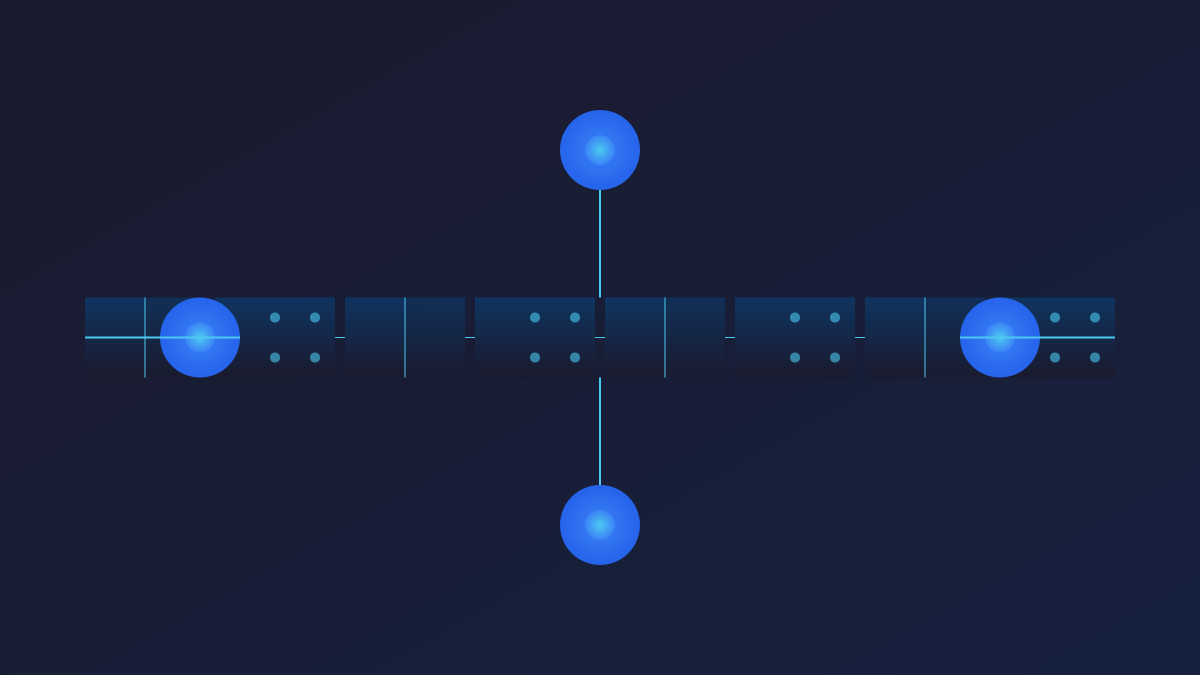
The distributed Llama framework adopts horizontal layer partitioning, assigning different layers of the model to different devices. Unlike data/tensor parallelism, each device processes the intermediate representation of the input through specific layers: for example, in the Transformer architecture, device A handles layers 1-10, device B handles layers 11-20, and the input flows through the devices in order. Although this increases communication overhead, it significantly reduces the memory requirement of a single device.

Quantization Technology

By compressing 32-bit floating-point weights to 16/8/4 bits, storage is reduced and computation is accelerated. However, low precision introduces numerical errors that affect output quality. Analysis shows that 8-bit quantization can achieve significant memory savings while maintaining acceptable quality.

4

Section 04

Cross-Device Synchronization and Communication Optimization

The biggest challenge of distributed inference is the communication overhead between devices, which requires optimizing activation value transmission:

  • Asynchronous pipeline: Overlap computation and communication of different devices (processing different batches of data);
  • Activation value compression: Reduce transmission bandwidth requirements;
  • Batch processing optimization: Adjust batch size to balance computation efficiency and communication frequency. These strategies are crucial for achieving usable inference speeds on consumer-grade hardware.
5

Section 05

Performance Trade-offs and Practical Considerations

Latency and Throughput Balance

Pipeline parallelism increases the latency of a single request (data flows through all devices), but improves overall throughput (overlapping processing of multiple requests): interactive applications focus on latency, while batch processing tasks focus on throughput.

Device Heterogeneity

Need to handle devices with different computing capabilities/memory and allocate loads reasonably.

Fault Tolerance and Recovery

Distributed systems face single-point failures. The framework discusses checkpoint and recovery mechanisms to resume from intermediate states after failures.

6

Section 06

Application Scenarios and Practical Experience

The distributed Llama framework is suitable for:

  1. Edge device clusters: Smartphones/IoT devices collaborate to run large models;
  2. Multi-GPU workstations: Use multiple consumer-grade GPUs to run models exceeding the capacity of a single card;
  3. Hybrid cloud deployment: Allocate computing loads between local and cloud resources. The project provides implementation code and analysis results, offering references for developers to configure and optimize distributed inference.
7

Section 07

Summary and Future Outlook

Distributed inference is an important path for the democratization of LLMs. As model scales grow, single-machine deployment becomes increasingly impractical. The technologies in this article (horizontal partitioning, quantization, communication optimization) provide feasible solutions.

Future directions: More intelligent load balancing algorithms, adaptive quantization strategies, and better integration with dedicated AI accelerators. Distributed inference needs to comprehensively consider dimensions such as computation, communication, storage, and fault tolerance.

