Zing Forum

Reading

A New Framework for Video Understanding with Multimodal Large Language Models: The Trinity of Watching, Memory, and Reasoning

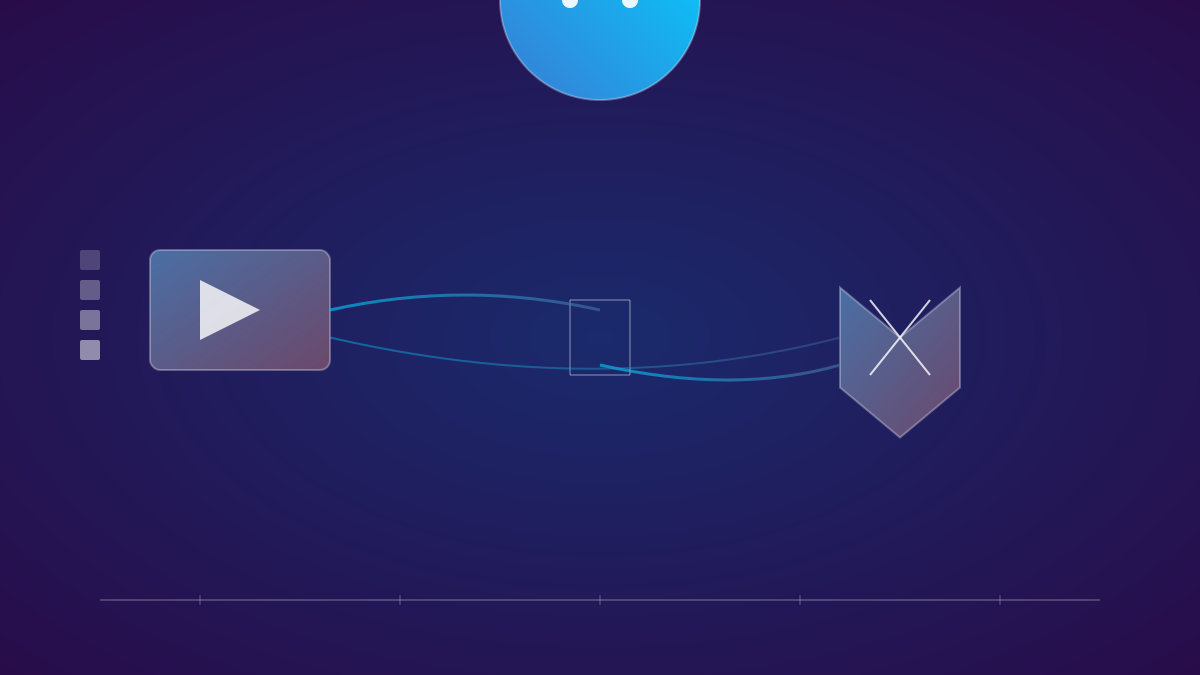
This article introduces a brand-new MLLM video understanding framework that, from a human perspective, decomposes video understanding into three core capabilities: "watching", "memory", and "reasoning". It systematically sorts out the technical challenges and solutions of current video multimodal large models in aspects such as spatiotemporal perception, long video processing, memory modeling, and faithful reasoning.

多模态大语言模型视频理解MLLM时空感知长视频处理记忆机制视觉推理人工智能
Published 2026-06-06 00:29Recent activity 2026-06-08 09:24Estimated read 8 min
A New Framework for Video Understanding with Multimodal Large Language Models: The Trinity of Watching, Memory, and Reasoning
1

Section 01

[Introduction] New Framework for Video Understanding with Multimodal Large Language Models: The Trinity of Watching, Memory, and Reasoning

This article introduces a new MLLM video understanding framework from a human perspective, with three core capabilities: "watching", "memory", and "reasoning". The original authors are arXiv authors, source platform is arXiv, original title is Watch, Remember, Reason: Human-View Video Understanding with MLLMs, link: http://arxiv.org/abs/2606.07433v1, release time: 2026-06-05T16:29:13Z. This framework systematically sorts out the technical challenges and solutions of current video multimodal large models in spatiotemporal perception, long video processing, memory modeling, and faithful reasoning.


2

Section 02

Background: Paradigm Shift in Video Understanding

Traditional video analysis methods often split tasks into independent benchmark tests, while MLLM methods understand video content from a macro perspective. As research expands to long videos, multimodal, and knowledge-intensive scenarios, models need to address challenges such as sparse evidence, long-range dependencies, multimodal alignment, and reliable reasoning under limited computation. The framework proposed in this article decomposes video understanding into three core capabilities—watching, memory, and reasoning—providing a unified analytical structure and systematic methodology.

3

Section 03

Method: Watching — The Foundation Layer of Multimodal Perception

"Watching" is the foundation of video understanding, covering the ability to extract perceptual representations from raw videos:

  1. Fine-grained spatiotemporal perception: Capture spatial details (object position/appearance) and temporal dynamics (actions/changes) using strategies like Transformer spatiotemporal attention, 3D convolution, and video encoders.
  2. Efficient processing: For long videos, balance quality and computational cost through sparse sampling of key frames, hierarchical processing, and progressive encoding.
  3. Audio-visual joint perception: Use early/mid/late fusion strategies to integrate visual and auditory cues for complete scene understanding.
4

Section 04

Method: Memory — Core Mechanism for Context Preservation

"Memory" addresses the context preservation problem for long videos:

  1. Offline memory: For complete videos, design compact memory vectors (key frames/event segments/implicit representations) and structured storage strategies for efficient retrieval.
  2. Streaming memory: In real-time scenarios, achieve incremental updates and historical references through sliding windows, memory compression, and selective forgetting.
  3. Long-range dependency modeling: Use approximate attention, hierarchical attention, and external memory expansion to solve the computation/memory bottlenecks of Transformers in ultra-long videos.
5

Section 05

Method: Reasoning — Elevation from Perception to Understanding

"Reasoning" transforms perception and memory into meaningful outputs:

  1. Text reasoning: Perform temporal (event sequence), causal (event relationship), and logical (multi-step inference) reasoning based on video features.
  2. Video-assisted reasoning: Dynamically review video clips to retrieve information, simulating the human cognitive process of "thinking while watching".
  3. Faithfulness and interpretability: Ensure conclusions are supported by videos through attention visualization, evidence chain tracking, and explicit evidence citation to enhance transparency.
6

Section 06

Application Domains and Evaluation Benchmarks

Application domains of video MLLMs include:

  • First-person perspective videos: Life assistance, health monitoring;
  • Sports event analysis: Tactical analysis, highlight extraction, commentary generation;
  • Educational video understanding: Intelligent Q&A, knowledge point extraction, learning path recommendation;
  • Medical video analysis: Surgical video processing, auxiliary diagnosis and education;
  • Narrative video understanding: Content recommendation, plot analysis, summary generation. Evaluation benchmarks cover dimensions such as various task types (from action recognition to open Q&A), video lengths (from short to several hours), and modal combinations (single/multimodal).
7

Section 07

Open Problems and Future Directions

Current challenges in the field:

  1. Scalability: Computation/memory bottlenecks when processing hour-long videos;
  2. Memory-perception architecture: More efficient explicit/implicit memory mechanisms;
  3. Evidence-anchored reasoning: Ensure reasoning is anchored to video evidence to avoid hallucinations;
  4. Cross-modal alignment: Better alignment of visual, auditory, and language modalities;
  5. Real-time interaction: Support streaming input and real-time responses. Conclusion: This framework provides a clear roadmap for video MLLMs. Enhancing the three core capabilities is expected to build human-level understanding systems. For related resources, please follow https://github.com/marinero4972/Awesome-HumanView-VideoUnderstanding.

