Zing Forum

Reading

Density-Aware Translation: Addressing Spurious Correlations in Zero-Shot Vision-Language Models

This article introduces a new method called Density-Aware Translation (DAT), which calibrates the similarity scores of vision-language models (VLMs) like CLIP by leveraging the local geometric density of the embedding space. It effectively suppresses spurious correlations and improves the robustness and accuracy of zero-shot classification.

视觉语言模型CLIP零样本学习虚假关联嵌入空间密度感知多模态学习模型校准鲁棒性
Published 2026-06-01 13:23Recent activity 2026-06-02 15:48Estimated read 6 min
Density-Aware Translation: Addressing Spurious Correlations in Zero-Shot Vision-Language Models
1

Section 01

[Introduction] Density-Aware Translation: A New Method to Address Spurious Correlations in Zero-Shot VLMs

This article introduces a new method called Density-Aware Translation (DAT), from the arXiv June 2026 paper Density-Aware Translation of Spurious Correlations in Zero-Shot VLMs. By leveraging the local geometric density of the embedding space to calibrate the similarity scores of vision-language models (VLMs) like CLIP, this method effectively suppresses spurious correlations and improves the robustness and accuracy of zero-shot classification. No model fine-tuning is required, fully preserving the zero-shot generalization ability of the pre-trained model.


2

Section 02

Research Background and Definition of Spurious Correlation Problem

Vision-language models (e.g., CLIP) map vision and text into the same embedding space via contrastive learning and perform well in zero-shot classification, but they are prone to spurious correlations—over-relying on non-essential contextual cues (such as umbrellas in beach images) instead of semantic content. This dependency is more dangerous in zero-shot scenarios, as the model needs to generalize to unseen categories.

3

Section 03

Analysis of Limitations of Existing Solutions

For spurious correlations, existing methods have shortcomings: 1. Fine-tuning: Corrects spurious correlations but weakens zero-shot generalization ability; 2. Prompt engineering: Relies on human experience, prone to hallucinations, lacks systematicity, and struggles to ensure consistent performance across tasks.

4

Section 04

Core Idea of DAT Method: Insights into Embedding Space Geometric Structure

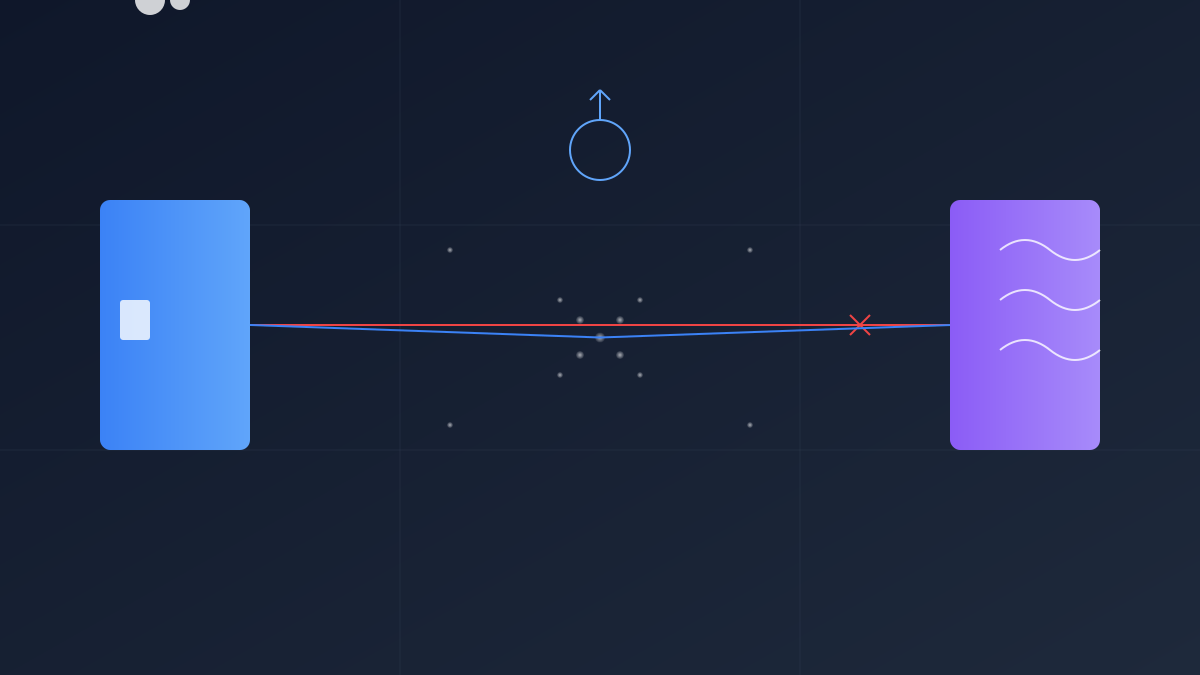
DAT is based on two key properties of CLIP's embedding space: 1. Modality gap: There is a distance between image and text embeddings; 2. Anisotropic shell structure: Common patterns cluster near the mean (high-density area), while rare semantic cues are in the outer region (low-density area). Spurious correlations are mostly in high-density areas, and semantic cues are in low-density areas; traditional similarity cannot distinguish between them, leading to misjudgments.

5

Section 05

Detailed Explanation of DAT Method Mechanism

DAT recalibrates similarity via local geometric density: 1. Calculate the original similarity of image-text pairs; 2. Compute the local density of embedding points based on a group reference set; 3. Adjust similarity: Reduce scores in high-density areas to suppress overconfidence, and keep/enhance scores in low-density areas to emphasize semantic cues.

6

Section 06

Experimental Validation Results: Dual Improvement in Robustness and Accuracy

Evaluated on multiple benchmark datasets, DAT consistently improves worst-group accuracy (robustness) and average accuracy (overall performance), while retaining zero-shot capability without fine-tuning. Ablation analysis confirms that local density is key; visualization shows that the embedding space structure is more reasonable, semantic samples cluster, and spurious correlations are dispersed and alleviated.

7

Section 07

Practical Significance and Application Prospects of DAT

Theoretically, it deepens the understanding of the geometric structure of VLMs' embedding space, and density-aware calibration can be extended to other multimodal models; in applications, it is lightweight and easy to deploy (no parameter modification/re-training needed), suitable for high-reliability scenarios such as medical image analysis and autonomous driving, and can also be extended to tasks like image retrieval and visual question answering.

8

Section 08

Limitations, Future Directions, and Research Insights

Limitations: Density estimation depends on the quality of the reference set, and it does not fundamentally change the embedding structure; Future directions: Integrate density awareness into the training process, extend to complex tasks (e.g., dense prediction); Insights: Deep understanding of embedding geometric structure can lead to improvements, and lightweight calibration is as important as large-scale models.

