Zing Forum

Reading

Natural Language-Driven Circuit Synthesis: Large Reasoning Models Surpass Specialized Synthesis Tools

By combining large reasoning models with symbolic verification in a neuro-symbolic approach, the research team achieved a breakthrough in reactive circuit synthesis—surpassing the annual competition champion tool in the number of benchmark tests solved, and for the first time using natural language specifications as valid input.

反应式综合神经符号方法形式验证大推理模型硬件电路自然语言规格
Published 2026-05-15 01:39Recent activity 2026-05-15 11:21Estimated read 5 min
Natural Language-Driven Circuit Synthesis: Large Reasoning Models Surpass Specialized Synthesis Tools
1

Section 01

Natural Language-Driven Circuit Synthesis: Large Reasoning Models Surpass Specialized Synthesis Tools

This study achieved a breakthrough in reactive circuit synthesis by combining large reasoning models with symbolic verification in a neuro-symbolic approach: it surpassed the annual competition champion tool in the number of benchmark tests solved, and for the first time used natural language specifications as valid input, bringing a new paradigm to hardware design.


2

Section 02

Reactive Synthesis: A Core Challenge in Formal Verification

Reactive synthesis is the problem of automatically constructing hardware circuits from logical specifications, and it has long been a core challenge in formal verification. Its difficulty lies in two aspects: algorithmically, it is a highly complex computational problem; manually writing formal specifications requires deep professional knowledge and a lot of time, which restricts its industrial application.

3

Section 03

Neuro-symbolic Approach: Combining Large Models with Symbolic Verification

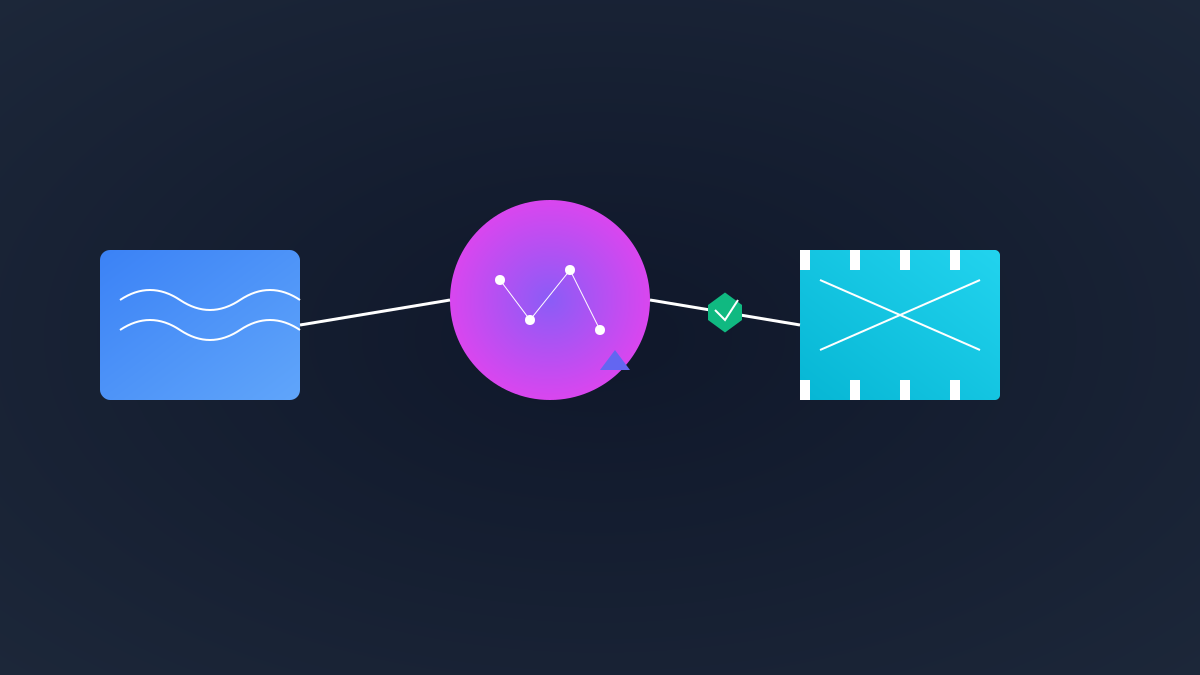
The research proposes an innovative neuro-symbolic approach: large reasoning models generate candidate circuit implementations, and model checkers verify whether they meet the specifications; when verification fails, the checker provides symbolic feedback to guide the model in fixing the issue, iterating until a correct implementation is found.

4

Section 04

Algorithmic Breakthrough: Surpassing the Best Specialized Tools of the Annual Competition

Experiments show that this method solved more benchmark tests than the best specialized tools in the annual synthesis competition, proving that general-purpose large models can surpass deeply optimized specialized algorithm tools; it can also handle the construction of undecidable parameterized systems that traditional methods are helpless to solve.

5

Section 05

Specification Innovation: Natural Language Replaces Formal Specifications

The team introduced an automatic formalization step, converting specification writing from temporal logic to natural language, and built a manually curated natural language specification dataset for evaluation. Results show that the synthesis performance starting from natural language specifications is comparable to that from formal specifications, and hardware designers do not need to master complex formal languages.

6

Section 06

End-to-End Workflow: Feasibility of Natural Synthesis

The research established an end-to-end workflow for 'natural synthesis', covering the complete chain from natural language requirements to verifiable hardware implementations. This greatly reduces the threshold for using reactive synthesis, is expected to shorten the hardware design and verification cycle, and allows designers to focus on functional innovation.

7

Section 07

Impact and Outlook: Driving a Paradigm Shift in Hardware Development

This work has far-reaching impacts on the fields of hardware design and formal verification, demonstrating the potential of neuro-symbolic approaches to solve traditional problems and opening up new possibilities for the application of natural language in engineering specifications. In the future, with the advancement of large models and natural language technologies, it is expected to be widely applied and drive a paradigm shift in hardware development processes.

