Zing Forum

Reading

Dual-Enhanced Product Bundle Recommendation: A New Paradigm Integrating Interaction Graphs and Large Language Models

The research team proposes a dual-enhanced method that converts interaction graph structures into natural language prompts via a dynamic concept binding mechanism, integrating graph learning and LLM semantic understanding. It achieves a 6.3%-26.5% performance improvement on benchmarks like POG and Steam, effectively addressing cold-start and graph modeling challenges.

商品捆绑推荐图神经网络大语言模型动态概念绑定电商推荐系统
Published 2026-04-16 00:09Recent activity 2026-04-16 10:22Estimated read 6 min
Dual-Enhanced Product Bundle Recommendation: A New Paradigm Integrating Interaction Graphs and Large Language Models
1

Section 01

Introduction: A New Paradigm for Dual-Enhanced Product Bundle Recommendation

The research team proposes a dual-enhanced product bundle recommendation method, which converts interaction graph structures into natural language prompts via a dynamic concept binding mechanism, integrating graph learning and Large Language Model (LLM) semantic understanding capabilities. It achieves a 6.3%-26.5% performance improvement on benchmark datasets like POG and Steam, effectively solving cold-start and graph modeling challenges.


2

Section 02

Practical Challenges in Product Bundle Recommendation

Practical Challenges in Product Bundle Recommendation

Product bundle recommendation is an important means for e-commerce to increase revenue, but existing methods face two major bottlenecks:

Cold-start Dilemma: Collaborative filtering-based methods rely on historical data; new or long-tail products suffer from reduced recommendation quality due to lack of behavioral records.

Graph Modeling Limitations: LLMs lack the ability to directly model interaction graphs, making it difficult to understand complementary information in product relationship networks.

3

Section 03

Core Architecture of the Dual-Enhanced Method

Core Architecture of the Dual-Enhanced Method

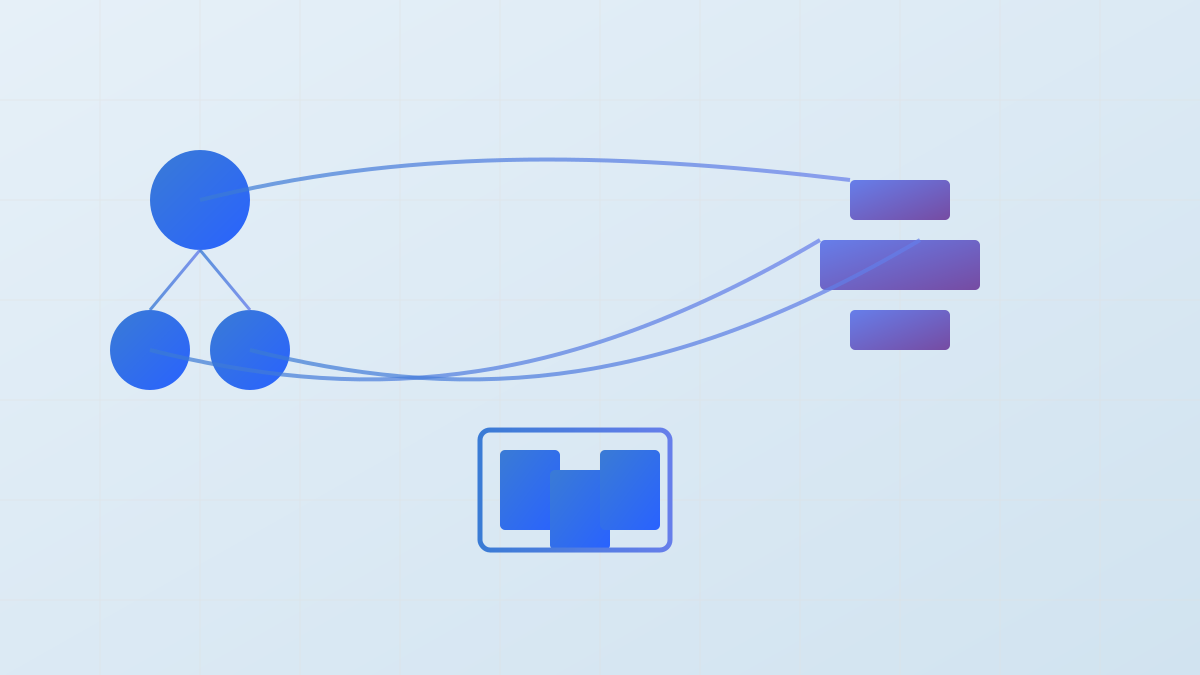
To address these challenges, the research team proposes a dual-enhanced method, with the core being a graph-to-text paradigm: designing a Dynamic Concept Binding Mechanism (DCBM) as a bridge. DCBM includes:

  • Domain Entity Alignment: Aligning product entities with the LLM token space;
  • Combinatorial Constraint Understanding: Encoding bundling rules into natural language;
  • Dynamic Adaptability: Generating appropriate text representations based on scenarios.
4

Section 04

Synergistic Effects of Dual Enhancement

Synergistic Effects of Dual Enhancement

This method strengthens two capabilities simultaneously:

Graph Learning Enhancement: Graph-to-text compensates for the semantic insufficiency of pure graph neural networks; Semantic Understanding Enhancement: LLM prior knowledge provides semantic support for graph learning, alleviating cold-start issues. The two work together to achieve a "1+1>2" effect.

5

Section 05

Experimental Validation and Significant Gains

Experimental Validation and Significant Gains

Evaluated on three benchmark datasets (POG, POG_dense, Steam), this method achieves a 6.3%-26.5% performance improvement compared to state-of-the-art baselines. It shows stronger robustness in cold-start scenarios, effectively alleviating the problem of recommending new products.

6

Section 06

Technical Contributions and Innovative Value

Technical Contributions and Innovative Value

  • Paradigm Innovation: Graph-to-text provides a new idea for integrating structured data with LLMs;
  • Mechanism Design: DCBM solves the problem of aligning domain concepts with general LLMs;
  • Practical Value: Validated on real datasets, it can be deployed in e-commerce recommendation systems.
7

Section 07

Implications for E-commerce Recommendation Systems

Implications for E-commerce Recommendation Systems

  • Advantages of Hybrid Architecture: A hybrid architecture combining graph structure and semantic understanding is superior;
  • New Solution for Cold-start: LLM general knowledge compensates for data insufficiency;
  • Improved Interpretability: Graph-to-text generates easily understandable recommendation reasons.
8

Section 08

Future Directions and Conclusion

Future Research Directions

  • Explore text representation of complex graph structures (heterogeneous graphs, temporal graphs);
  • Joint modeling of multimodal information and graph structures;
  • Lightweight conversion mechanisms to reduce inference overhead;
  • Cross-domain validation of method generality.

Conclusion

This method provides a new paradigm for e-commerce AI, solving cold-start and graph modeling challenges. The approach integrating graph learning and semantic understanding will play a greater role as personalized demand grows.

