Zing Forum

Reading

Deep Dive into Sampling Strategies for Large Model Reasoning: Why Parallel Sampling Outperforms Sequential Sampling

Latest research reveals the root cause of the performance gap between parallel and sequential sampling in large reasoning models, finding that insufficient exploration is the main reason for the poor performance of sequential sampling.

大模型推理采样策略并行采样顺序采样模型探索Qwen3DeepSeek-R1Gemini 2.5
Published 2026-04-07 21:28Recent activity 2026-04-08 11:47Estimated read 4 min
Deep Dive into Sampling Strategies for Large Model Reasoning: Why Parallel Sampling Outperforms Sequential Sampling
1

Section 01

[Main Post/Introduction] Deep Dive into Sampling Strategies for Large Model Reasoning: Why Parallel Sampling Outperforms Sequential Sampling

The latest study Understanding Performance Gap Between Parallel and Sequential Sampling in Large Reasoning Models delves into the performance differences between parallel and sequential sampling in large reasoning models, revealing that insufficient exploration is the main reason for the poor performance of sequential sampling. The study involves models such as Qwen3, DeepSeek-R1 distilled model, and Gemini 2.5, covering tasks like mathematical reasoning and code generation.


2

Section 02

Background: Sampling Dilemma of Reasoning Models and the Essential Differences Between Two Strategies

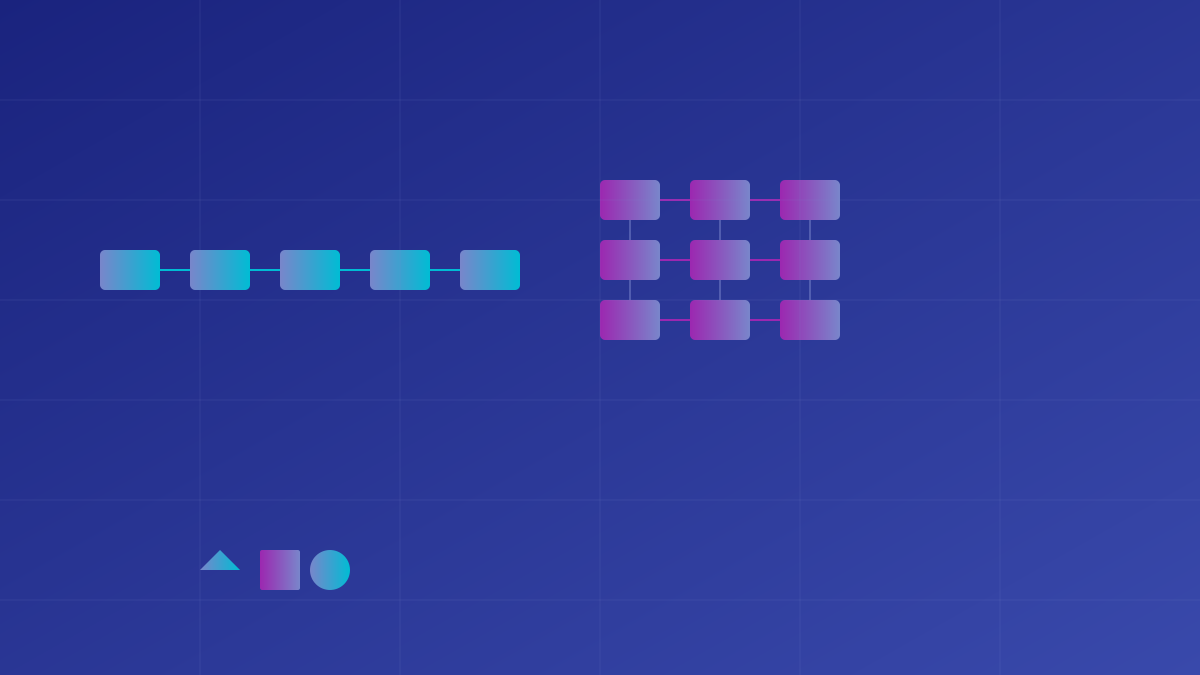
Large reasoning models struggle to obtain optimal solutions with a single sampling in complex tasks, requiring multiple samplings. Sampling strategies are divided into parallel and sequential: parallel sampling generates multiple independent reasoning paths simultaneously and selects the best via an aggregator; sequential sampling generates iteratively, using previous answers as context to continue generation. Theoretically, it should be stronger, but in practice, its performance is worse than parallel sampling.

3

Section 03

Research Methods: Proposal and Verification of Three Hypotheses

To explain the performance gap, the research team proposed and verified three hypotheses: 1. The advantage of parallel sampling comes from the aggregation operation; 2. Sequential sampling's quality is affected by context length limitations; 3. The conditional dependence of sequential sampling limits the exploration space. Experiments cover multiple model families and task domains.

4

Section 04

Experimental Evidence: Insufficient Exploration is the Main Cause of Sequential Sampling's Poor Performance

Experimental results show that aggregation operations and context length are not the main causes; the difference in exploration ability is the key. Sequential sampling tends to fine-tune based on existing answers, limiting the discovery of new problem-solving paths; parallel sampling generates independently, maintains a complete exploration space, and is more likely to find optimal solutions.

5

Section 05

Conclusions and Implications: The Importance of Exploration Diversity and Recommendations for Strategy Selection

Conclusion: Maintaining exploration diversity is more important than sequential incremental improvement. Implications: Prioritize parallel sampling; if using sequential sampling, design mechanisms to prevent premature convergence. The study reminds us that theoretical intuition in AI systems may not align with reality, and empirical research is crucial to building more reliable and efficient intelligent systems.

