Zing Forum

Reading

LLM Cost Intelligence Pipeline: Enterprise-Grade Real-Time API Cost Monitoring and Visualization Solution

A production-grade streaming data pipeline that enables real-time capture, processing, and visualization of LLM API costs across multiple teams and models. From raw inference events to Grafana dashboards, the entire workflow is orchestrated by Airflow.

LLM成本管理实时数据管道Grafana可视化Apache AirflowAPI成本监控企业AI治理多模型定价成本归因分析
Published 2026-05-04 21:08Recent activity 2026-05-04 21:24Estimated read 6 min
LLM Cost Intelligence Pipeline: Enterprise-Grade Real-Time API Cost Monitoring and Visualization Solution
1

Section 01

LLM Cost Intelligence Pipeline: Introduction to Enterprise-Grade Real-Time API Cost Monitoring Solution

This article introduces the open-source production-grade solution LLM-Cost-Intelligence-Pipeline, which provides enterprises with end-to-end capabilities for real-time capture, processing, and visualization of LLM API costs across multiple teams and models. From raw inference events to Grafana dashboards, the entire process is orchestrated by Apache Airflow, addressing core issues in enterprise LLM cost management such as real-time performance, multi-model pricing, and cost attribution.


2

Section 02

Background and Challenges: Core Pain Points in Enterprise LLM Cost Management

Enterprises using LLMs face multiple cost management challenges: different teams adopt models like GPT-4, Claude, and Gemini, each with distinct pricing strategies and token calculation methods; real-time dynamic budget control needs are hard to meet via post-hoc statistics; there is a strong demand to link costs with business metrics to evaluate ROI. Traditional cloud service provider billing systems have limitations such as high latency, coarse granularity, and difficulty in custom dimensions, so a real-time and flexible cost intelligence system is urgently needed.

3

Section 03

System Architecture: Four-Layer Design from Data Collection to Visualization

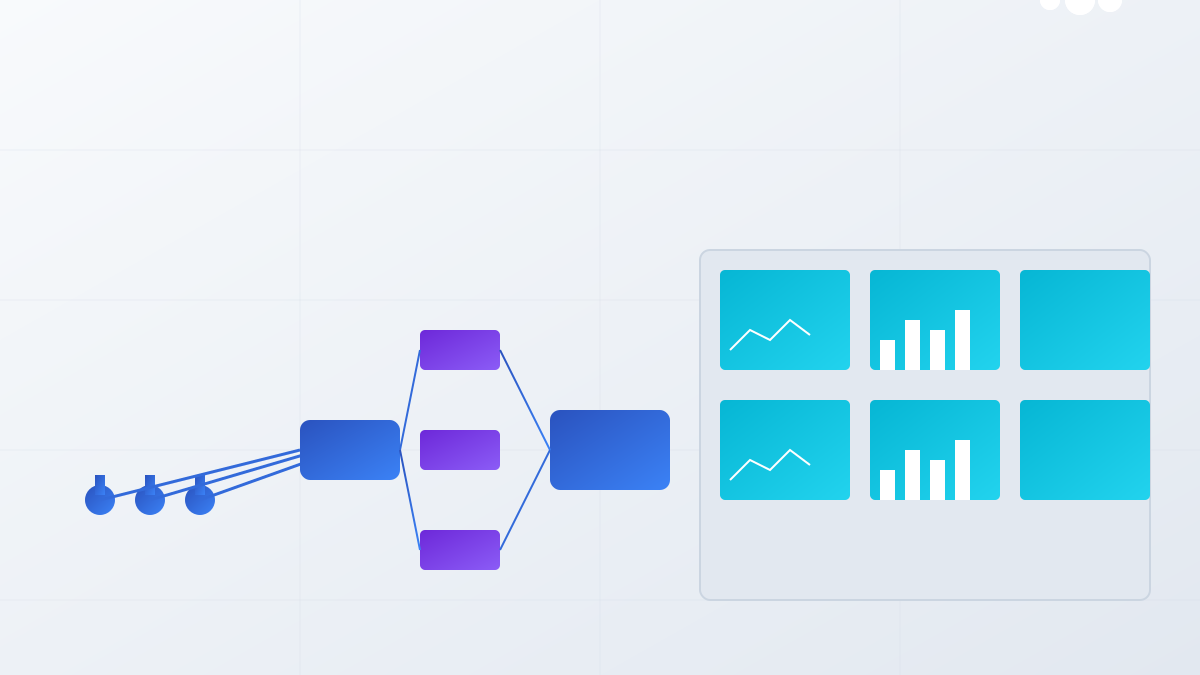
The pipeline adopts modern data engineering best practices, with four core layers: 1. Data Collection Layer: Capture raw inference events containing metadata such as model name, token count, and user ID via SDK middleware, API gateway logs, or proxy servers; 2. Streaming Processing Engine: Use Kafka as a buffer to calculate request costs in real time (converted according to model pricing tables) and aggregate metrics across multiple time granularities; 3. Data Warehouse: Load processed data into PostgreSQL/ClickHouse, supporting multi-tenant cost allocation and complex queries; 4. Visualization and Alerts: Grafana provides views like real-time trends, model proportion, and team rankings, with threshold-based alerting.

4

Section 04

Workflow Orchestration and Key Technical Features

The entire workflow is orchestrated by Apache Airflow, using DAGs to define dependencies, enabling task scheduling, retries, and monitoring to ensure maintainability and scalability. Key features include: multi-model pricing support (built-in mainstream provider pricing + custom rules); separation of real-time and offline computing (streaming second-level estimation, T+1 batch processing for reconciliation and calibration); flexible cost tag system (attach business tags like project ID to facilitate analysis and decision-making).

5

Section 05

Deployment Methods and Application Value Across Multiple Scenarios

Supports deployment via Docker Compose and Kubernetes Helm Chart. Environment variable-driven configuration facilitates CI/CD management, and it is compatible with monitoring tools like Prometheus and ELK. Application scenarios include: R&D teams optimizing prompts and model selection; product managers evaluating the economic feasibility of features; finance departments optimizing budget allocation; operation teams preventing API abuse risks.

6

Section 06

Summary and Outlook: Infrastructure for LLM Cost Optimization

LLM-Cost-Intelligence-Pipeline provides a complete open-source solution for enterprise LLM cost management, solving real-time monitoring challenges and transforming cost data into actionable insights. As LLM applications expand, cost optimization will become a key part of enterprise AI strategies, and such infrastructure tools will help organizations balance AI capabilities and cost structures.