Zing Forum

Reading

From Useful to Trustworthy: Research on Multi-Agent LLM Systems for Pair Programming

This article introduces a doctoral research project on multi-agent LLM pair programming, exploring how to build more reliable, auditable, and maintainable AI programming assistants through intent externalization and iterative verification mechanisms.

LLM结对编程多智能体系统代码生成软件工程形式化验证
Published 2026-04-12 01:39Recent activity 2026-04-14 14:50Estimated read 7 min
From Useful to Trustworthy: Research on Multi-Agent LLM Systems for Pair Programming
1

Section 01

[Introduction] From Useful to Trustworthy: Research on Multi-Agent LLM Systems for Pair Programming

This article introduces a doctoral research project on multi-agent LLM pair programming. Its core goal is to build more reliable, auditable, and maintainable AI programming assistants through intent externalization and iterative verification mechanisms, addressing the core dilemma of current LLM programming assistants where generated code seems correct but actually deviates from the developer's true intent.


2

Section 02

Research Background and Challenges

Large Language Models (LLMs) have demonstrated strong capabilities in software development tasks such as code generation, test writing, and documentation. However, current LLM programming assistants face a core dilemma: generated code may seem reasonable on the surface but deviate from the developer's true intent, and it is difficult to provide sufficient audit evidence as the project evolves. Existing tools focus on single-time code generation, lacking deep understanding of development intent and continuous verification mechanisms, leading to accumulated biases as the codebase evolves. A systematic methodology is urgently needed to build reliable AI programming assistants.

3

Section 03

Multi-Agent Pair Programming Framework

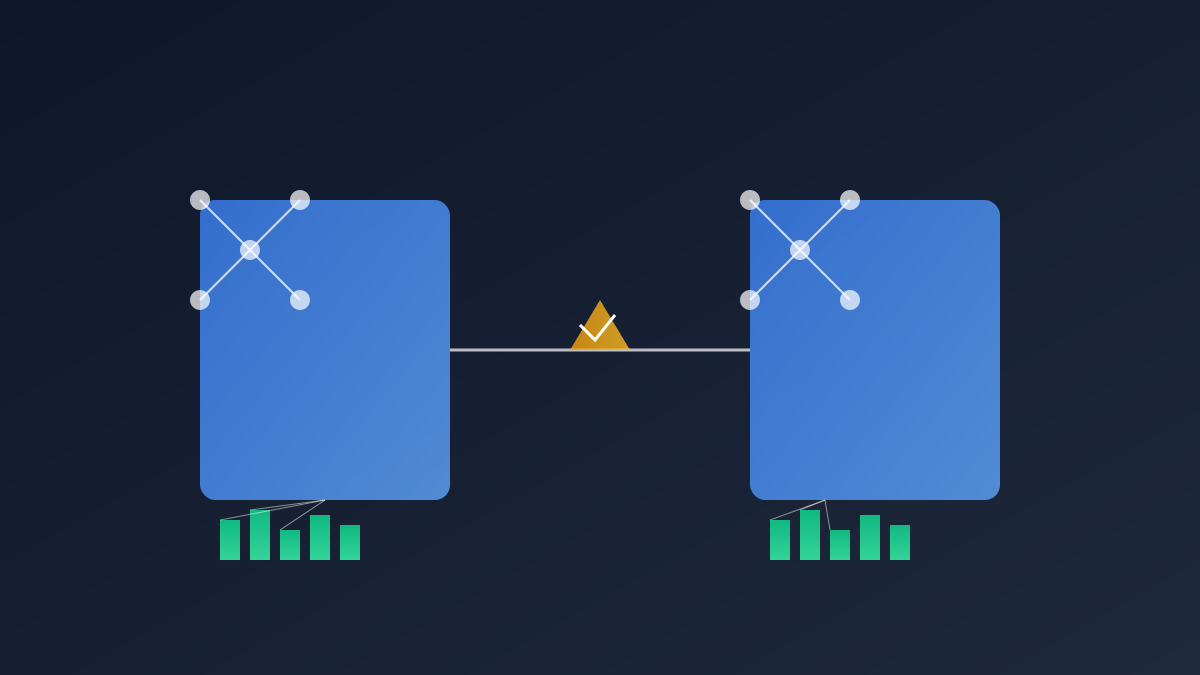
This research proposes an innovative multi-agent LLM pair programming paradigm, with the core being intent externalization + iterative verification via development tools. The framework introduces multiple specialized agents, each responsible for tasks such as requirement analysis, code generation, test verification, and documentation maintenance. Its advantages include: intent externalization explicitly records and tracks requirements to reduce information distortion; mutual verification among multi-agents detects inconsistencies early; verification embedded in the toolchain enables continuous monitoring of code quality.

4

Section 04

Research Direction 1: From Informal Requirements to Formal Definitions

This direction focuses on converting developers' informal problem descriptions into structured requirements and formal specifications, involving technical challenges such as natural language understanding, domain knowledge modeling, and specification language generation. The system incorporates best practices from requirements engineering, identifies ambiguities and inconsistencies in requirements and proactively clarifies them. The generated formal specifications can serve as constraints for code generation and benchmarks for correctness verification.

5

Section 05

Research Direction 2: Code Refinement Based on Automated Feedback

This direction explores using automated feedback mechanisms to iteratively refine tests and implementations, including methods such as solver counterexample generation, static analysis tool integration, and runtime behavior monitoring. After an agent generates code, the verification agent automatically constructs test cases to find counterexamples. If a violation of specifications is found, feedback is sent to the generating agent to trigger code improvements. The generation-verification-feedback loop significantly enhances code reliability.

6

Section 06

Research Direction 3: Behavior Preservation During Evolution

This direction focuses on software maintenance tasks (code refactoring, API migration, documentation updates, etc.). The core challenge is to maintain verified behaviors unchanged when modifying code structure. The system establishes traceable links between code changes and specifications, ensuring that each modification is verified against the original intent. When potential behavior deviations are detected, it issues warnings to developers and provides repair suggestions.

7

Section 07

Expected Contributions and Significance

This research is expected to provide systematic guidance for building the credibility of LLM programming assistants, clarify the conditions under which multi-agent workflows enhance developer trust, and offer practical design principles and best practices to the industry. In the long run, it will promote the evolution of AI-assisted programming from a 'useful but need to be cautious' tool to a 'trustworthy and reliable' development partner, which is of great significance for improving development efficiency, reducing maintenance costs, and promoting the popularization of AI programming tools.

