Zing Forum

Reading

LLM Inference Router: A Multi-Model Inference Optimization Scheme Based on Query Complexity-Intelligent Routing

llm-inference-router is an innovative multi-model routing system that dynamically selects between local and cloud models by intelligently analyzing query complexity, achieving dual optimization of cost and latency.

大语言模型模型路由推理优化成本优化多模型智能路由查询复杂度
Published 2026-04-20 13:15Recent activity 2026-04-20 13:20Estimated read 7 min
LLM Inference Router: A Multi-Model Inference Optimization Scheme Based on Query Complexity-Intelligent Routing
1

Section 01

LLM Inference Router: Intelligent Routing Optimizes Multi-Model Inference Cost and Latency

llm-inference-router is an innovative multi-model routing system that dynamically selects between local and cloud models by intelligently analyzing query complexity, achieving dual optimization of cost and latency. This project aims to address the challenges enterprises face in the multi-model era, such as cost-quality trade-offs, uncertain latency, resource waste, and complex operation and maintenance. Its core is to accurately match queries with model capabilities, balancing quality, cost, and latency.


2

Section 02

Background: Inference Dilemmas in the Multi-Model Era

With the development of the large language model ecosystem, enterprises face challenges in choosing diverse models: cloud-based large models have good performance but are expensive, while local small models are low-cost but have limited capabilities; large differences in response times between models affect user experience; using large models for simple queries wastes resources, while using small models for complex queries leads to poor results; managing multiple model endpoints increases operational complexity. The core issue is how to balance cost and latency while ensuring quality.

3

Section 03

Core Mechanism: Complexity-Driven Routing Decisions

Query Complexity Evaluation

Uses a multi-dimensional framework: semantic complexity (concept depth, professionalism, reasoning level), task type identification (Q&A, code generation, etc.), context length, and output expectations (length and format).

Dynamic Routing Strategy

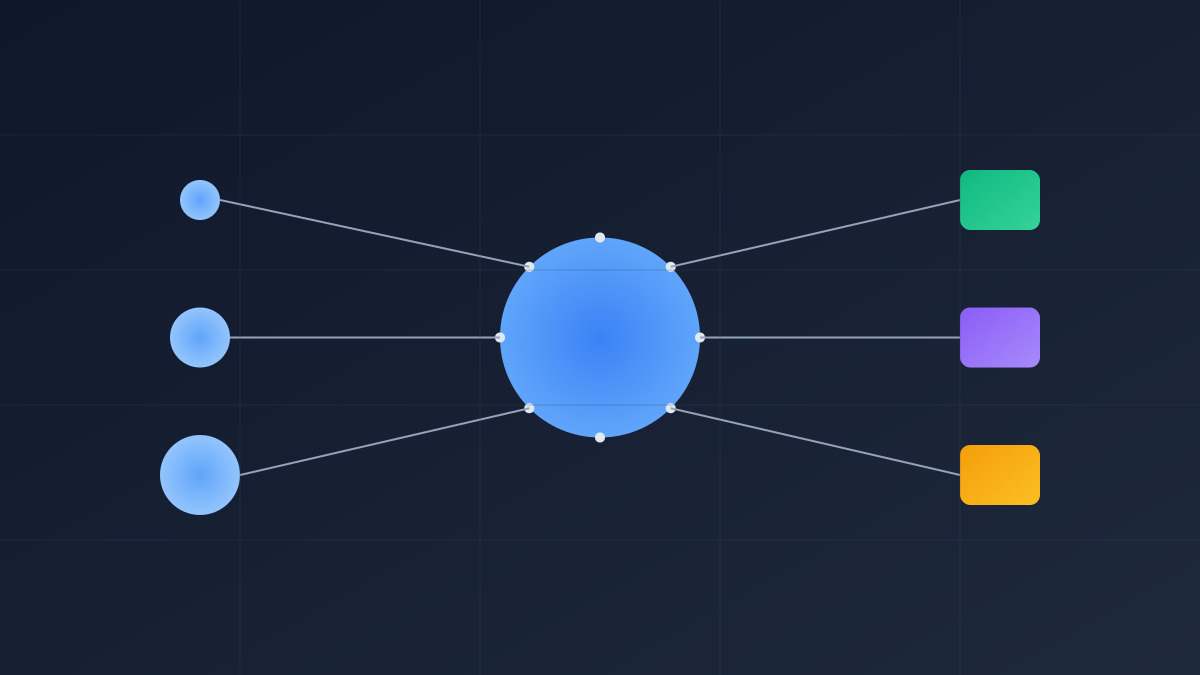
Lightweight queries (greetings, factual Q&A) are routed to local small models (Phi-3, Llama-3-8B); medium-complexity queries (code explanation, document summarization) to medium models or low-cost cloud models; high-complexity queries (multi-step reasoning, professional analysis) to the most powerful models (GPT-4, Claude3 Opus).

Feedback Learning

Monitor routing effects (response quality, user satisfaction), calibrate the complexity evaluation model, and optimize strategies.

4

Section 04

Architecture Design: Modularity and Scalability

Unified Interface Layer

Provides an OpenAI API-compatible interface, allowing existing applications to migrate seamlessly without code changes.

Pluggable Model Backend

Supports local models (vLLM, TGI), cloud APIs (OpenAI, Anthropic), and hybrid deployment.

Configuration-Driven Rules

Manage routing strategies via configuration files: keyword rules, complexity-based dynamic routing, cost budget downgrading, and A/B testing.

Monitoring and Observability

Collect metrics such as routing distribution, model usage rate, latency and cost statistics, error rate and retry status.

5

Section 05

Practical Application Value: Cost, Latency, and Compliance Optimization

Cost Optimization

In high-frequency scenarios (customer service, content moderation), 70% of queries use local models, reducing costs by 50-70%.

Latency Sensitivity

In real-time interactions, simple queries get sub-second responses from local models, while complex queries use cloud models, improving user experience.

Compliance and Privacy

Sensitive data is prioritized for local models to ensure data does not leave the country, meeting compliance requirements.

6

Section 06

Technical Challenges and Limitations

  • Accuracy of complexity evaluation: Robust mechanisms to avoid misjudgment and routing errors
  • Latency overhead: Complexity analysis adds latency to extremely short queries
  • Model capability drift: Continuous calibration of routing strategies is needed when models are updated
  • Cold start: New models need to accumulate data, leading to less accurate initial decisions
7

Section 07

Future Development Directions

  • Multi-modal routing expansion: Support multi-modal queries such as images and audio
  • Personalized routing: Optimize strategies based on user history
  • Reinforcement learning optimization: RL automatically learns optimal routing
  • Edge computing integration: Deploy at edge nodes to reduce latency
8

Section 08

Conclusion: An Important Evolutionary Direction for Multi-Model Collaboration

llm-inference-router represents the development direction from single-model dependency to intelligent multi-model collaboration. Against the backdrop of differentiated model capabilities and significant cost differences, it provides a reference for building efficient and economical LLM applications. For developers of production-level LLM applications, this project not only provides tools but also demonstrates an intelligent hierarchical optimization approach to balance quality, cost, and latency.

