Zing Forum

Reading

Hands-On Distributed LLM Inference System: Architecture Design for Supporting Thousand-Level Concurrency

A course project-oriented distributed LLM inference system that implements RAG enhancement, three load balancing strategies, and fault tolerance mechanisms, verified in a real GPU environment to support over 1000 concurrent users.

分布式LLM推理系统负载均衡RAG容错机制GPU推理并发优化LlamaThunder Compute模型部署
Published 2026-05-12 09:44Recent activity 2026-05-12 10:06Estimated read 10 min
Hands-On Distributed LLM Inference System: Architecture Design for Supporting Thousand-Level Concurrency
1

Section 01

Hands-On Distributed LLM Inference System: Guide to Thousand-Level Concurrency Architecture Design

Hands-On Distributed LLM Inference System: Guide to Thousand-Level Concurrency Architecture Design

This project is an open-source project for the CSE354 Distributed Computing course, aiming to build a distributed LLM inference system that supports over 1000 concurrent users while balancing low latency and high availability. The system integrates RAG enhancement capabilities, three load balancing strategies, and a complete fault tolerance mechanism. It has been verified on the RTX A6000 GPU of the Thunder Compute platform using the Llama 3.2 1B model, providing a practical architectural reference for LLM service deployment in production environments.


2

Section 02

Project Background and Objectives

Project Background and Objectives

With the widespread application of LLMs in various industries, building large-scale concurrent inference services has become a key engineering challenge. This course project aims to implement a distributed LLM inference system that supports over 1000 concurrent users in a real GPU environment, serving not only as an academic exercise but also providing a production-level deployment reference. The project has been verified on the RTX A6000 GPU of the Thunder Compute platform using the Llama 3.2 1B model for testing.

3

Section 03

Core Components of System Architecture

Core Components of System Architecture

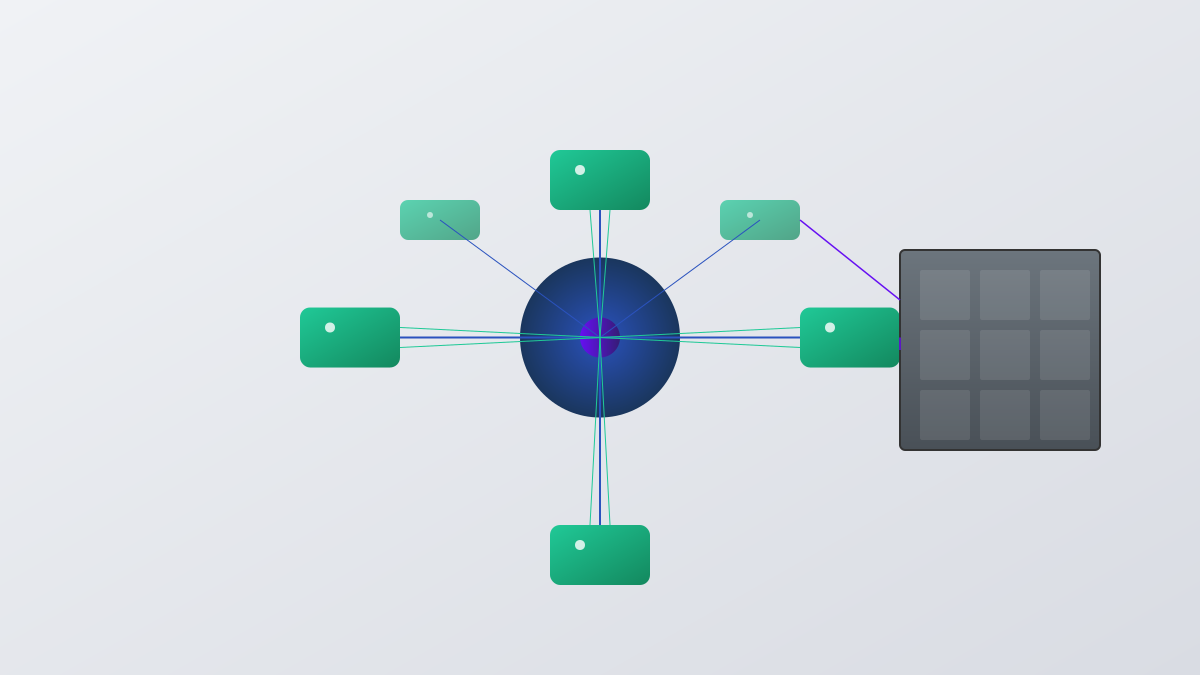
The system adopts a layered architecture to decouple request processing, model inference, and resource management:

  • API Gateway Layer: Unified entry point responsible for request routing, traffic control, authentication and authorization, and protocol conversion;
  • Inference Service Layer: Core computing layer including model instances, batch processing optimization, KV caching, and dynamic scaling;
  • Retrieval Enhancement Layer: Integrates RAG, supporting document indexing, semantic retrieval, and context assembly;
  • Storage and Cache Layer: Includes vector database, session cache, and result cache.
4

Section 04

Load Balancing and Fault Tolerance Mechanisms

Load Balancing and Fault Tolerance Mechanisms

Load Balancing Strategies

  1. Round Robin Scheduling: Simple uniform distribution, suitable for scenarios where node performance is similar;
  2. Least Connections: Assign to nodes with the fewest active connections, adapted to scenarios with large differences in request processing time;
  3. Weighted Response Time: Dynamically adjust weights based on node performance and load to maximize throughput, suitable for latency-sensitive scenarios.

Fault Tolerance Mechanisms

  • Health Check: Active probing + passive monitoring to determine node status;
  • Failover: Remove faulty nodes, reroute requests, alert, and auto-recover;
  • Request Retry: Automatically retry failed requests to ensure idempotency;
  • Data Consistency: Session affinity + state synchronization + eventual consistency.
5

Section 05

RAG Implementation and Performance Optimization

RAG Implementation and Performance Optimization

RAG Retrieval Enhancement

  • Document Processing: Parse multi-format documents → text chunking → embedding generation → index construction;
  • Retrieval Flow: Query embedding → similarity search → reordering → context construction;
  • Generation Enhancement: Inject retrieved context to reduce LLM hallucinations.

Performance Optimization

  • GPU Memory Optimization: INT8/INT4 quantization, gradient checkpointing, paged attention;
  • Batch Processing Optimization: Dynamic batching, continuous batching, request bucketing;
  • Asynchronous Architecture: Non-blocking IO, coroutine scheduling, streaming response;
  • Cache Strategies: Prefix matching cache, semantic cache, multi-level cache.
6

Section 06

Real Environment Verification Results

Real Environment Verification Results

Test Configuration

  • Model: Llama 3.2 1B;
  • GPU: NVIDIA RTX A6000 (48GB VRAM);
  • Concurrent users: 1000+;
  • Scenarios: Q&A, code generation, text summarization.

Performance Metrics

  • Throughput: Hundreds of requests per second;
  • Latency: Average second-level response;
  • Success rate: 99.9%+;
  • GPU utilization: 80%+.

The verification results prove the effectiveness of the architecture and provide confidence for production deployment.

7

Section 07

Deployment, Operation, and Scalability

Deployment, Operation, and Scalability

Deployment and Operation

  • Containerization: Docker configuration (CUDA base image, multi-stage build, environment variable injection);
  • K8s Orchestration: Deployment for replica management, Service for load balancing, HPA for auto-scaling, Ingress for unified entry;
  • Monitoring and Alerting: Prometheus metrics, Grafana visualization, ELK log aggregation, anomaly alerts.

Scalability

  • Model Hot Update: Parallel deployment → gray switch → full switch → old version offline;
  • Multi-Model Support: Parallel deployment of multiple models, automatic request routing, resource sharing and isolation;
  • Cross-Region Deployment: Multi-region clusters, intelligent traffic scheduling, cross-region failover.
8

Section 08

Practical Experience, Summary, and Outlook

Practical Experience, Summary, and Outlook

Practical Experience

  • Key Decisions: Async-first, layered decoupling, intelligent load balancing, comprehensive fault tolerance;
  • Common Pitfalls: Over-batching, cache invalidation, resource contention, monitoring blind spots;
  • Optimization Suggestions: Tune batch processing parameters, establish benchmark tests, pay attention to cold start and long-tail latency, reserve resources for sudden surges.

Summary and Outlook

This project has implemented a distributed LLM inference system supporting thousand-level concurrency, providing practical references for production deployment. As LLM scales and application scenarios expand, distributed inference technology will become more important, and the value of open-source projects will stand out.

