Zing Forum

Reading

Adaptive LLM Routing System: Finding the Optimal Balance Between Cost and Accuracy

Introduces an adaptive routing system based on confidence signals that intelligently switches between small and large language models, significantly reducing inference costs while maintaining answer quality, especially suitable for on-premises deployment scenarios.

LLM路由模型编排成本优化置信度估计本地部署推理效率
Published 2026-04-20 19:14Recent activity 2026-04-20 19:19Estimated read 7 min
Adaptive LLM Routing System: Finding the Optimal Balance Between Cost and Accuracy
1

Section 01

Adaptive LLM Routing System: An Innovative Solution for Balancing Cost and Accuracy

This article introduces the open-source adaptive-llm-routing-v1 project by the TheSkyBiz team. The project proposes an adaptive routing system based on confidence signals that can intelligently switch between small and large language models, significantly reducing inference costs while maintaining answer quality—especially suitable for on-premises deployment scenarios. The core idea is to use a small model to initially evaluate the query and output a confidence score: if the score is above a threshold, the small model answers directly; otherwise, the query is routed to a large model, achieving the optimal balance between cost and performance.


2

Section 02

Background and Challenges: The Dilemma of Enterprise LLM Applications

With the widespread application of LLMs, enterprises face a core dilemma: how to control inference costs while ensuring answer quality. Large models (such as GPT-4, Claude) have strong capabilities but high calling costs; small models are low-cost but perform poorly on complex tasks. Traditional fixed strategies (using all large models or all small models) struggle to balance cost and performance.

3

Section 03

Solution: Adaptive Routing Architecture and Confidence Mechanism

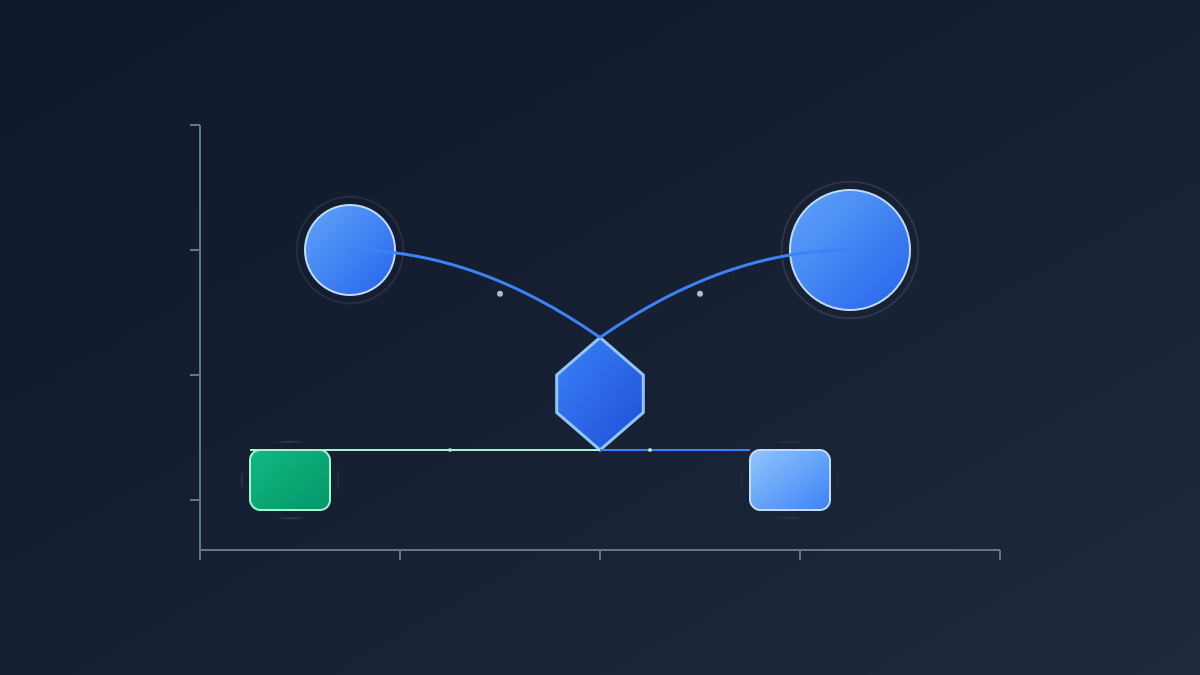
The core of the adaptive-llm-routing-v1 project is an adaptive routing architecture that operates based on a "confidence signal" mechanism: user queries are first sent to a local small and fast model for initial evaluation, which generates an answer and outputs a confidence score. If the score is above a preset threshold, the small model's answer is returned directly; otherwise, the query is routed to a large model for processing. The advantages of this mechanism include cost optimization (small models for simple questions), quality assurance (escalating complex questions to large models), controllable latency (fast response to common queries), and transparent decision-making (confidence scores provide a basis).

4

Section 04

Key Points of Technical Implementation

The project implementation involves three key links: 1. Confidence calibration: The small model needs special training to ensure that the confidence score truly reflects the reliability of the answer; 2. Threshold tuning: Finding the optimal switching point based on business scenarios and cost budgets; 3. Feedback loop: Collecting routing decision results to optimize future strategies. In on-premises deployment scenarios, small models are deployed on own servers, and only complex queries are sent to cloud APIs, reducing costs and protecting sensitive data.

5

Section 05

Application Scenarios and Economic Benefit Evidence

The adaptive routing model is applicable to multiple scenarios: customer service Q&A (common questions responded to by local small models, difficult ones escalated to large models), document retrieval (lightweight path for factual queries, deep path for analytical questions), multi-tenant SaaS platforms (users of different payment tiers routed to different models). In terms of economic benefits, assuming the cost of a small model is 1/20 that of a large model, and 70% of queries can be accurately answered by small models, the overall inference cost can be reduced to 15% of the original, with almost no impact on user experience.

6

Section 06

Current Limitations and Future Improvement Directions

The current implementation faces challenges: the accuracy of confidence estimation relies on a large amount of labeled data; for some multi-step reasoning problems, small models may give high-confidence wrong judgments. Future improvement directions include: introducing fine-grained confidence modeling that integrates model uncertainty estimation, developing a small→medium→large three-level routing strategy, and optimizing the system with an online learning mechanism that combines user feedback.

7

Section 07

Conclusion: A Pragmatic LLM Orchestration Approach

adaptive-llm-routing-v1 represents a pragmatic engineering approach: using intelligent orchestration to let models of different capabilities do their best, rather than pursuing the extreme performance of a single model. In today's era of widespread LLM applications, this cost-sensitive architecture will become an important reference model for enterprise-level deployments.

