Zing Forum

Reading

LLM Inference Phase Separation Technology: The Path to Heterogeneous Computing Optimization for Prefill and Decode Phases

An in-depth analysis of cutting-edge research such as Splitwise and DistServe, exploring how to optimize the throughput, latency, and cost efficiency of large language model inference systems by separating the prefill and decode phases.

LLM推理优化阶段分离预填充解码SplitwiseDistServe异构计算KV Cache吞吐量优化
Published 2026-04-05 01:13Recent activity 2026-04-05 01:18Estimated read 4 min
LLM Inference Phase Separation Technology: The Path to Heterogeneous Computing Optimization for Prefill and Decode Phases
1

Section 01

LLM Inference Phase Separation Technology: The Path to Heterogeneous Computing Optimization for Prefill and Decode Phases (Introduction)

In the production deployment of LLMs, inference efficiency is a key bottleneck restricting application implementation. Phase separation technology optimizes throughput, latency, and cost by separating the prefill and decode phases to run on different hardware resources. This article combines cutting-edge research such as Splitwise and DistServe to analyze the background, methods, benefits, and ecosystem development of this technology.


2

Section 02

Background: Two-Phase Characteristics of LLM Inference and the Pitfall of Co-Location

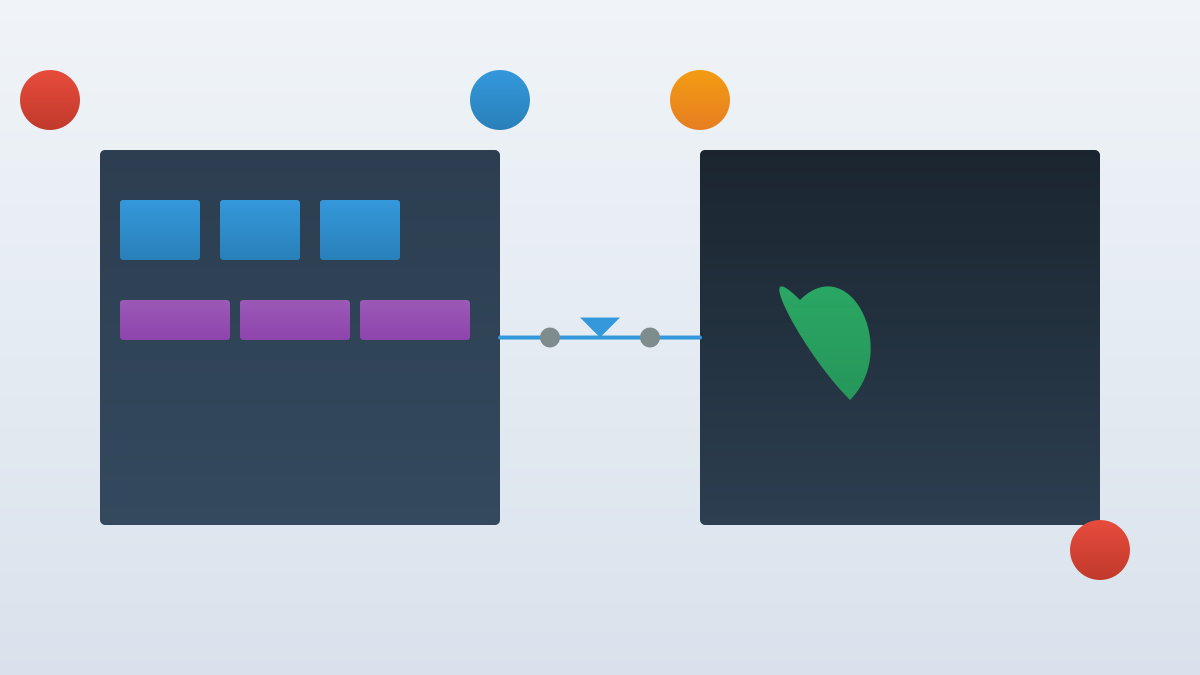
LLM inference consists of two phases: prefill (processing the complete prompt, compute-intensive) and decode (generating tokens one by one, memory bandwidth-limited). Traditional co-location on the same GPU leads to unbalanced resource utilization: prefill seizes compute units, decode suffers from bandwidth competition, latency increases by 2-5 times, and batch processing strategies are difficult to optimize.

3

Section 03

Splitwise: Heterogeneous Hardware Allocation Strategy

Splitwise deploys prefill on high-compute GPUs (e.g., H100) and decode on cheaper older GPUs (e.g., A100). By optimizing layer-wise transmission of KV Cache, the overhead is controlled within 0.1% of end-to-end latency, balancing performance and cost.

4

Section 04

DistServe: Placement Strategy for Throughput Optimization

DistServe dynamically selects parallel strategies for the decode phase: tensor parallelism for latency-sensitive scenarios, and pipeline parallelism for throughput-priority scenarios. Through collaborative optimization of parallelism, combined with resource allocation, batch size, and scheduling strategies, it achieves a globally optimal configuration.

5

Section 05

Practical Benefits of Phase Separation

Phase separation brings multiple benefits: throughput increases by 2-7 times; cost reduces by 30-50%; decode latency fluctuations decrease; resource utilization is balanced, reducing idling and contention.

6

Section 06

Related Systems and Ecosystem Development

Phase separation is moving toward practice; mainstream inference frameworks such as vLLM, Sarathi, Orca, and SGLang have explored or supported this technology. vLLM integrates continuous batching and phase separation optimization, while SGLang provides an engineering foundation through flexible scheduling.

7

Section 07

Future Outlook and Key Challenges

Large-scale deployment of phase separation faces challenges: increased system complexity, need for KV Cache transmission tuning, and synergy with technologies like speculative decoding. However, this technology is an important direction for LLM inference optimization and is expected to drive more efficient large model service infrastructure.

