Zing Forum

Reading

LISA: Implementing Signal-Free Intelligent Traffic Intersection Management Using Large Language Models

LISA is a cognitive arbitration framework based on large language models (LLMs) for signal-free autonomous driving intersection management. By understanding vehicle intentions, priorities, and queue pressure, the system makes real-time decisions, reducing control latency by 89% and waiting time by 93% compared to traditional methods.

大语言模型智能交通自动驾驶路口管理多智能体协调LLM应用交通优化信号控制
Published 2026-05-13 00:04Recent activity 2026-05-13 11:19Estimated read 7 min
LISA: Implementing Signal-Free Intelligent Traffic Intersection Management Using Large Language Models
1

Section 01

Introduction: LISA — A Signal-Free Intersection Management Solution Based on Large Language Models

LISA is a cognitive arbitration framework based on large language models for signal-free autonomous driving intersection management. By understanding vehicle intentions, priorities, and queue pressure, the system makes real-time decisions, reducing control latency by 89% and waiting time by 93% compared to traditional methods, thus providing an innovative direction for intelligent traffic intersection management.


2

Section 02

Background: Existing Challenges in Intelligent Traffic Intersection Management

One of the core challenges of intelligent transportation systems (ITS) is efficiently managing intersection traffic flow. Traditional solutions rely on fixed signal cycles or rule-based reservation systems, which struggle in complex dynamic traffic environments. The development of autonomous driving technology requires more flexible coordination mechanisms, but existing solutions mostly use large language models (LLMs) as auxiliary components superimposed on signal systems rather than main decision-makers. The complexity of intersection management lies in right-of-way conflicts, varying vehicle priorities, different kinematic constraints, and the need for sub-second coordination; LLM inference latency also restricts their application in real-time scenarios.

3

Section 03

Methodology: Core Design and Technical Implementation of the LISA Framework

Overview of the LISA Framework

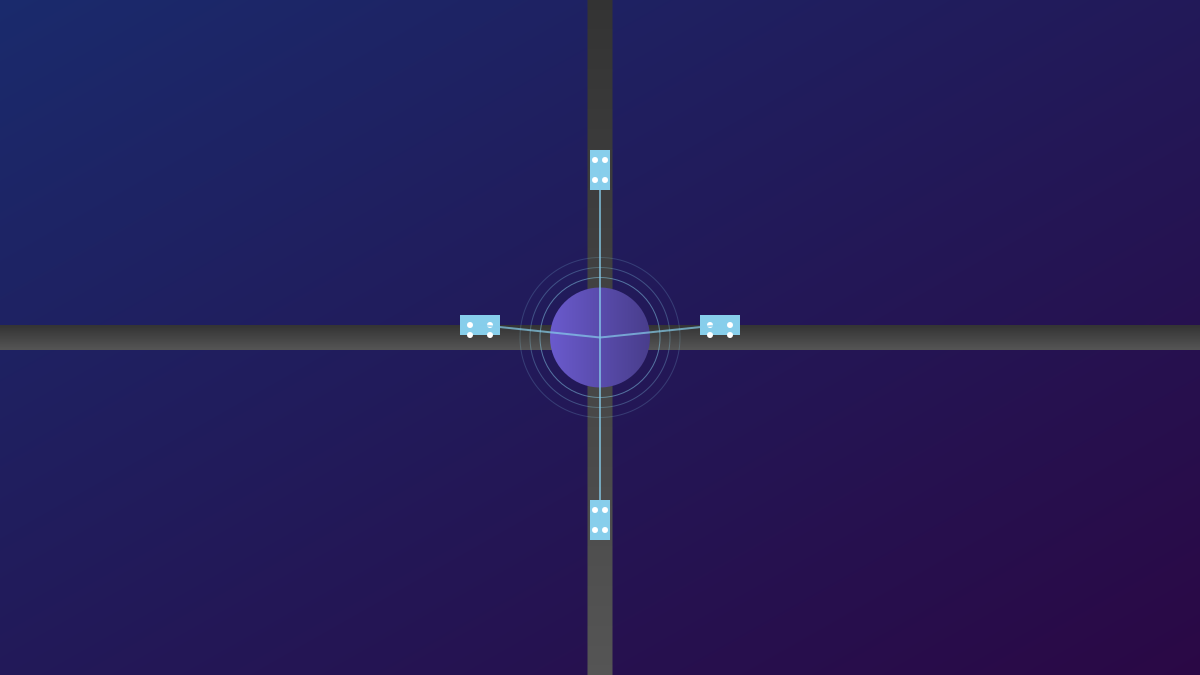
LISA (LLM-based Intention-Driven Speed Advisory) abandons signal light infrastructure and assigns the LLM to the role of cognitive arbitrator at intersections. Its workflow consists of three phases:

  1. Intention Collection: Vehicles declare their driving intentions (e.g., target exit, desired speed, whether they are emergency vehicles).
  2. Cognitive Reasoning: The LLM comprehensively analyzes vehicle intentions, queue pressure, energy preferences, and potential conflicts, and understands context-dependent priorities (e.g., ambulances have priority but this depends on the scenario).
  3. Speed Advisory Generation: Returns personalized speed suggestions (vehicle speed, acceleration/deceleration timing, stop instructions) and issues them in real-time via vehicle-road communication.

Key Technical Considerations

  • Latency Optimization: Uses model distillation and edge deployment strategies to achieve millisecond-level response.
  • Safety Assurance: Multi-layer safety fallback mechanism—switches to conservative preset rules if the LLM times out or has insufficient confidence.
  • Interpretability: The LLM generates natural language decision explanations (e.g., "Pause north-south traffic due to ambulance entry").
4

Section 04

Evidence: Significant Results from LISA's Experimental Evaluation

The research team conducted comparative tests of LISA against fixed-cycle control, SCATS adaptive system, AIM reservation system, and GLOSA speed guidance system, covering various traffic load scenarios:

  • Control Latency: Reduced by 89.1% compared to fixed-cycle control; maintains Level C service under high load (other methods degrade to Level F).
  • Waiting Time: Reduced by 93% under near-saturation conditions; peak queue length decreased by 60.6%.
  • Energy Efficiency: Fuel consumption reduced by up to 48.8%.
  • Intent Satisfaction Rate: Reached 86.2% (the best non-LLM method was 61.2%).
5

Section 05

Conclusion: Implications of LISA for Intelligent Transportation Development

LISA's achievements offer multiple implications for intelligent transportation:

  1. LLMs can be applied to complex multi-agent coordinated physical systems (e.g., robots, logistics scheduling).
  2. Signal-free infrastructure solutions are feasible, reducing deployment costs (suitable for new areas or temporary scenarios).
  3. Moving from lab to real-world deployment still requires solving issues like large-scale intersection network coordination, extreme weather reliability, and human-machine hybrid interaction.
6

Section 06

Epilogue: Exploration Value and Future Outlook of LISA

LISA is an important exploration at the intersection of AI and traffic engineering. It challenges the traditional belief that signal lights are a necessity for intersection management and demonstrates the potential of cognitive agents in real-time decision-making scenarios. With improvements in edge computing capabilities and model efficiency optimization, similar systems are expected to move from the lab to the streets, transforming the commuting experience.

