Zing Forum

Reading

LiLa-WAM: A Lightweight Implicit Reasoning World-Action Model for Robot Manipulation

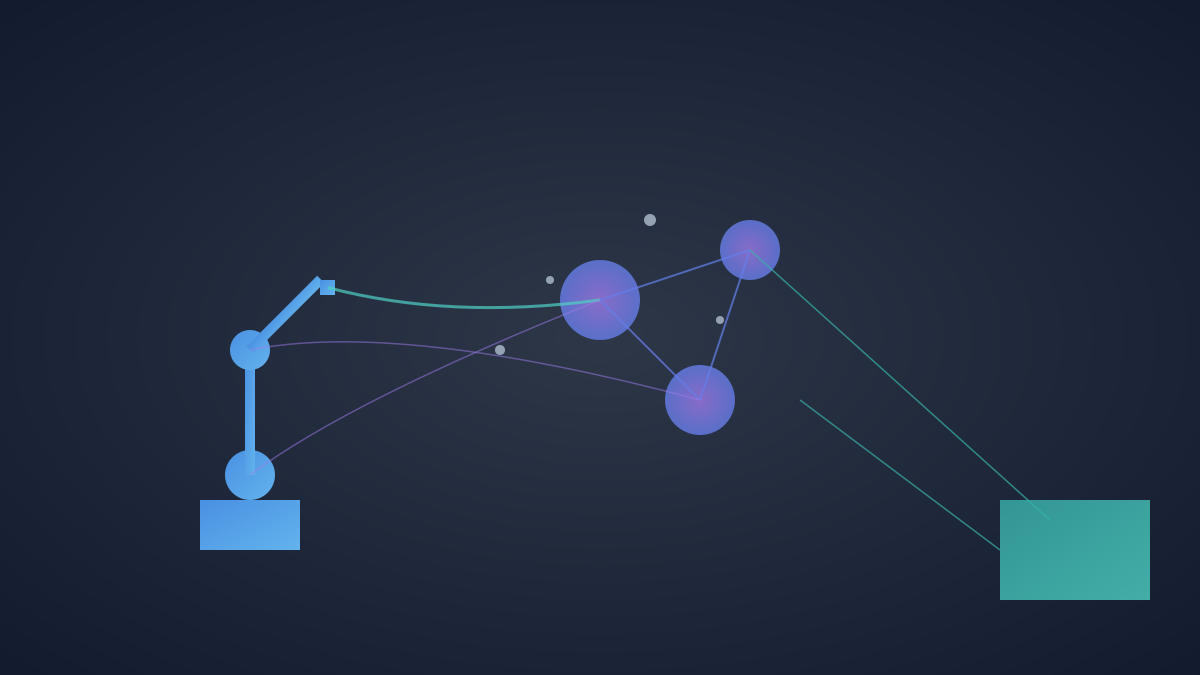
LiLa-WAM is a lightweight implicit reasoning world-action model designed specifically for robot manipulation tasks. By integrating visual perception, world modeling, and action planning, this model enables efficient robot control in resource-constrained environments.

机器人操作VLA模型轻量级模型隐式推理世界模型动作规划边缘AI机器人学习
Published 2026-08-06 14:22Recent activity 2026-08-06 14:28Estimated read 6 min
LiLa-WAM: A Lightweight Implicit Reasoning World-Action Model for Robot Manipulation
1

Section 01

[Introduction] LiLa-WAM: A Lightweight Implicit Reasoning World-Action Model for Robot Manipulation

LiLa-WAM is a lightweight implicit reasoning world-action model designed for robot manipulation tasks. By combining visual perception, world modeling, and action planning, it aims to address issues such as high computational resource consumption, long inference latency, and expensive deployment costs of existing Visual-Language-Action (VLA) models, enabling efficient robot control in resource-constrained environments. This project is maintained by teee000 and was released on the GitHub platform on August 6, 2026.


2

Section 02

Background: Evolutionary Dilemmas of Robot Manipulation Models

In recent years, the development of LLMs and VLMs has driven robot learning from traditional control to data-driven, end-to-end learning (e.g., models like RT-1, RT-2, OpenVLA, π0). However, existing VLA models face issues such as high computational resource consumption, long inference latency, and expensive deployment costs, which pose bottlenecks for robot applications running in real time on edge devices. LiLa-WAM was born in this context to explore a lightweight and efficient technical path.

3

Section 03

Core Design Philosophy: Balance Between Lightweight and Capability

The design philosophy of LiLa-WAM is "reducing computational complexity while maintaining capability", which is reflected in three aspects:

  1. Implicit Reasoning Mechanism: Encode visual observations into a low-dimensional implicit space for reasoning, reducing computational load while improving generalization and interpretability;
  2. Joint World-Action Modeling: Integrate world modeling and action planning end-to-end to understand the causal relationship between actions and their consequences;
  3. Lightweight Architecture: Use optimized visual encoders, streamlined Transformer structures, and quantization-aware training to reduce overhead.
4

Section 04

Technical Implementation Details: From Code to Deployment

LiLa-WAM's code repository includes a complete training and evaluation workflow:

  • Data Pipeline: The dataloader directory supports processing of variable-length data sequences based on task conditions;
  • Model Architecture: The models directory contains modules such as visual encoders, implicit reasoning networks, and action decoders;
  • Training & Evaluation: train.py is the training entry point; eval_vla_bridge.py and robotwin_infer.py support benchmark testing and real robot evaluation; monitor_eval.py implements visual monitoring;
  • Configuration System: The configs directory supports modular configuration management.
5

Section 05

Application Scenarios and Potential Value

The lightweight nature of LiLa-WAM makes it suitable for the following scenarios:

  1. Edge Device Deployment: Resource-constrained scenarios such as industrial automation and home service robots, without relying on the cloud;
  2. Multi-Robot Collaboration: Reduce system computational load and support large-scale deployment;
  3. Rapid Prototype Development: Shorten training cycles, lower experimental costs, and accelerate the validation of new ideas.
6

Section 06

Limitations and Future Directions

Limitations:

  • Lightweight design may lead to loss of model capacity, requiring a balance between performance and efficiency;
  • Cross-platform and cross-task generalization capabilities need to be verified;
  • Long-term planning capabilities for complex multi-step tasks need further testing.

Future Directions:

  • Introduce distillation technology to transfer knowledge from large models;
  • Use neural architecture search to automatically discover optimal lightweight architectures;
  • Combine reinforcement learning to optimize end-to-end strategies.
7

Section 07

Conclusion: Significance and Outlook of LiLa-WAM

LiLa-WAM is an important attempt in the evolution of robot learning toward efficiency and practicality, providing a reference for the technical implementation of resource-constrained scenarios. For developers interested in robot manipulation, edge AI, and model lightweighting, this open-source project is worth paying attention to and participating in.