Zing Forum

Reading

LexFlow: A Graph-Based AI Agent Workflow Orchestration Framework

LexFlow is an open-source framework that combines FastAPI and MCP tools to enable visual orchestration and debugging of AI Agent systems using graph structures, supporting dialogue-driven workflows and tool calls.

AI Agent工作流编排FastAPIMCP图结构开源框架LLM工具调用
Published 2026-05-23 19:45Recent activity 2026-05-23 19:49Estimated read 9 min
LexFlow: A Graph-Based AI Agent Workflow Orchestration Framework
1

Section 01

LexFlow: Open-Source Graph-Based AI Agent Workflow Orchestration Framework (Main Guide)

LexFlow is an open-source AI Agent workflow orchestration framework developed by VforVitorio (source: GitHub, link: https://github.com/VforVitorio/LexFlow, released on 2026-05-23). It addresses key challenges in building scalable, debuggable, and maintainable AI Agent systems—such as hard-to-visualize workflow logic, complex tool call chains, and tedious debugging—by using graph structures to model execution flows. Built on FastAPI and integrated with the MCP (Model Context Protocol), it supports parallel execution, dialogue-driven workflows, and seamless tool calls. Core features include visual workflow design/debugging, MCP tool compatibility, and async support for efficient concurrency.


2

Section 02

Background: Challenges in AI Agent System Development

With the continuous improvement of large language model (LLM) capabilities, AI Agent systems are evolving from simple Q&A tools to intelligent agents that can perform complex tasks, call external tools, and conduct multi-step reasoning. However, building scalable, debuggable, and maintainable Agent systems still faces many challenges: workflow logic is difficult to visualize, tool call chains are complex, and debugging processes are tedious. LexFlow was created to address these pain points.

3

Section 03

Core Design & Key Methods

Graph Structure Workflow

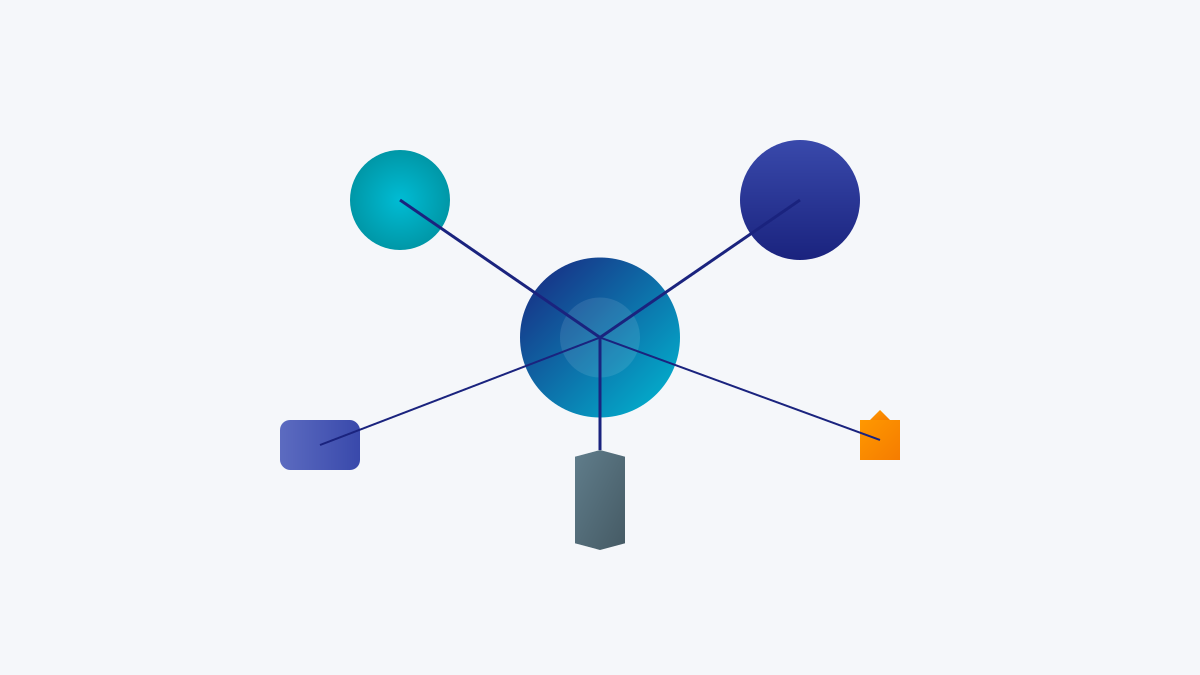
LexFlow abstracts the Agent's execution flow into a directed graph structure. Each node represents an execution unit (e.g., LLM call, tool execution, conditional judgment), and edges represent execution order and data flow. This design supports parallel execution of independent nodes and enables intuitive visualization for debugging.

Dialogue-Driven Workflow

LexFlow supports 'chat-driven workflows'—users can trigger and guide workflow execution via natural language dialogue. The system parses user intent and maps natural language instructions to predefined graph node execution paths.

MCP Tool Integration

LexFlow deeply integrates the MCP (Model Context Protocol) proposed by Anthropic, which standardizes interactions between LLMs and external tools/data sources. Developers can easily access MCP-compatible tools (e.g., file system access, database queries, API calls) without writing custom integration code.

4

Section 04

Technical Architecture: FastAPI & Visualization Tools

FastAPI as Service Base

LexFlow uses FastAPI as its web framework, which supports asynchronous programming (async/await) to handle concurrent requests efficiently—critical for Agent systems that frequently call LLM APIs and external tools. FastAPI also auto-generates OpenAPI documentation and an interactive Swagger UI for easy API exploration and testing.

Visual Debugging & Orchestration Interface

LexFlow includes a built-in visual graph editor and debugging interface, allowing developers to:

  • Design workflows by dragging nodes and connecting edges
  • Monitor real-time execution status and input/output data of each node
  • Pause execution at specific nodes for breakpoint debugging
  • Analyze performance to identify bottlenecks and optimize paths
5

Section 05

Application Scenarios & Practical Value

Automated Document Processing

In industries like law, finance, and healthcare, LexFlow can build workflows for document processing: receiving uploaded documents, performing OCR recognition, extracting key information, conducting compliance checks, generating summary reports, and triggering approval processes.

Smart Customer Service & Ticket Systems

Combining dialogue-driven features, LexFlow is suitable for building smart customer service Agents. It can understand user questions, query knowledge bases, call order system APIs, and create tickets for human agents when necessary.

Data Pipelines & ETL

For data engineers, LexFlow can act as a lightweight ETL orchestration tool: extracting data from various sources, transforming/cleaning it, and loading it into target storage—with support for error retries, parallel processing, and dependency management.

6

Section 06

Comparison with Similar Agent Orchestration Tools

LexFlow differentiates itself from similar projects like LangChain's LangGraph, LlamaIndex's Workflows, and Airflow:

  • Agent-Specific Focus: Optimized for LLM calls, tool usage, and dialogue management (unlike general workflow engines)
  • Native MCP Support: Built around the MCP protocol from the start (vs. needing extra adaptation in other frameworks)
  • Visualization-First: Built-in graph editor and debugging interface as core features (not add-ons)
  • FastAPI Ecosystem: Lower learning curve and integration cost for teams already using Python and FastAPI
7

Section 07

Conclusion & Future Outlook

LexFlow represents an important direction in AI Agent development tools: transitioning from code-defined workflows to visual orchestration, and from black-box execution to observable, debuggable systems. As the MCP ecosystem matures and Agent application scenarios expand, such orchestration-focused infrastructure will become increasingly important.

For developers building production-level Agent systems, LexFlow offers a valuable option—it integrates FastAPI's high performance, MCP's open ecosystem, and graph structure's visualization advantages, providing a solid foundation for developing and operating complex AI applications.

