Zing Forum

Reading

LENS-ADNet: An Alzheimer's Disease Detection Model Integrating 3D CNN, Transformer, and Symbolic Reasoning

LENS-ADNet is a hybrid deep learning model that accurately detects Alzheimer's disease from MRI scan images and provides clinically interpretable diagnostic results by integrating 3D CNN feature extraction, Transformer attention mechanism, and symbolic reasoning layers.

医学AI阿尔茨海默病深度学习3D CNNTransformer可解释AIMRI神经影像
Published 2026-06-04 14:31Recent activity 2026-06-04 14:57Estimated read 7 min
LENS-ADNet: An Alzheimer's Disease Detection Model Integrating 3D CNN, Transformer, and Symbolic Reasoning
1

Section 01

LENS-ADNet: Introduction to a Multi-Technology Integrated Alzheimer's Disease Detection Model

LENS-ADNet is a hybrid deep learning model integrating 3D CNN feature extraction, Transformer attention mechanism, and symbolic reasoning layers, designed to accurately detect Alzheimer's Disease (AD) from MRI scan images and provide clinically interpretable diagnostic results. Addressing issues in traditional AD diagnosis such as strong subjectivity, difficulty in early identification, and lack of trust in black-box models, this model balances diagnostic accuracy and clinical practicality, offering a new paradigm for AI-assisted medical diagnosis.


2

Section 02

Research Background: Core Challenges in AD Diagnosis

Alzheimer's disease is the main cause of dementia in the elderly, and the intensification of global population aging makes its early diagnosis increasingly important. Traditional diagnostic methods face the following challenges:

  • Strong subjectivity: Individual differences exist in doctors' interpretation of MRI images
  • Difficulty in early identification: Symptoms in the Mild Cognitive Impairment (MCI) stage are subtle and easy to miss
  • Lack of interpretability: Diagnostic results from black-box models are hard to gain doctors' trust
  • High data dimensionality: 3D MRI scan data is large in volume, making feature extraction difficult The design goal of LENS-ADNet is precisely to address these pain points.
3

Section 03

Model Architecture: Innovative Three-Layer Integration Design

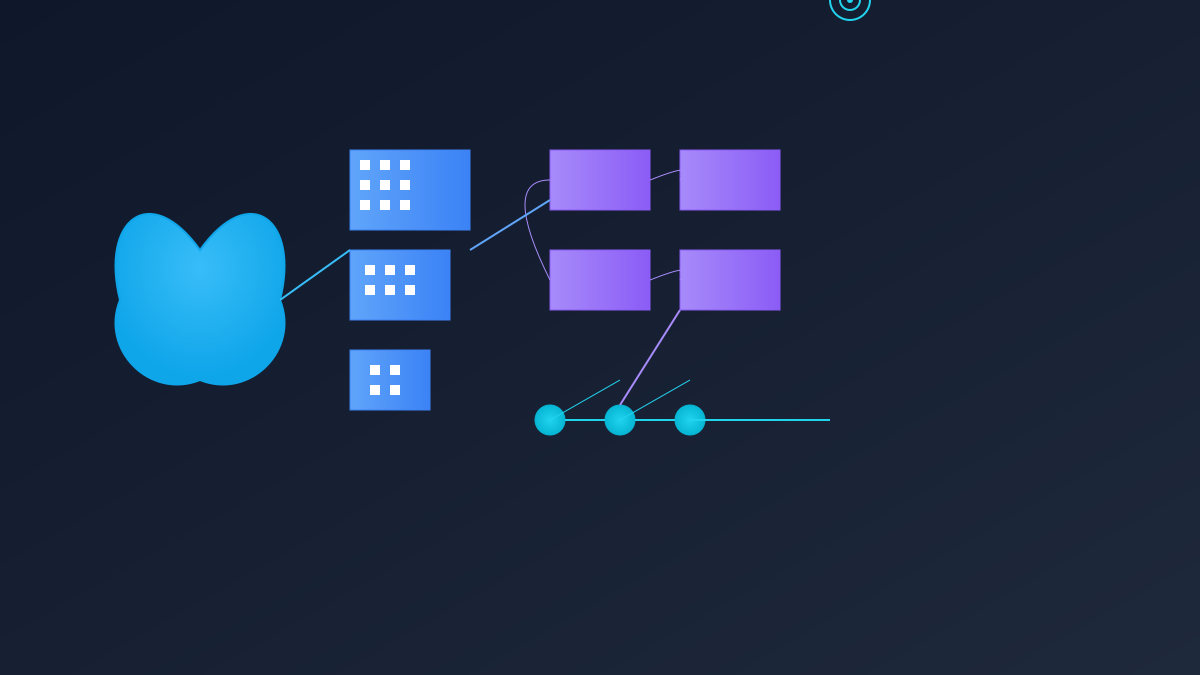
The core innovation of LENS-ADNet lies in its three-layer integration architecture:

  1. 3D CNN Feature Extraction Layer: Directly processes 3D voxel data, learns hierarchical spatial features, and identifies AD-related brain atrophy patterns (e.g., changes in the hippocampus and temporal cortex).
  2. Transformer Attention Layer: Models global dependency relationships among brain regions, visualizes key diagnostic areas through attention weights, and improves interpretability.
  3. Symbolic Reasoning Layer: Encodes medical knowledge rules, performs logical reasoning based on feature activation, generates diagnostic explanations in natural language form, and ensures decisions align with clinical logic.
4

Section 04

Data and Implementation: ADNI Dataset and Project Structure

Dataset: Uses the ADNI (Alzheimer's Disease Neuroimaging Initiative) dataset, which features multimodality (MRI/PET/CSF, etc.), longitudinal tracking, expert annotation, and public availability. The preprocessing pipeline includes skull stripping, standard space registration, intensity normalization, and data augmentation. Project Structure: Modular design covering modules for data download/preprocessing, implementation of each model layer, training and evaluation, interpretability analysis, etc., making it easy for developers to use and extend.

5

Section 05

Technical Advantages and Application Scenarios

Technical Advantages:

  • Hybrid architecture: Combines the representational power of deep learning with the transparency of symbolic reasoning, overcoming black-box issues and feature engineering difficulties.
  • 3D processing: Preserves spatial structure information, outperforming 2D slice methods.
  • Attention-guided: Intrinsic interpretability without the need for additional tools.
  • Clinical alignment: Symbolic layer encodes medical knowledge, enhancing doctor acceptance. Application Scenarios:
  • Clinical assistance: Radiology second opinions, large-scale screening, follow-up monitoring.
  • Research applications: Biomarker discovery, drug trial evaluation, MCI conversion prediction.
6

Section 06

Limitations and Future Directions

Limitations:

  • Data dependency: Requires large amounts of annotated data, facing domain differences and class imbalance issues.
  • Computational resources: 3D models have a large number of parameters, requiring GPU acceleration and distributed training.
  • Clinical validation: Needs prospective trials and regulatory approval; doctor acceptance needs to be cultivated. Future Directions:
  • Multimodal fusion: Integrate PET, CSF, and genetic data to improve accuracy.
  • Federated learning: Collaborative training with multi-center data under privacy protection.
  • Real-time deployment: Optimize model efficiency to achieve clinical real-time reasoning.
  • Disease prediction: Extend to the identification of individuals at high risk of AD.

