Zing Forum

Reading

LayoutEnv: A Poster Layout Optimization Evaluation Environment for Large Language Models

This article details the design philosophy and implementation mechanism of the LayoutEnv evaluation framework, an OpenEnv-compatible environment specifically designed to assess the performance of LLMs and VLMs in iterative layout optimization tasks, supporting discrete action spaces and multi-dimensional quality evaluation.

LayoutEnvOpenEnv布局优化LLM评测VLM空间推理FastAPI多模态AI
Published 2026-04-11 03:38Recent activity 2026-04-11 03:46Estimated read 6 min
LayoutEnv: A Poster Layout Optimization Evaluation Environment for Large Language Models
1

Section 01

LayoutEnv: A Poster Layout Optimization Evaluation Environment for Large Language Models (Introduction)

LayoutEnv is an OpenEnv-compatible evaluation environment specifically designed to assess the performance of Large Language Models (LLMs) and Vision-Language Models (VLMs) in iterative layout optimization tasks. It supports discrete action spaces and multi-dimensional quality evaluation, filling the gap in AI evaluation for spatial reasoning and iterative optimization task assessment, and providing a standardized tool for related research.


2

Section 02

AI Challenges in Layout Optimization and Background of OpenEnv Standards

AI Challenges in Layout Optimization

In graphic design, poster layout optimization requires spatial reasoning and iterative improvement capabilities, which are highly challenging for AI: it needs to understand spatial relationships, search for optimal solutions in discrete decision spaces, and continuously improve based on feedback.

OpenEnv Standards and Evaluation Ecosystem

OpenEnv is an open evaluation framework standard that provides a unified interface to ensure the reproducibility and comparability of research results. LayoutEnv is fully compatible with OpenEnv specifications and can be seamlessly integrated into existing evaluation pipelines.

3

Section 03

Core Mechanisms and Evaluation System of LayoutEnv

Core Mechanisms of the Environment

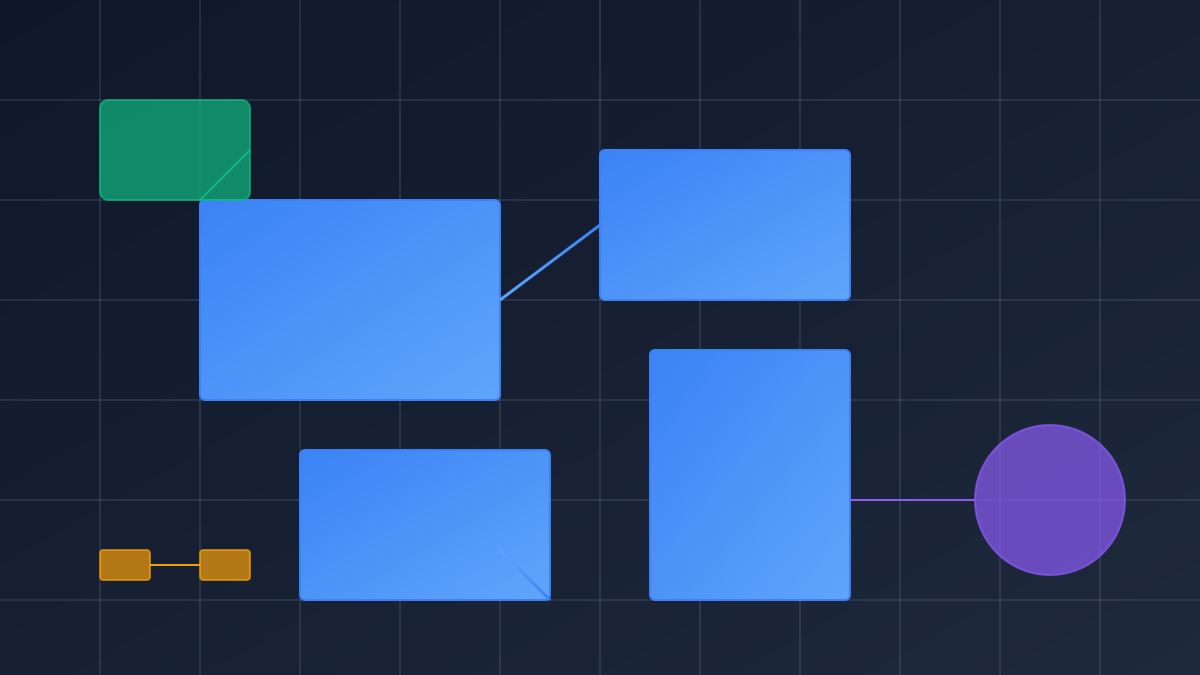
Task: AI agents perform iterative optimization on initially chaotic poster layouts, with optional actions including discrete operations such as moving (direction + magnitude), resizing, aligning, and snapping to grids.

State Representation and Observation Space

Provides canvas information, element lists (ID/type/coordinates/size, etc.), layout metrics (overlap/alignment degree, etc.); additionally provides rendered images (path or Base64 encoding) for VLMs.

Reward Function and Evaluation System

Uses dense rewards (quality score change + scaling factor - step penalty), with penalties for invalid actions; at the end of the round, scoring is based on the magnitude of quality improvement, with three difficulty thresholds: easy (≥0.05), medium (≥0.10), and hard (≥0.15).

4

Section 04

Deployment and Usage Methods

LayoutEnv supports flexible deployment:

  • Local: Run the environment server via Docker;
  • Cloud: Deploy to Hugging Face Spaces;
  • Python client: Provides synchronous/asynchronous APIs, supports automatic container startup and cleanup, facilitating integration into evaluation processes.
5

Section 05

Inference Baselines and Model Support

The project repository includes baseline implementations based on Hugging Face inference services, using the Qwen2.5-VL-72B-Instruct model by default. The baseline demonstrates the process of VLMs accessing LayoutEnv (processing observations, parsing actions, interacting to complete optimization), with output formats compatible with evaluator parsing requirements, and standardized logs that can track each step's actions, rewards, and state changes.

6

Section 06

Application Scenarios, Research Value, and Conclusion

Application Scenarios and Research Value

LayoutEnv defines representative AI capability testing scenarios, comprehensively assessing models' spatial understanding, long-term planning, and feedback improvement capabilities, providing researchers with an extensible platform to test new architectures/methods, and demonstrating formalized solutions for practical tasks to developers.

Conclusion

LayoutEnv fills the gap in AI evaluation, and its simple, open, and extensible design embodies the wisdom of the open-source community, which is of great significance to multi-modal AI and spatial intelligence research.