Zing Forum

Reading

L0 Python: A New Paradigm for Building Reliability Infrastructure for AI Applications

L0 Python is a reliability substrate for large language model (LLM) applications. It addresses the reliability challenges of AI applications in production environments through a stream-first architecture, atomic event logging, and deterministic replay mechanisms.

L0 PythonAI可靠性大语言模型流式架构事件溯源多模型回退确定性重放AI基础设施
Published 2026-04-03 06:01Recent activity 2026-04-03 06:19Estimated read 7 min
L0 Python: A New Paradigm for Building Reliability Infrastructure for AI Applications
1

Section 01

L0 Python: A New Paradigm for Building Reliability Infrastructure for AI Applications (Introduction)

L0 Python is a reliability substrate for large language model (LLM) applications, designed to address the reliability challenges of AI applications in production environments. It fundamentally reconstructs the runtime architecture of AI applications through a stream-first architecture, atomic event logging, and deterministic replay mechanisms, elevating reliability to a first-class architectural concern.

2

Section 02

Background: The Reliability Dilemma of AI Applications

Most current LLM applications are based on a request-response model that directly calls model APIs, performing well in the prototype phase but facing issues like network timeouts, unstable model outputs, hard-to-track streaming responses, and difficult-to-reproduce debugging problems in production environments. Traditional error handling methods (such as try-catch, exponential backoff retries) are insufficient in AI scenarios—due to model uncertainty, provider differences, and complex conversation state management, a new reliability engineering approach is needed.

3

Section 03

Core Design Philosophy: Stream-First, Deterministic Execution, Fully Observable

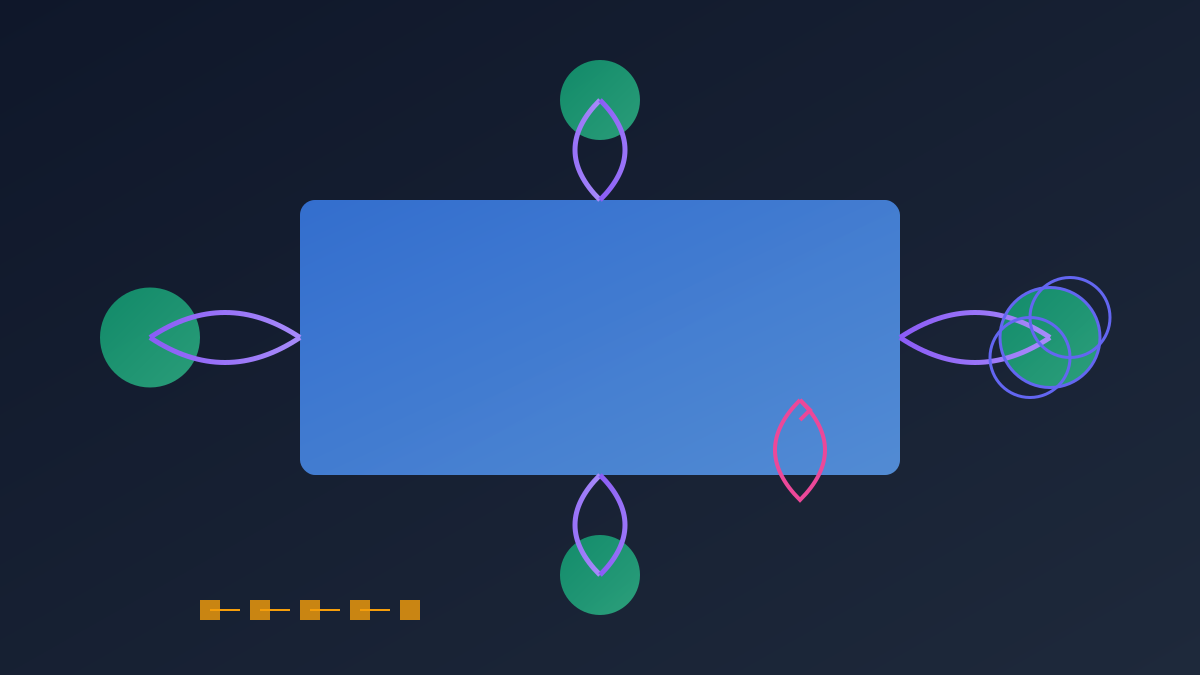
The architectural philosophy of L0 Python is "stream-first, deterministic execution, fully observable". The team believes that LLM interactions are continuous data streams, so they model model calls, tool executions, and state transitions as atomic events and persist them. This design brings three key advantages: sessions can be accurately replayed from any point in time (time travel); failures can be recovered from breakpoints; multi-model strategies (fallback, consensus) can be implemented transparently.

4

Section 04

Analysis of Key Mechanisms

Atomic Event Logging and Deterministic Replay

Using the event sourcing pattern, external calls, intermediate results, and state changes are captured as immutable events, forming the single source of truth for the system state. This allows state reconstruction in any environment to achieve deterministic replay across sessions/machines.

Multi-Level Fault Tolerance Strategy

Intelligent retries at the individual request level (distinguishing between transient network errors and model errors); automatic fallback based on confidence at the model level (switching to backups or aggregating outputs when the main model is uncertain); breakpoint resumption at the session level to ensure no progress is lost in long tasks.

Stream Architecture and Multi-Modal Support

The underlying layer is designed around streams, unifying the abstraction of text, image, and audio processing. Multi-modal data can be naturally mixed without writing different logic for each modality.

Guardrails and Consensus Mechanism

A configurable guardrail system inserts validation logic at data stream nodes; consensus mechanisms are supported in key decision scenarios (querying multiple models in parallel, obtaining reliable conclusions via voting/confidence weighting).

5

Section 05

Practical Application Scenarios and Value

It is particularly valuable for teams building long-running AI applications such as customer service robots, code assistants, and research agents: for example, multi-step research agents can elegantly retry/replace unavailable tool APIs, recover from breakpoints after process crashes, and accurately replay contexts during debugging. For high-availability enterprise applications, multi-model fallback and consensus mechanisms provide a safety net—seamlessly switching to backup providers when the main model service is degraded, without users noticing.

6

Section 06

Technical Implementation and Ecosystem Positioning

L0 Python is implemented in pure Python, with the core runtime written in Rust (balancing development efficiency and performance). Its design maintains compatibility with mainstream LLM SDKs, allowing developers to gradually adopt its capabilities. Its ecosystem positioning is as an infrastructure layer beneath upper-level frameworks (such as LangChain, LlamaIndex), and any AI application requiring a reliable runtime can benefit from its deterministic execution and observability.

7

Section 07

Conclusion: Reliability as a First-Class Citizen

L0 Python represents a paradigm shift: elevating reliability from a post-hoc patch to a first-class architectural concern. In today's increasingly complex AI applications, reconstructing underlying thinking is more valuable in the long run than chasing the latest model capabilities. It is recommended that teams seriously considering putting LLM applications into production should thoroughly evaluate L0 as a foundational option.


