Zing Forum

Reading

Benchmarking KV Cache Eviction Strategies: Optimizing Large Model Inference Under GPU Memory Pressure

An in-depth analysis of KV cache management challenges in large language model (LLM) inference, introducing benchmarking methods for various cache eviction strategies, and how to balance inference efficiency and context length in memory-constrained scenarios.

KV缓存大模型推理GPU内存优化注意力机制缓存淘汰策略长上下文Transformer显存管理推理效率LLM优化
Published 2026-05-10 11:15Recent activity 2026-05-10 11:19Estimated read 6 min
Benchmarking KV Cache Eviction Strategies: Optimizing Large Model Inference Under GPU Memory Pressure
1

Section 01

[Main Post/Introduction] Benchmarking KV Cache Eviction Strategies: Optimizing Large Model Inference Under GPU Memory Pressure

This article provides an in-depth analysis of KV cache management challenges in large language model (LLM) inference, introduces benchmarking methods for various cache eviction strategies, and explores how to balance inference efficiency and context length in memory-constrained scenarios. It covers core topics including KV cache memory bottlenecks, strategy classification, benchmark design, practical application trade-offs, and cutting-edge directions, providing references for LLM inference system optimization.


2

Section 02

Background: KV Cache Memory Bottleneck in Large Model Inference

As LLM context windows expand (from 4K to 128K+ tokens), KV cache memory usage becomes a core challenge. In autoregressive generation, the key-value pair cache for each attention head in each layer can easily occupy tens of gigabytes of GPU memory, limiting batch size and context length. KV cache eviction strategies balance inference efficiency and performance by intelligently retaining/discarding KV representations of historical tokens.

3

Section 03

KV Cache Working Principle and Memory Overhead Quantification

During the Transformer generation phase, the KV cache stores key (K) and value (V) vectors for each head in each layer, reducing computational complexity from O(n²) to O(n). The memory usage formula: Memory (GB) = 2 × number of layers × number of attention heads × per-head dimension × sequence length × batch size × precision bytes / 1e9. For example, Llama-2-70B uses approximately 10.5GB for 4K tokens with a batch size of 1, and up to 336GB for 128K tokens—far exceeding the memory of a single GPU card.

4

Section 04

Classification and Principles of KV Cache Eviction Strategies

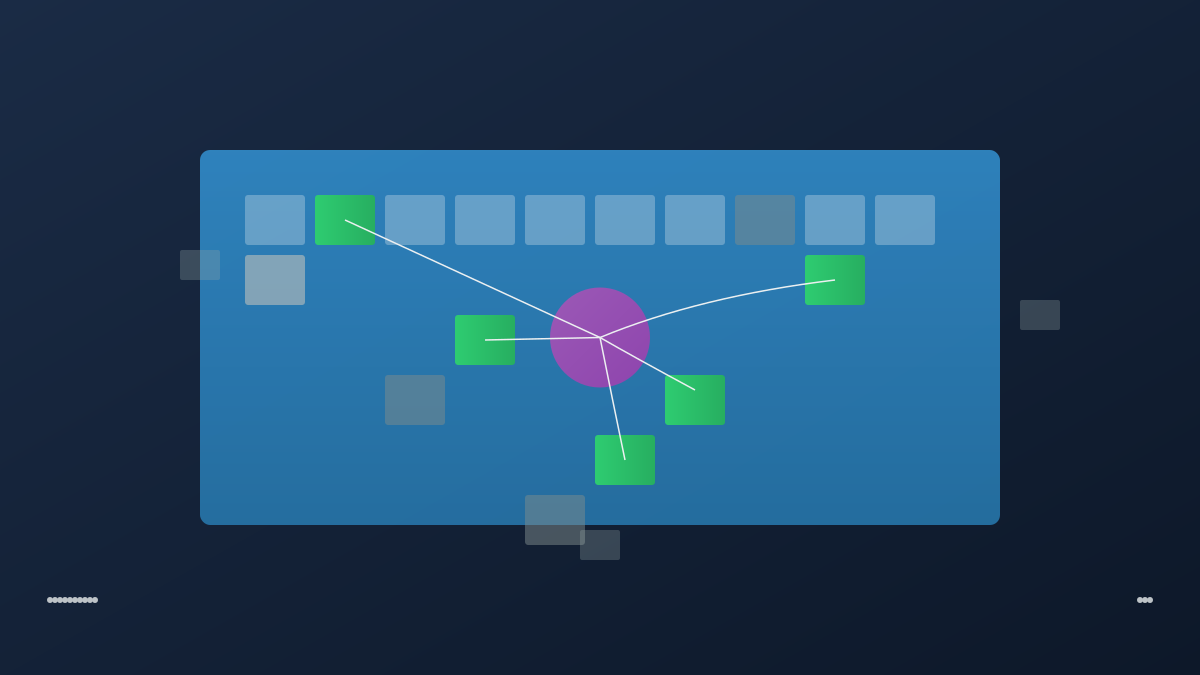
Strategies are divided into four categories: 1. Window-based (fixed/sliding window, retaining the latest N tokens); 2. Importance-based (e.g., H2O identifies hot tokens); 3. Compression-based (quantization, low-rank approximation, hierarchical aggregation); 4. Dynamic allocation (adaptive strategy switching).

5

Section 05

Benchmark Design and Evaluation Dimensions

Test scenarios need to cover context length, task type, access pattern, and memory pressure. Evaluation metrics include: Accuracy (perplexity, task-specific metrics, long-range dependencies); Efficiency (throughput, latency, peak memory usage, cache hit rate); Robustness (model scale generalization, precision stability, long-context decay).

6

Section 06

Strategy Selection and Optimization Tips in Practical Applications

Strategy selection needs to consider application scenarios (sliding window for dialogue, importance retention for document analysis), hardware constraints (compression for high-end GPUs, strict management for consumer-grade GPUs), and service quality (prioritize integrity for medical applications, allow moderate precision loss for real-time dialogue). Optimization tips: pre-allocated memory pool, asynchronous eviction and prefetching, mixed-precision strategy.

7

Section 07

Cutting-edge Research Directions and Future Outlook

Cutting-edge directions include: 1. Learning-based cache management (lightweight models predict which KV to retain); 2. Cross-layer sharing and recursive compression; 3. Hardware-software co-design (GPU native support for sparse attention, etc.).

8

Section 08

Conclusions and Practical Recommendations

KV cache eviction strategies are crucial for the practical application of LLM long contexts. Benchmarking can quantify the pros and cons of strategies. It is recommended that teams start from their own workloads, establish scenario-based benchmark suites, and balance accuracy, efficiency, and resource utilization.

