Zing Forum

Reading

Kimi-VL: A 16B-Parameter MoE-Based Vision-Language Model with Only 3B Activated Parameters That Outperforms GPT-4o

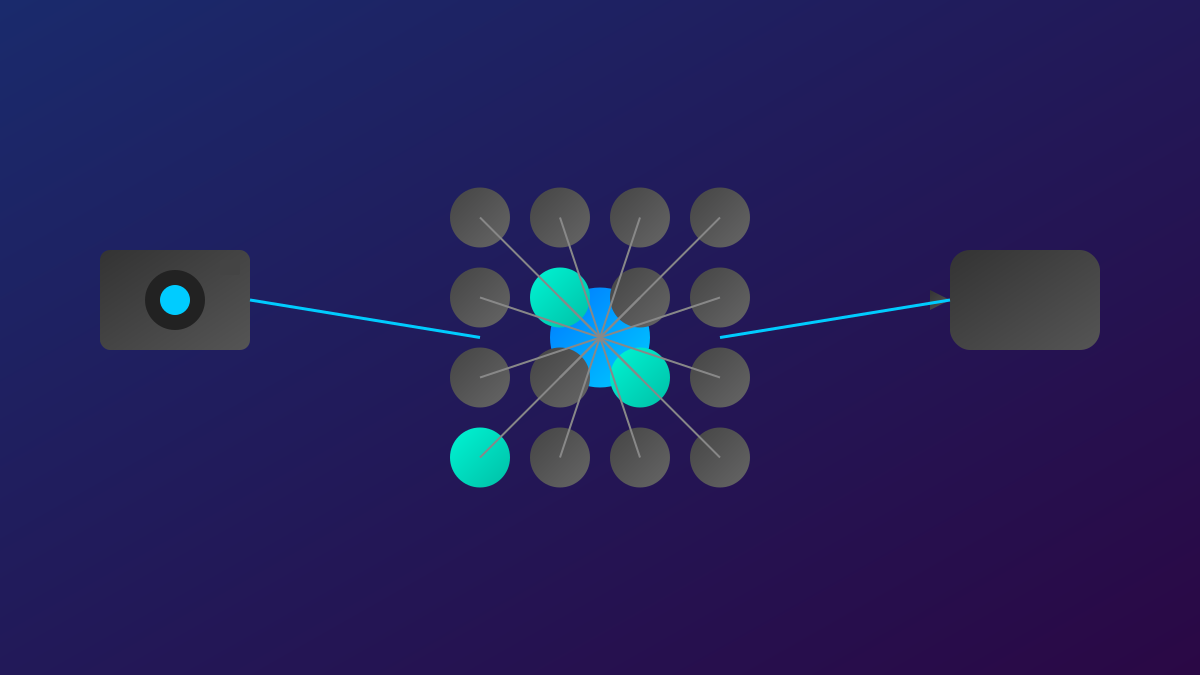
Moonshot AI's open-source Kimi-VL uses a Mixture of Experts (MoE) architecture, with a total of 16B parameters but only 3B activated during inference. It excels in scenarios like 128K long context, multimodal reasoning, and agent tasks. Its Thinking version outperforms 70B-scale open-source models on mathematical reasoning benchmarks.

Kimi-VL视觉语言模型MoE混合专家多模态长上下文开源模型Moonshot AI推理模型智能体
Published 2026-04-30 11:33Recent activity 2026-04-30 11:48Estimated read 8 min
Kimi-VL: A 16B-Parameter MoE-Based Vision-Language Model with Only 3B Activated Parameters That Outperforms GPT-4o
1

Section 01

Introduction: Kimi-VL — A Compact Yet Powerful Multimodal Vision-Language Model

Introduction: Kimi-VL — A Compact Yet Powerful Multimodal Vision-Language Model

Moonshot AI's open-source Kimi-VL uses a Mixture of Experts (MoE) architecture, with a total of 16B parameters but only 3B activated during inference. It excels in scenarios such as 128K long context, multimodal reasoning, and agent tasks. Its Thinking version outperforms 70B-scale open-source models on mathematical reasoning benchmarks and even surpasses GPT-4o in some scenarios, providing a new solution for balancing efficiency and performance in multimodal models.


2

Section 02

Background: The Dilemma of Balancing Efficiency and Performance in Multimodal Models

Background: The Dilemma of Balancing Efficiency and Performance in Multimodal Models

In the field of large multimodal models, a long-standing problem is how to achieve performance close to flagship models with limited computing resources. Kimi-VL's emergence provides an answer: through the MoE architecture, with a configuration of 16B total parameters and 3B activated parameters, it achieves performance that surpasses closed-source flagship models, offering an efficient solution for resource-constrained scenarios.

3

Section 03

Model Architecture: Innovative Design of MoE + Native Vision Encoder

Model Architecture: Innovative Design of MoE + Native Vision Encoder

Kimi-VL's core architecture consists of three key components:

  1. MoE Language Decoder: Total parameters 16B, 2.8B activated during inference, reducing cost and latency;
  2. MoonViT Native Resolution Vision Encoder: Processes native resolution inputs, with the new version supporting 3.2 million pixels (1792×1792);
  3. MLP Projector: Connects visual and language modalities to enable cross-modal understanding and generation.
4

Section 04

Core Capabilities: Comprehensive Coverage of Six Key Scenarios

Core Capabilities: Comprehensive Coverage of Six Key Scenarios

Kimi-VL covers six key areas:

  • Long Context Understanding: 128K window, scoring 64.5 on LongVideoBench and 35.1 on MMLongBench-Doc;
  • Ultra-High Resolution Perception: 83.2 on InfoVQA and 52.8 on the new version of ScreenSpot-Pro;
  • Multi-Round Agent Interaction: OSWorld performance reaches flagship model level;
  • Mathematical Reasoning: The Thinking version scores 80.1 on MathVista (an 8.4-point improvement), with average thinking length reduced by 20%;
  • Video Understanding: New open-source high score of 65.2 on VideoMMMU;
  • OCR: Accurately recognizes text in images, supporting document digitization.
5

Section 05

Performance Comparison: Empirical Results of Punching Above Its Weight

Performance Comparison: Empirical Results of Punching Above Its Weight

Compared to same-level 10B dense models (e.g., Qwen2.5-VL-7B) and DeepSeek-VL2, Kimi-VL shows competitive advantages. More surprisingly, it surpasses GPT-4o in some professional fields:

  • Kimi-VL-A3B-Thinking matches 30B/70B-scale open-source models on the MathVision benchmark, proving that architectural innovation and training optimization can enable small-scale models to achieve large-scale capabilities.
6

Section 06

Conclusion: A New Direction for Efficiency-First Multimodal Models

Conclusion: A New Direction for Efficiency-First Multimodal Models

Kimi-VL represents an important direction in the development of multimodal models: efficiency-first architectural design. Against the backdrop of high computing costs and growing demand for edge AI, achieving flagship performance with only 3B activated parameters has practical value. It also verifies the effectiveness of the MoE architecture in the multimodal field, providing a scalable path for future models. As an open-source contribution, Kimi-VL offers a cost-effective option for multimodal applications, and ecosystem tool support lowers deployment barriers.

7

Section 07

Usage Recommendations: Version Selection and Deployment Guide

Usage Recommendations: Version Selection and Deployment Guide

Version Selection

Model Version Total Parameters Activated Parameters Context Length Applicable Scenarios
Kimi-VL-A3B-Thinking-2506 16B 3B 128K Recommended version, balancing reasoning and perception
Kimi-VL-A3B-Instruct 16B 3B 128K General multimodal understanding, OCR, long documents
Kimi-VL-A3B-Thinking 16B 3B 128K Early version (deprecated)

Parameter Settings

  • Thinking models: Temperature=0.8 (enrich reasoning)
  • Instruct models: Temperature=0.2 (deterministic output)

Deployment and Fine-Tuning

Supports mainstream frameworks: vLLM (efficient inference), LLaMA-Factory (fine-tuning), Transformers (native support). It is recommended to install flash-attn and use bfloat16+flash_attention_2 to solve memory issues.

