Zing Forum

Reading

Keelson: An Issue-Driven Workflow Framework for Building Anti-Drift Guardrails for AI Agents

Keelson is a lightweight framework that effectively prevents specification drift in AI agents during code generation through an issue-driven workflow and human intervention mechanisms, supporting any code repository and issue tracking system.

AI智能体规格漂移代码生成Issue驱动人工介入LLM护栏Claude CodeCodex工作流框架
Published 2026-06-04 08:44Recent activity 2026-06-04 08:49Estimated read 5 min
Keelson: An Issue-Driven Workflow Framework for Building Anti-Drift Guardrails for AI Agents
1

Section 01

Introduction: Keelson — An Issue-Driven Framework for Preventing AI Agent Drift

Keelson is a lightweight open-source framework developed by innovestrum. It addresses the specification drift problem of AI agents in code generation through an issue-driven workflow and human intervention mechanisms. The framework supports any code repository and issue tracking system, with its core being binding AI activities to clear issues, setting human checkpoints, and balancing AI automation efficiency with human control.


2

Section 02

Background: The Challenge of Specification Drift in AI Agents

With the improvement of LLM capabilities, AI agents are widely used in software development, but there is a problem of specification drift: AI deviates from original requirements due to context bias, iterative errors, etc.—for example, a login function evolving into an over-scoped implementation, leading to increased complexity and security risks. Traditional code reviews face obvious efficiency bottlenecks when the volume of AI-generated code is large, requiring a systematic protection mechanism.

3

Section 03

Keelson Project Overview: Positioning and Core Features

Keelson is derived from a nautical term (a structural support in a ship's hull) and is specifically designed to prevent AI specification drift, with its core concept being issue-driven development. The framework uses the MIT license, is lightweight (about 61KB), does not bind to specific AI models or platforms, can work with Claude Code and Codex, and supports issue tracking systems like GitHub Issues and Jira.

4

Section 04

Core Mechanisms: Three-Tier Defense System to Prevent Specification Drift

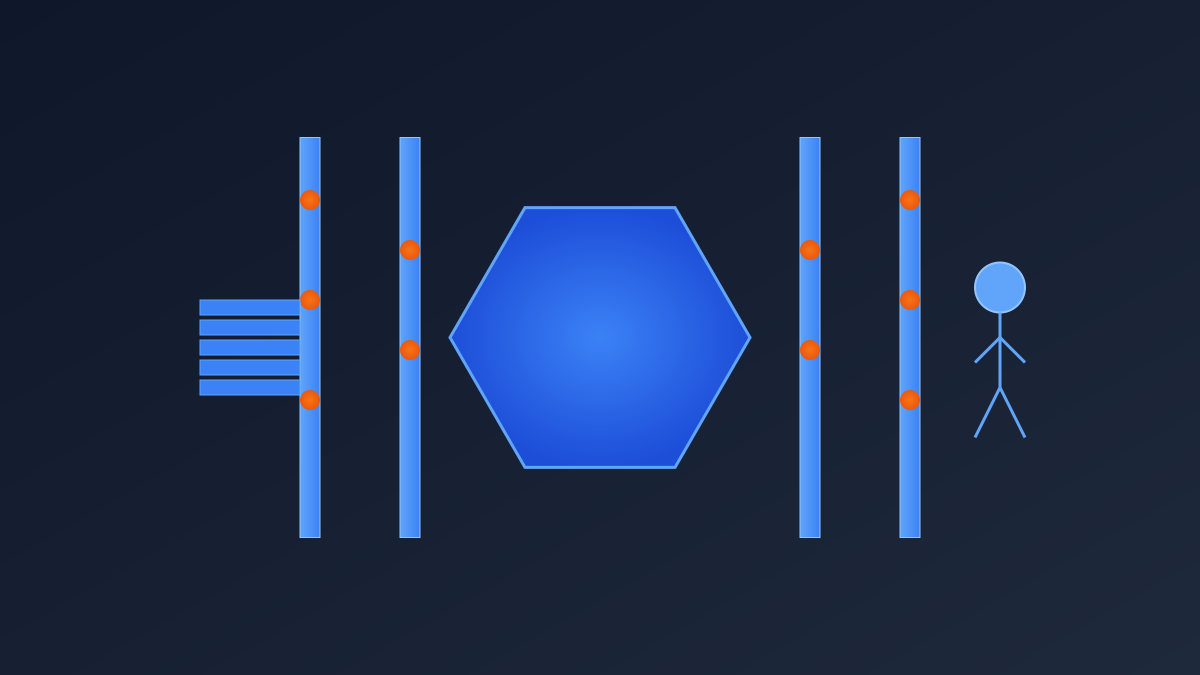
  1. Issue-driven workflow: AI activities must be associated with issues containing clear problems and acceptance criteria, forcing them to work under constraints; 2. Human intervention gate: When AI encounters ambiguity, over-scoped modifications, etc., it must pause and request human decision-making, with customizable trigger conditions; 3. Portable guardrail configuration: Rules are abstracted into version-controlled configuration files, including code scope, prohibited operations, quality thresholds, etc.
5

Section 05

Technical Implementation: Lightweight Integration and Cross-Platform Support

Keelson acts as a supervision layer for AI tools and does not replace existing tools; it supports cross-platform via plug-ins, natively supports GitHub Issues, and can be extended to Jira, etc.; it is deeply integrated with Git, marking AI changes for easy auditing, and automatically verifying compliance with issue requirements during the PR phase.

6

Section 06

Application Scenarios: Value in Multiple Contexts

  1. Enterprise-level codebases: Ensure high-risk AI changes undergo human review, while low-risk changes pass quickly; 2. Open-source projects: Help maintainers identify whether AI-generated code complies with specifications; 3. Personal development: Prevent AI from over-extending and keep tasks focused.
7

Section 07

Limitations and Future Outlook

Keelson is currently in the proof-of-concept stage (created in June 2026), with basic functions and a lack of community feedback. In the future, it may expand into directions like agentic workflows and LLM guardrails, or become an industry-standard practice.

8

Section 08

Conclusion: The Optimal Solution for Human-AI Collaboration

Keelson represents a shift from pursuing AI autonomy to optimizing human-AI collaboration, emphasizing that AI tools need to introduce human wisdom at the right time. For teams using AI programming assistants, it is a reference architecture worth paying attention to.

