Zing Forum

Reading

Kaola-Workflow: A Six-Stage Intelligent Development Workflow Framework for Claude Code

This article introduces Kaola-Workflow, a six-stage development workflow framework specifically designed for Claude Code. It enables end-to-end automation from requirement research to code delivery through multi-agent orchestration, supporting session recovery and cross-context state management.


Claude CodeAI编程工作流框架智能体编排TDD代码审查多智能体开发自动化
Published 2026-05-16 18:45Recent activity 2026-05-16 18:51Estimated read 6 min
Kaola-Workflow: A Six-Stage Intelligent Development Workflow Framework for Claude Code
1

Section 01

Introduction / Main Floor: Kaola-Workflow: A Six-Stage Intelligent Development Workflow Framework for Claude Code

This article introduces Kaola-Workflow, a six-stage development workflow framework specifically designed for Claude Code. It enables end-to-end automation from requirement research to code delivery through multi-agent orchestration, supporting session recovery and cross-context state management.

2

Section 02

Background: Pain Points of AI-Assisted Development

Current mainstream AI coding assistants (such as Claude Code, GitHub Copilot) can generate code snippets, but still face many challenges in complex project development:

  • Context loss: Easy to forget early requirements in long sessions, leading to implementation deviating from the original intent
  • Lack of systematicity: A single conversation cannot cover the complete development cycle, often requiring manual coordination of multiple links
  • Uncontrollable quality: No standardized code review and testing process, resulting in uneven output quality
  • Difficult to recover: Hard to continue from breakpoints after session interruption, often needing to restart

Kaola-Workflow is born to solve these problems. It combines traditional software engineering methodology with AI capabilities to create a reproducible, auditable, and recoverable intelligent development process.

3

Section 03

Core Design Philosophy: Goal-Driven Six-Stage Workflow

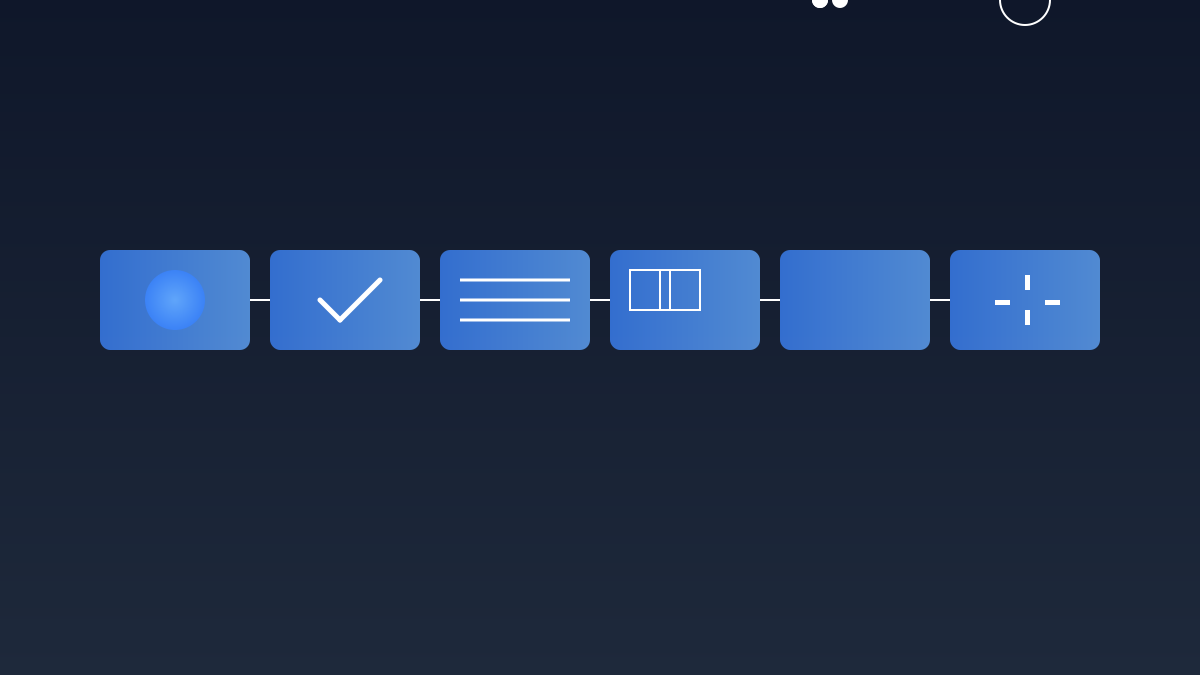
Kaola-Workflow divides the entire development process into six clear stages, each with distinct input, output, and acceptance criteria:

4

Section 04

Stage 1: Research/Discovery

In this stage, the system uses multiple specialized agents working in parallel to comprehensively collect project-related information:

  • Code Explorer Agent (code-explorer): Analyzes the structure of existing codebases, understands project architecture and dependency relationships
  • Documentation Lookup Agent (docs-lookup): Retrieves external documents, API references, and best practices

The core output of this stage is a detailed technical research report, providing factual basis for subsequent decisions.

5

Section 05

Stage 2: Ideation

Based on the information collected in the first stage, the Planning Agent (planner) starts working. This stage uses high-level models (such as Claude Opus) for in-depth thinking, with outputs including:

  • Functional requirement list and priority ranking
  • Technical solution comparison and selection recommendations
  • Risk identification and mitigation strategies

The planning stage emphasizes "think clearly before acting" to avoid subsequent rework.

6

Section 06

Stage 3: Architecture Planning (Plan)

The Architect Agent (code-architect) converts high-level design into executable technical solutions, with outputs including:

  • Module division and interface definition
  • Data flow design diagram
  • Technology stack selection and version locking
  • Development task decomposition and dependency diagram
7

Section 07

Stage 4: Execution & Development (Execute)

This is the most workload-intensive stage. The TDD Guide Agent (tdd-guide) executes according to the Test-Driven Development (TDD) process:

  1. Red Phase: Write failing test cases to clarify functional expectations
  2. Green Phase: Write minimal implementation code to pass the tests
  3. Refactor Phase: Optimize code structure and eliminate technical debt

Each task has an independent TDD cycle to ensure code quality. When build errors occur, a dedicated Build Error Resolver Agent (build-error-resolver) intervenes to handle them.

8

Section 08

Stage 5: Code Review (Review)

The Code Review Agent (code-reviewer) and Security Review Agent (security-reviewer) work in parallel, with inspection contents including:

  • Consistency of code style
  • Compliance with design patterns
  • Potential security vulnerabilities
  • Performance optimization opportunities

The review results are output in the form of a structured report, marking the severity of issues and repair suggestions.
