Zing Forum

Reading

Kairos: An Intelligent LLM Inference Routing System Based on Real-Time Learning

Kairos is an adaptive inference router that uses machine learning to real-time learn optimal routing strategies under different traffic patterns, instead of relying on traditional round-robin or random load balancing, providing intelligent request distribution capabilities for large-scale LLM inference clusters.

LLM负载均衡路由机器学习推理优化自适应系统MLOps
Published 2026-04-01 19:44Recent activity 2026-04-01 19:48Estimated read 6 min
Kairos: An Intelligent LLM Inference Routing System Based on Real-Time Learning
1

Section 01

Introduction to Kairos: An Intelligent LLM Inference Routing System Based on Real-Time Learning

Kairos is an adaptive inference router that uses machine learning to real-time learn optimal routing strategies under different traffic patterns, providing intelligent request distribution capabilities for large-scale LLM inference clusters. It aims to solve problems such as resource waste and service degradation caused by traditional load balancing strategies (e.g., round-robin, random allocation) that ignore model differences. Its core value lies in improving system efficiency, reducing operational costs, and ensuring user experience.


2

Section 02

Background: Challenges of Traditional LLM Inference Routing Solutions

With the popularization of LLMs in enterprise applications, multi-model inference clusters have become the norm. Different models vary in performance, cost, latency, and capabilities, but traditional load balancing strategies (round-robin, random allocation) treat requests homogeneously, leading to resource waste (e.g., expensive flagship models handling simple greetings). Moreover, static strategies cannot adapt to sudden traffic or model failures, which easily cause service degradation.

3

Section 03

Core Design and System Architecture of Kairos

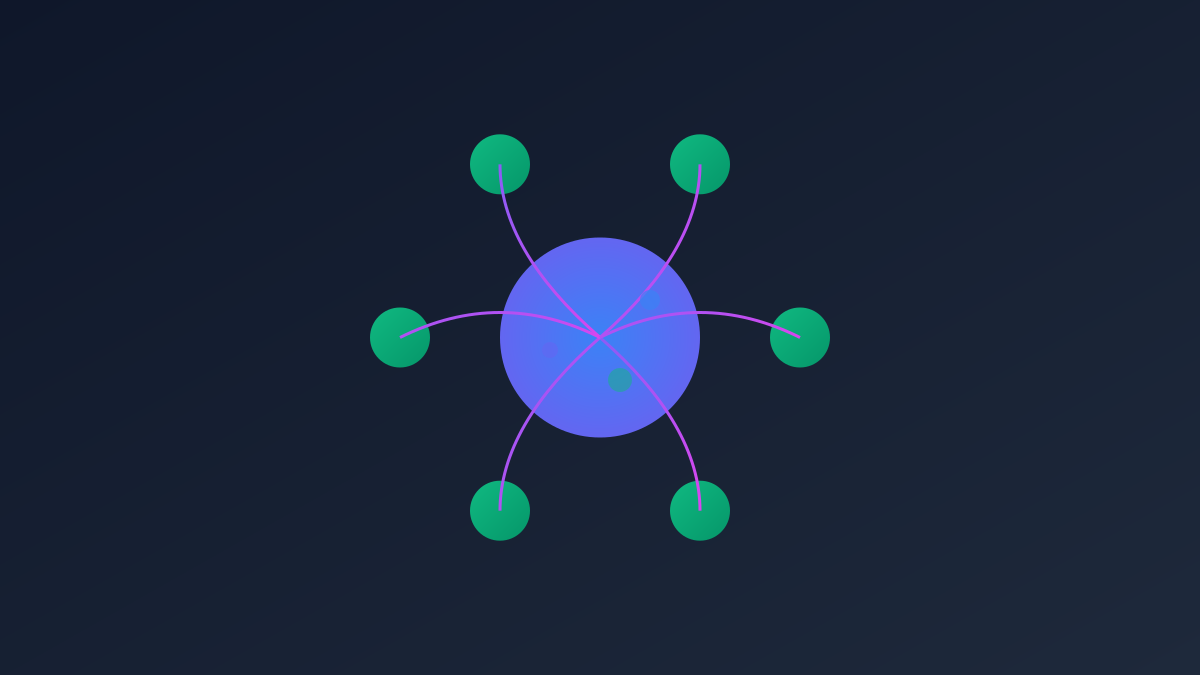
The core design concept of Kairos is to build a 'learning routing plane', drawing on the trial-and-error feedback idea of reinforcement learning, continuously observing traffic patterns, model performance, and task characteristics, and dynamically adjusting routing strategies. Its working mechanism is as follows: 1. Extract request features (complexity, domain type, output length, etc.); 2. Query the learning model to predict the optimal backend engine (considering real-time load and model health status); 3. Route the request and collect feedback (response time, output quality, resource consumption) to update the model, forming a closed-loop optimization.

4

Section 04

Comparative Analysis with Traditional Load Balancing

Traditional load balancing focuses on even distribution and is suitable for web requests with similar computing costs, but LLM inference requests are highly heterogeneous (the resource consumption of complex requests is hundreds of times that of simple requests). The differences of Kairos are: 1. Understand request heterogeneity and intelligently match requests with models; 2. No need to manually define complex rules, self-learning and optimization; 3. Improve user experience (faster response, better quality) and reduce operational costs.

5

Section 05

Practical Application Scenarios and Value

Kairos provides enterprises with multiple values: 1. Cost optimization: Route simple queries to low-cost models (e.g., GPT-3.5 or open-source models); 2. Performance guarantee: Transfer requests to idle instances during traffic peaks; 3. Model experiments: Support A/B testing and collect performance data of new models; 4. Fault tolerance: Automatically switch traffic to healthy nodes without manual intervention.

6

Section 06

Key Technical Implementation Points

The implementation of Kairos involves multiple technical challenges: 1. Feature engineering: Design vectors that effectively represent requests (number of input tokens, prompt complexity, annotations of historically similar requests, etc.); 2. Learning algorithms: Use contextual bandits or policy gradient methods to balance exploration and exploitation; 3. Real-time performance: Routing decisions need to be completed in milliseconds, using lightweight models or precomputation architectures, and feedback collection is done asynchronously.

7

Section 07

Future Outlook and Industry Significance

Kairos represents the evolution direction of LLM infrastructure from static to dynamic intelligence. In the future, it can be extended to more decision scenarios (e.g., RAG activation, CoT selection), where humans only need to set high-level goals, and the system automatically optimizes strategies. Its open-source framework encourages community contributions and accelerates progress in the field. Eventually, adaptive routing will become an essential component for large-scale LLM deployment.

