Zing Forum

Reading

K-9 LLM Router: Intelligent Inference Routing Layer for Balancing Local and Cloud LLM Calls

A task-type-aware LLM inference routing system that automatically routes requests to local Ollama/VLLM or cloud backup services, achieving optimal balance between cost and performance.

LLM路由OllamavLLM混合推理成本优化Swarm API本地部署
Published 2026-04-10 12:07Recent activity 2026-04-10 12:19Estimated read 7 min
K-9 LLM Router: Intelligent Inference Routing Layer for Balancing Local and Cloud LLM Calls
1

Section 01

K-9 LLM Router: Intelligent Inference Routing Layer for Balancing Local and Cloud LLM Calls

K-9 LLM Router is a task-type-aware LLM inference routing system designed to solve the cost-performance balance challenge faced by developers and enterprises in LLM inference. It automatically routes requests to local deployments like Ollama/VLLM or cloud backup services, achieving optimal balance between cost and performance.


2

Section 02

Cost and Performance Dilemma in LLM Inference

With the popularization of large language model applications, developers and enterprises face the challenge of balancing cost and performance:

  • Pure local deployment: Running on own hardware using Ollama or vLLM, with good data privacy and no API fees, but limited by hardware performance;
  • Pure cloud call: Using commercial APIs like OpenAI, which has strong performance but high cost and risks of data cross-border transfer. The ideal solution is to intelligently select the execution location based on task characteristics, which is what K-9 LLM Router is designed for.
3

Section 03

K-9 LLM Router Architecture and Core Features

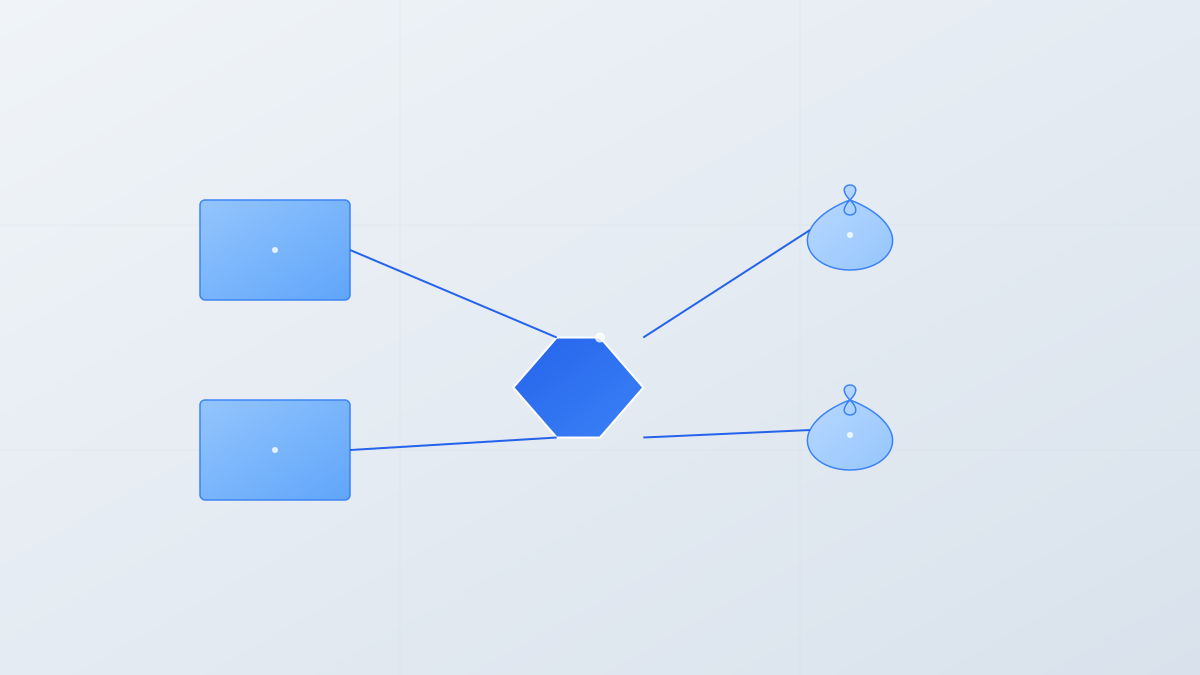
K-9 LLM Router is an inference routing middleware compliant with the Swarm API contract specification, located between the application layer and model providers. Its core features include:

  1. Task type recognition: Analyze requests to determine complexity;
  2. Routing decision: Select the execution end based on task type, load, and cost strategy;
  3. Failover: Automatically switch to the cloud when local services are unavailable;
  4. Load balancing: Distribute requests among multiple local instances. Supported backends:
  • Local deployment: Ollama, vLLM, TGI;
  • Cloud backup: OpenAI, Anthropic, Azure OpenAI and other services compatible with OpenAI API.
4

Section 04

Flexible Routing Strategy Design

K-9 LLM Router supports multiple configurable routing strategies:

Task Type Routing

Task Type Recommended Routing Reason
Simple Q&A Local small model Low cost, fast response
Code generation Local/cloud hybrid Medium complexity, try local first
Complex reasoning Cloud large model Requires strong reasoning ability
Creative writing Cloud model High quality requirements
Embedding generation Local embedding model Batch processing friendly, low cost

Cost Priority Strategy

Prioritize local inference, switch to cloud only when local cannot handle, load is too high, or user specifies cloud.

Quality Priority Strategy

Prioritize cloud large models, use local only when network is unavailable, API is rate-limited, or data is sensitive.

Latency Priority Strategy

Dynamically select based on current response time, automatically adapt to network fluctuations.

5

Section 05

Practical Application Scenarios

Enterprise Knowledge Base Q&A

  • Common questions → handled by local 7B model;
  • Complex technical questions → handled by cloud GPT-4;
  • Expected to save 60-80% of API costs.

Code Assistant

  • Code completion → local CodeLlama;
  • Complex refactoring suggestions → cloud Claude;
  • Maintain response speed while obtaining high-quality suggestions.

Multi-agent System

  • Simple subtasks → local parallel processing;
  • Coordination decisions → cloud centralized processing;
  • Maximize hardware utilization.
6

Section 06

Project Significance and Value

K-9 LLM Router represents the direction of LLM application architecture from single model dependency to intelligent routing hybrid architecture, enabling developers to:

  1. Progressive migration: Start from the cloud and gradually introduce local inference;
  2. Cost control: Significantly reduce API expenses for high-frequency simple requests;
  3. Privacy compliance: Keep sensitive data locally for processing;
  4. High availability: Local and cloud serve as backups for each other. With the improvement of edge model capabilities and maturity of local tools, intelligent routing will become a standard infrastructure for LLM applications.
7

Section 07

Support for Multiple Deployment Modes

K-9 LLM Router supports three deployment modes:

Independent Service

Run as an independent process, receive request routing via HTTP API, suitable for microservice architecture.

Sidecar Mode

Deployed on the same host/container as the application, acting as a local proxy, suitable for edge scenarios.

Library Integration

Integrated directly into the application as a Python/Node.js library, suitable for fine-grained control scenarios.

