Zing Forum

Reading

J.U.M.B.O.: End-Side Multimodal AI Assistant Connecting Large Models with Windows System Automation

J.U.M.B.O. is a fully localized multimodal AI companion that connects large language models (LLMs) with Windows system-level automation via JSON configuration, enabling an intelligent assistant experience with zero privacy risks.

端侧AI多模态Windows自动化隐私保护本地部署LLMAI助手JSON配置
Published 2026-06-02 13:42Recent activity 2026-06-02 13:49Estimated read 6 min
J.U.M.B.O.: End-Side Multimodal AI Assistant Connecting Large Models with Windows System Automation
1

Section 01

J.U.M.B.O. - Local Multimodal AI Assistant Bridging LLM and Windows Automation

J.U.M.B.O. (Json-backed Universal Multimodal Bot with Optimized-latency) is a fully local multimodal AI companion developed by Raghav Maheshwari. It connects large language models (LLM) with Windows system-level automation via JSON configuration, ensuring zero privacy risk as all processing runs locally. Key features include end-side privacy protection, JSON-driven customization, Windows deep integration, and optimized latency.


2

Section 02

Background & Core Design Philosophy

Unlike cloud-based AI assistants, J.U.M.B.O. adopts an end-side-first design to eliminate data leakage risks—all AI processing cycles run locally, no sensitive data uploaded to external servers. Its "Json-backed" feature uses JSON as the carrier for configuration and instructions, enabling high scalability and customization without modifying underlying code.

3

Section 03

Technical Architecture & Core Capabilities

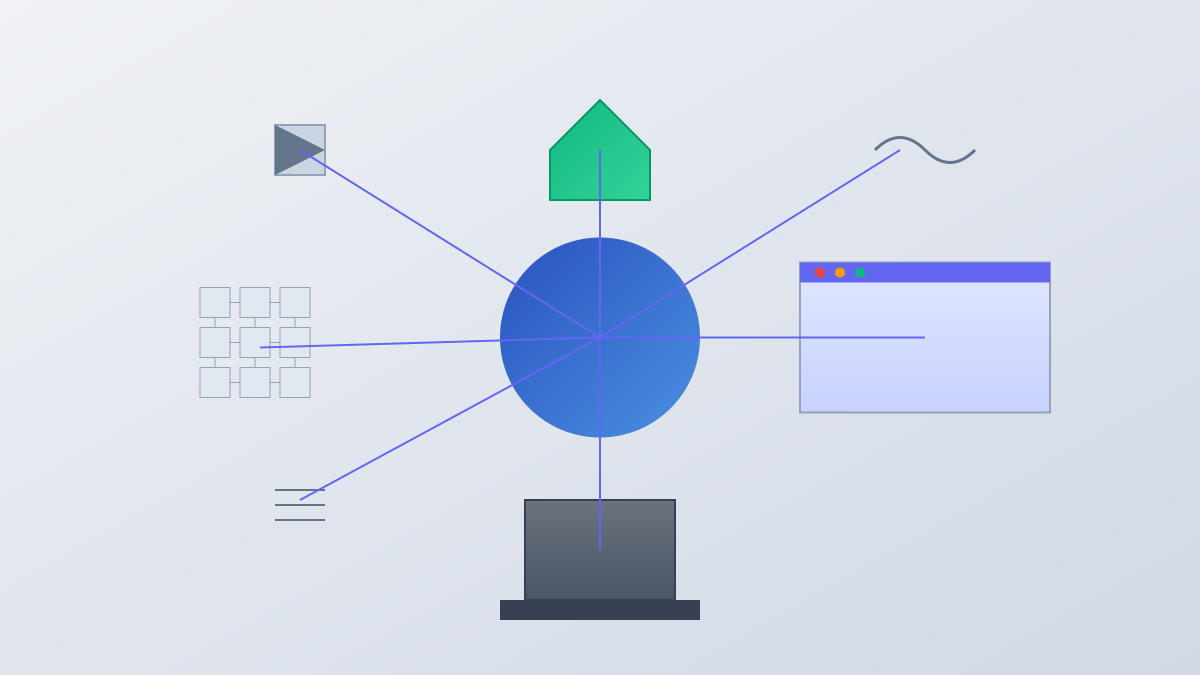
J.U.M.B.O. integrates multi-modal processing (text, voice, potential visual inputs) and deep Windows system automation. It can perform tasks like file management (organize/search files), app control (launch/config apps), system settings adjustment, and workflow automation via system-level API calls. Latency optimization is achieved through local operation and possible model quantization/inference optimization.

4

Section 04

Key Application Scenarios

  • Personal Productivity: Automate repetitive tasks (e.g., organize downloaded PDFs by project).
  • Enterprise Compliance: Ideal for industries like finance/healthcare with strict data privacy requirements (local deployment avoids cloud data risks).
  • Offline Environments: Works in network-unstable/offline settings (industrial, remote offices) without relying on cloud services.
5

Section 05

Technical Implementation Highlights

  • Local Model Inference: Supports open-source LLMs (Llama, Mistral) locally, protecting privacy and reducing long-term costs (no API fees).
  • Modular Tools: New tools can be added via JSON config, with JSON Schema validating tool calls.
  • Context-Aware Interaction: Maintains dialogue context and Windows system state to provide relevant suggestions.
6

Section 06

Comparison with Cloud & Traditional Tools

Feature J.U.M.B.O. Cloud AI Assistants Traditional Automation Tools
Data Privacy Fully local, zero upload Dependent on service providers Local processing
Multimodal Capability Supported Supported Limited
Natural Language Interaction Natively supported Natively supported Usually not
System Integration Deep integration Restricted Deep integration
Offline Availability Fully supported Not supported Supported
Customization High (JSON config) Low Medium
7

Section 07

Future Prospects & Challenges

Potential Directions:

  1. Cross-platform expansion to macOS/Linux (JSON-driven architecture allows this).
  2. Integrate more local models (code generation, image understanding).
  3. Build a community plugin market for shared JSON configs/automation scripts.

Challenges:

  1. Local computing power constraints (high-quality models need strong hardware).
  2. Model update management (users must handle updates locally).
  3. Function boundary definition (avoid system-level misoperations).
8

Section 08

Summary & Future Outlook

J.U.M.B.O. represents the trend of AI moving from cloud to end-side. It balances intelligence and privacy, proving both can coexist. For developers, it's a reference for integrating LLMs with OS; for users, it signals a more private, responsive AI era. With advancing local hardware and open-source models, such end-side AI assistants will have broader development space.

