Zing Forum

Reading

Implementing LLM INT8 Quantization from Scratch: A Practical Guide to Block-wise Quantization and Efficient Inference

This article deeply analyzes a pure PyTorch implementation of an INT8 block-wise quantization scheme, exploring how to achieve efficient LLM inference acceleration without relying on external libraries through block-wise scaling factors and batched matrix multiplication.

LLMquantizationINT8PyTorch模型量化推理优化块级量化大语言模型
Published 2026-05-12 19:15Recent activity 2026-05-12 19:22Estimated read 5 min
Implementing LLM INT8 Quantization from Scratch: A Practical Guide to Block-wise Quantization and Efficient Inference
1

Section 01

Introduction: Core Guide to Implementing LLM INT8 Block-wise Quantization from Scratch

This article will deeply analyze a pure PyTorch implementation of an INT8 block-wise quantization scheme, exploring how to achieve LLM inference acceleration without external libraries through block-wise scaling factors and batched matrix multiplication. The content covers the importance of quantization, block-wise quantization principles, implementation details, performance analysis, and application extension directions.


2

Section 02

Background: Why Model Quantization is Key to LLM Deployment

As LLM parameter sizes expand (from billions to hundreds of billions), the memory footprint of FP32-precision weights (e.g., GPT-3-level models require hundreds of GB of VRAM) becomes a bottleneck for deployment on consumer hardware. Quantization technology converts high-precision floating-point numbers into low-precision integers (such as INT8), significantly reducing memory usage and improving inference speed while maintaining acceptable accuracy. However, simple linear mapping easily leads to accuracy loss due to the non-uniform distribution of weights.

3

Section 03

Advantages and Principles of Block-wise Quantization

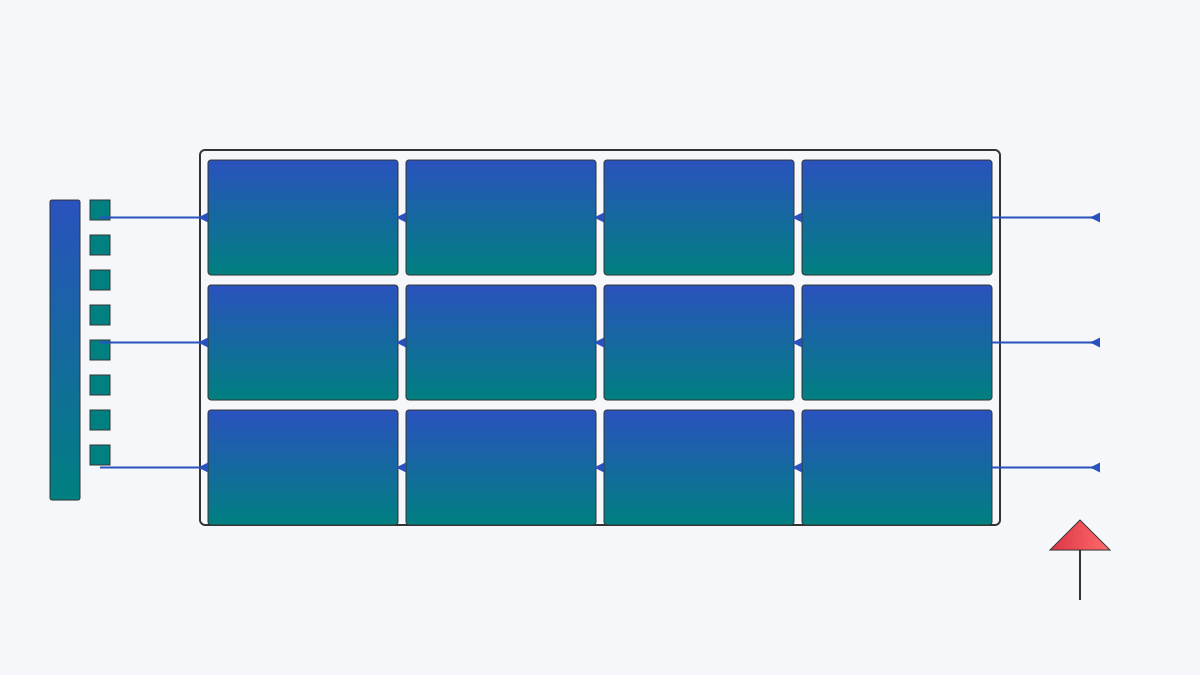
Block-wise quantization divides the weight tensor into small blocks (e.g., 64 elements per block) and calculates an independent scaling factor and zero point for each block. Compared to global scaling, its advantages include: 1. More fine-grained numerical representation; 2. Lower quantization error; 3. Hardware-friendly computation mode (block size can be optimized for SIMD width).

4

Section 04

Core Steps of Pure PyTorch Implementation

This scheme uses only PyTorch native operations with no external library dependencies. Core process: 1. Block division and scaling factor calculation: Divide weights into blocks of 64 elements, compute max/min for each block to get scale=(max-min)/255 and zero_point=round(-min/scale); 2. INT8 encoding: quantized=round(weight/scale)+zero_point; 3. Batched matrix multiplication: Reduce iteration count and improve performance via PyTorch batch operations. During inference, block-wise dequantization, batched matrix multiplication, and fusion operations are used for optimization.

5

Section 05

Performance Analysis: Trade-off Between Memory and Speed

Computational complexity comparison: A naive implementation requires N×K/64 Python loops, while the optimized implementation only needs K/64 iterations. Memory and speed improvements: Compared to FP16, INT8 reduces model size to 50%, increases memory bandwidth by ~2×, and improves computational throughput by 2-4× (depending on hardware support). Modern GPUs (e.g., NVIDIA Ampere) and AI accelerators have hardware optimizations for INT8 operations.

6

Section 06

Application Scenarios and Extension Directions

Applicable scenarios: Edge device deployment, rapid prototype verification, educational research, custom hardware adaptation. Improvement directions: Activation quantization, dynamic quantization, mixed precision (keep sensitive layers in FP16), extension to INT4 quantization.

7

Section 07

Conclusion: Value and Learning Significance of Quantization Technology

This project demonstrates a path to efficient quantization without complex libraries, revealing the core principles of block-wise processing balancing accuracy and efficiency, and batching unlocking hardware parallelism. Mastering quantization technology is an essential skill for AI engineers, as it can reduce deployment costs and enable LLM operation in resource-constrained environments.

