Zing Forum

Reading

Infernet: How the Decentralized GPU Inference Protocol Reshapes AI Computing Infrastructure

This article provides an in-depth analysis of the Infernet protocol—a peer-to-peer distributed GPU inference network—exploring its technical architecture, economic incentive mechanisms, and how it addresses the accessibility and cost issues of AI inference services through decentralized means.

去中心化GPU推理点对点网络AI基础设施区块链分布式计算代币经济
Published 2026-05-01 11:43Recent activity 2026-05-01 11:52Estimated read 7 min
Infernet: How the Decentralized GPU Inference Protocol Reshapes AI Computing Infrastructure
1

Section 01

Introduction: Infernet—How the Decentralized GPU Inference Protocol Reshapes AI Computing Infrastructure

This article provides an in-depth analysis of the Infernet protocol: a peer-to-peer distributed GPU inference network designed to address the accessibility and cost issues of AI inference services through decentralized means. It will explore its technical architecture, economic incentive mechanisms, and potential impact on AI computing infrastructure.


2

Section 02

Background: Centralized Dilemma of AI Inference and the Birth of Infernet

Current AI inference infrastructure is characterized by centralization, where a few tech giants control most high-performance GPU resources. This leads to difficulties in access and high costs for small developers and startups, along with systemic risks such as single points of failure and privacy leaks. Against this backdrop, the Infernet protocol was born, proposing to connect idle GPU resources worldwide via a peer-to-peer network architecture, build a unified inference service market, lower entry barriers, and change resource allocation methods.

3

Section 03

Core Concept: Decentralized Inference Market and Trust Mechanism

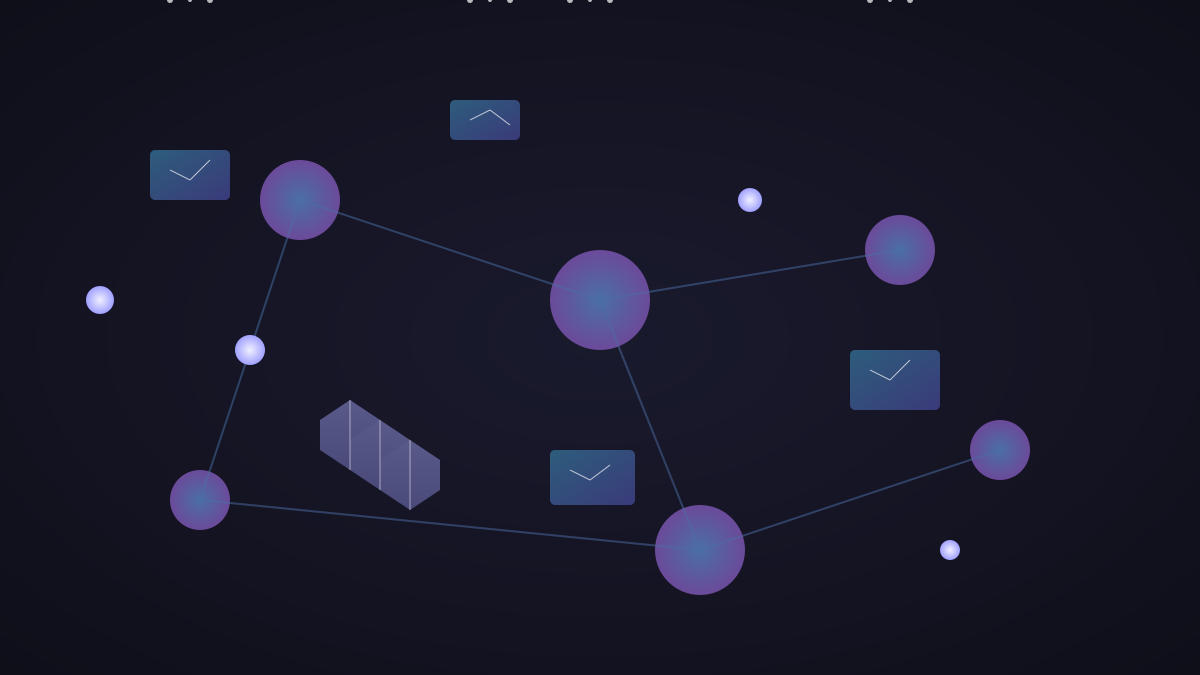
The core vision of Infernet is to establish a decentralized GPU inference market: GPU resource providers (miners) contribute idle computing power, AI application developers (consumers) purchase services, and smart contracts automatically match supply and demand. To address decentralized trust issues, the protocol uses a multi-layer verification mechanism: computation proof ensures tasks are completed on specified hardware; result verification confirms correctness through sampling and redundant computation; a reputation system assigns tasks based on participation history and eliminates malicious nodes.

4

Section 04

Technical Architecture: Layered Design and Key Technical Strategies

Infernet adopts a layered architecture: the consensus layer maintains network state, processes payments, and handles smart contracts based on blockchain; the scheduling layer distributes tasks according to task characteristics and node status; the execution layer is responsible for actual inference computation; the verification layer independently verifies results. Model distribution and caching strategies include preloading popular models, on-demand pulling of less popular models, and layered storage to balance speed and cost. Privacy protection mechanisms cover secure enclaves (e.g., Intel SGX), federated learning integration, and differential privacy.

5

Section 05

Economic Model: Token Incentives and Dynamic Pricing

Infernet introduces a native token as a value carrier and incentive tool: consumers pay for services using tokens (dynamically priced based on computation complexity, etc.); providers need to stake tokens to participate in the network, and malicious behavior will result in token forfeiture; token holders participate in governance. The dynamic pricing mechanism adjusts based on real-time supply and demand: prices decrease when resources are abundant to stimulate consumption, and increase when resources are tight to attract providers; meanwhile, premiums are charged based on service quality (low latency, high availability, etc.).

6

Section 06

Application Scenarios, Technical Challenges, and Solutions

Application scenarios include: lowering the threshold for AI applications (startups pay by usage); edge AI and IoT (local nodes offload tasks to reduce latency and bandwidth); Model-as-a-Service (MaaS, where model developers directly provide services); emergency computing and anti-censorship (decentralization ensures service continuity). Technical challenges and solutions: latency optimization (geographically aware scheduling, predictive preloading, layered inference); quality consistency (standardized containers, performance benchmarks, redundant execution); cold start (subsidizing seed providers, collaborating on initial demand scenarios).

7

Section 07

Competitive Landscape and Future Outlook

Comparison with centralized cloud services: advantages include no fixed data center costs, global low-latency coverage, anti-censorship, and rapid community iteration; disadvantages are difficulty in ensuring service consistency and limited enterprise-level support. Differences from other decentralized projects (e.g., Filecoin, Golem): focus on AI inference scenarios, deep optimization for GPU and inference needs, development of dedicated verification mechanisms, and building an AI developer toolchain. Future outlook: reshaping the AI industry landscape (resource democratization, new business models, regulatory challenges); technical evolution directions (model fragmentation, privacy computing integration, cross-chain interoperability, AI-native optimization).

