Zing Forum

Reading

IM.codes: A Real-Time Communication and Remote Control Platform Built for AI Programming Agents

IM.codes is a dedicated real-time communication tool for AI programming agents, enabling developers to remotely manage long-running agent sessions in terminals via mobile phones or browsers. It supports multiple agents such as Claude Code, Codex, Gemini CLI, and OpenClaw, and provides complete features including terminal access, file browsing, Git views, local host preview, push notifications, and multi-agent collaboration.

AI代理Claude CodeCodexGemini CLIOpenClaw远程开发移动办公多代理协作即时通讯终端工具
Published 2026-04-03 20:45Recent activity 2026-04-03 20:50Estimated read 6 min
IM.codes: A Real-Time Communication and Remote Control Platform Built for AI Programming Agents
1

Section 01

IM.codes: A Real-Time Communication and Remote Control Platform Built for AI Programming Agents

IM.codes is a dedicated real-time communication tool for AI programming agents, allowing developers to remotely manage long-running agent sessions in terminals via mobile phones or browsers. It is compatible with multiple agents such as Claude Code, Codex, Gemini CLI, and OpenClaw, and provides complete features including terminal access, file browsing, Git views, local host preview, push notifications, and multi-agent collaboration, solving the pain point of AI agents being hard to reach in mobile office scenarios.


2

Section 02

Problem Background: The Conflict Between AI Agents and Mobile Office

With the popularity of AI programming agents like Claude Code, Codex, and Gemini CLI, developers rely on them to complete coding tasks. However, these agents often run as terminal sessions on local/remote servers. When leaving the workstation, traditional solutions (SSH, tmux, remote desktop) are either complex to configure and have a fragmented experience, or cause work to stall, making it difficult to access running agent sessions at any time.

3

Section 03

Solution: IM.codes' Positioning and Core Value

IM.codes is a dedicated real-time communication platform designed specifically to solve the above pain points. As the message and control layer for terminal-based AI programming agents, it allows developers to connect to agent sessions via mobile phones/browsers just like WeChat/Slack. It does not replace existing AI tools, but supplements them to solve the problem of 'accessibility of long-running agent sessions'.

4

Section 04

Panoramic View of Core Features

IM.codes provides the following key features:

  1. Terminal Access: Supports original terminal mode and structured chat view, with smooth real-time PTY stream transmission;
  2. File and Git Management: Tree-structured file browsing, upload and download, color-coded Git change marking and preview;
  3. Local Host Preview: Preview local development servers without deployment via WebSocket tunnel, supporting HMR and traffic encryption;
  4. Mobile Experience: iOS app supports biometric authentication, push notifications, and interactive keyboard input;
  5. Multi-agent Collaboration: Supports multi-agent discussion and review, with a circular progress indicator showing the completion status of rounds.
5

Section 05

Multi-agent Workflow and Automation Capabilities

IM.codes supports direct communication between agents (via the imcodes send command), allowing requests for other agents to review code, run tests, etc. It supports target parsing of tags/session names/agent types and a circuit breaker mechanism. In addition, script sessions can build automation: such as automatic repair via log monitoring, Webhook-triggered code review, automatic diagnosis of CI failures, etc.

6

Section 06

Supported Agent Ecosystem and Technical Architecture

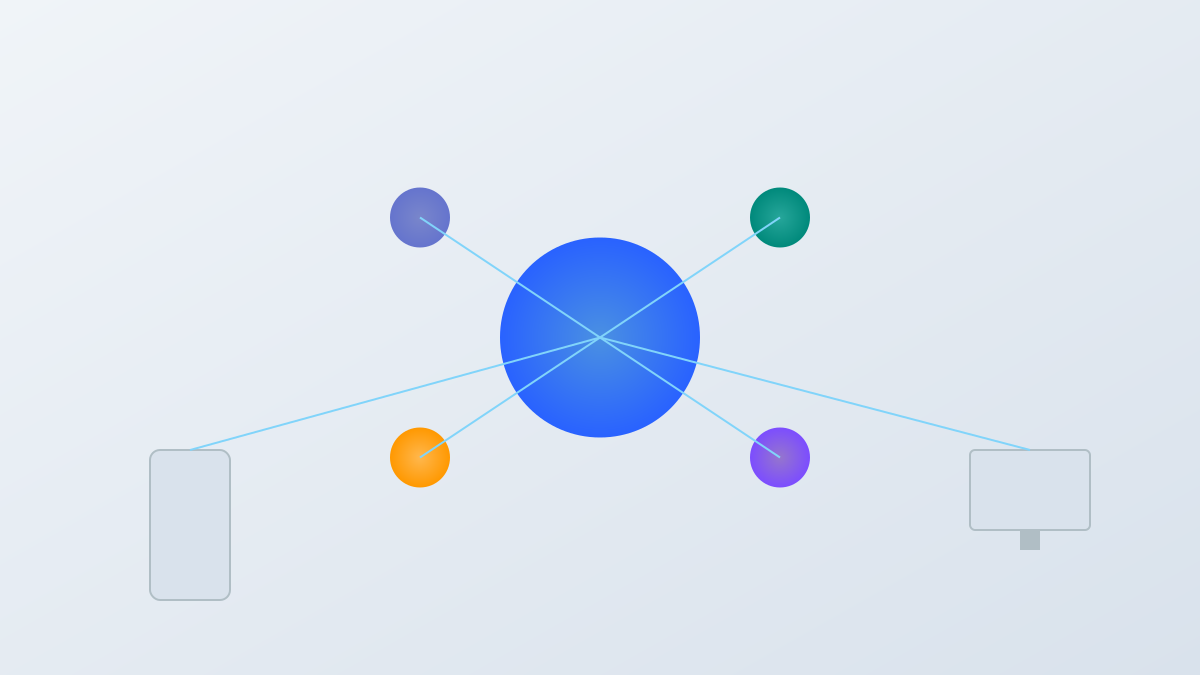
Supported Agents: Claude Code, Codex, Gemini CLI, OpenClaw, Qwen (free quota: 1000 times/day), with native streaming output support for transmission-type agents. Technical Architecture: Client-server model, including a web application (app.im.codes), iOS mobile app, and daemon CLI (installed via npm), connected via WebSocket with end-to-end traffic encryption. Note: This is a personal open-source project with no warranty; use at your own risk, and it was almost entirely built by Claude Code.

7

Section 07

Use Cases and Conclusion

Applicable Scenarios: Remote development, long-term task management, team collaboration, automated workflows, mobile-first development. Conclusion: IM.codes is a connection layer for AI agents, transforming the relationship between developers and AI agents from 'command-execution' to 'dialogue-collaboration', making AI agents team members ready at any time.

