Zing Forum

Reading

HyperLogic-Agent: A Multi-Agent Smart Home Decision Engine Based on Xiaomi MiMo

Leveraging the advanced reasoning capabilities of the Xiaomi MiMo model, we build an Agent system that can automatically decompose, verify, and execute complex daily life instructions, enabling cross-device scenario automation.

智能家居多智能体小米MiMoHyperOS场景自动化思维链Agent系统物联网
Published 2026-05-02 18:41Recent activity 2026-05-02 18:49Estimated read 6 min
HyperLogic-Agent: A Multi-Agent Smart Home Decision Engine Based on Xiaomi MiMo
1

Section 01

[Introduction] HyperLogic-Agent: Xiaomi MiMo-Powered Multi-Agent Smart Home Decision Engine

HyperLogic-Agent is a multi-agent smart home decision engine built on the Xiaomi MiMo model, aiming to address two core challenges users face: ambiguous intent and complex device linkage. Through a closed-loop process consisting of four stages—semantic perception, long-chain reasoning, conflict verification, and execution instruction set—it automatically decomposes and executes complex daily life instructions, enabling cross-device scenario automation and significantly improving configuration efficiency and dynamic adaptability.


2

Section 02

Project Background and Core Pain Points

Smart homes have entered the era of scenario linkage, but configuration complexity is rising: manually setting up complex scenarios takes users 5-10 minutes, and traditional systems lack dynamic sensing capabilities, unable to adjust strategies based on real-time data. Traditional IFTTT logic struggles to handle complex tasks with causal relationships (e.g., "prepare the office environment"). HyperLogic-Agent was developed to address these pain points, serving as a complete decision-making system with multi-agent collaboration capabilities.

3

Section 03

System Architecture and Four-Stage Decision-Making Process

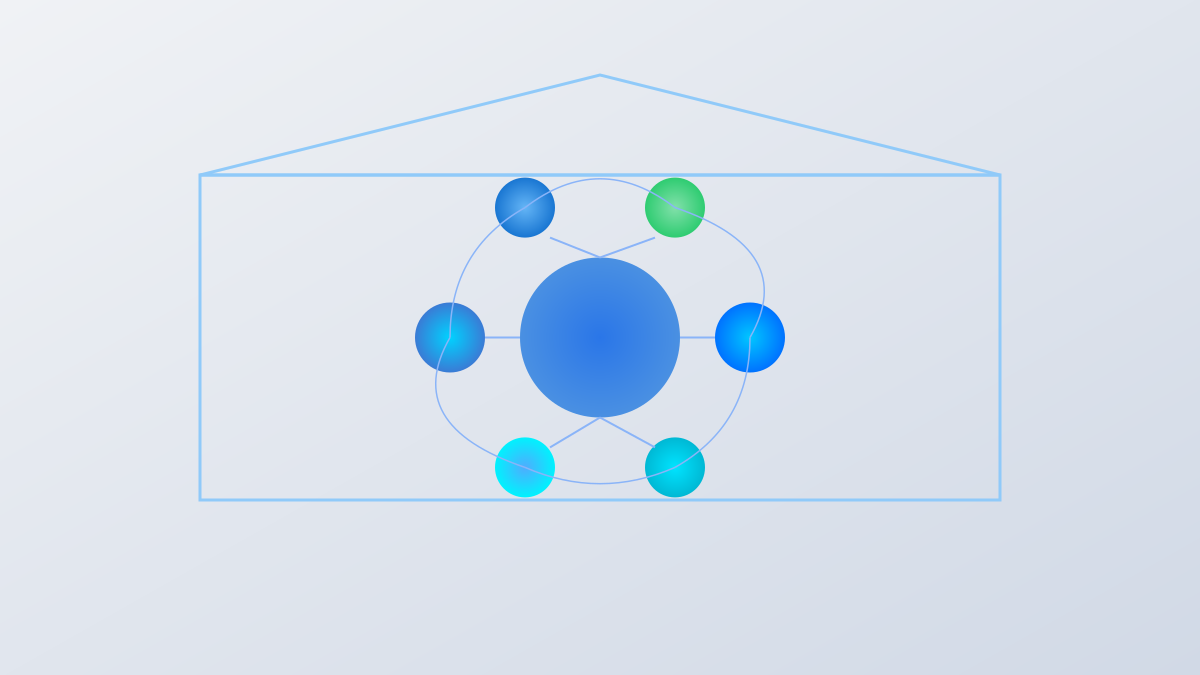
The core logic of HyperLogic-Agent forms a closed loop of perception-reasoning-verification-execution:

  1. Semantic Perception Layer: Extracts key entities (rooms, device types, etc.) from users' ambiguous needs;
  2. Long-Chain Reasoning: Uses chain-of-thought technology to proactively deduce task correlations (e.g., turning off the robot vacuum before watching a movie);
  3. Conflict Verification: Real-time access to hardware status to detect conflicts (e.g., checking if windows are open when cooling is on);
  4. Execution Instruction Set: Outputs HyperOS-standard JSON instruction streams to interface with Xiaomi ecosystem devices.
4

Section 04

Core Capabilities and Innovative Features

HyperLogic-Agent achieves multi-dimensional innovation:

  • Multi-step Task Automation: One-click generation of cross-device linkage schemes without manual configuration;
  • Dynamic Environment Adaptation: Corrects execution logic based on sensor data (temperature, light, etc.) (e.g., canceling constant lighting if the office has sufficient light);
  • Significant Efficiency Improvement: Prototype tests show that the configuration time for complex scenarios is reduced from 5-10 minutes to within 5 seconds, an efficiency increase of over 90%.
5

Section 05

Technical Implementation and Deployment Methods

The project is developed based on Python3.8+ and adopts a modular design for easy expansion. It relies on the Xiaomi MiMo model or GPT-4o API as the logical base, balancing self-developed optimization and compatibility. A typical execution flow: identify office needs → retrieve study room devices → adjust lights based on illumination → pause the robot vacuum → return execution success and instruction list.

6

Section 06

Application Scenarios and Value Outlook

The application scenarios are wide-ranging: ordinary users lower the threshold for using smart homes; developers obtain an extensible multi-agent framework. From an industry perspective, this project promotes the evolution of smart homes from "device connectivity" to "intelligent decision-making", allowing AI Agents to truly understand intent, autonomously plan and execute, and fulfill the "smart" promise of smart homes.

