Zing Forum

Reading

HyperbolicLCM: A New Paradigm for Concept-Level Reasoning Reshaped by Hyperbolic Geometry

Explore how HyperbolicLCM achieves more efficient multi-step reasoning in hierarchical knowledge structures using hyperbolic embeddings, the Poincaré ball model, and Möbius transformations.

双曲几何概念推理庞加莱球莫比乌斯变换层次化知识注意力机制嵌入学习
Published 2026-04-30 21:16Recent activity 2026-04-30 21:21Estimated read 6 min
HyperbolicLCM: A New Paradigm for Concept-Level Reasoning Reshaped by Hyperbolic Geometry
1

Section 01

HyperbolicLCM: Introduction to the New Paradigm of Concept-Level Reasoning Reshaped by Hyperbolic Geometry

The HyperbolicLCM project proposes introducing hyperbolic geometry into concept-level reasoning to address the limitations of traditional Euclidean embeddings in handling hierarchical knowledge. This method leverages hyperbolic embeddings, the Poincaré ball model, Möbius transformations, and tangent space attention mechanisms to achieve efficient representation and multi-step reasoning of hierarchical knowledge, with excellent experimental performance and broad application prospects.


2

Section 02

Traditional Dilemmas of Hierarchical Knowledge Representation

Real-world knowledge often takes tree-like or graph-like hierarchical structures (e.g., biological classification, concept ontologies). However, traditional Euclidean embeddings face the curse of dimensionality: as the depth of the hierarchy increases, the embedding dimension needs to grow exponentially, or it becomes difficult to maintain hierarchical distance relationships under fixed dimensions, leading to challenges in capturing semantic associations between distant concepts and a decline in multi-step reasoning performance.

3

Section 03

Hyperbolic Geometry: A Natural Representation Space for Hierarchical Structures

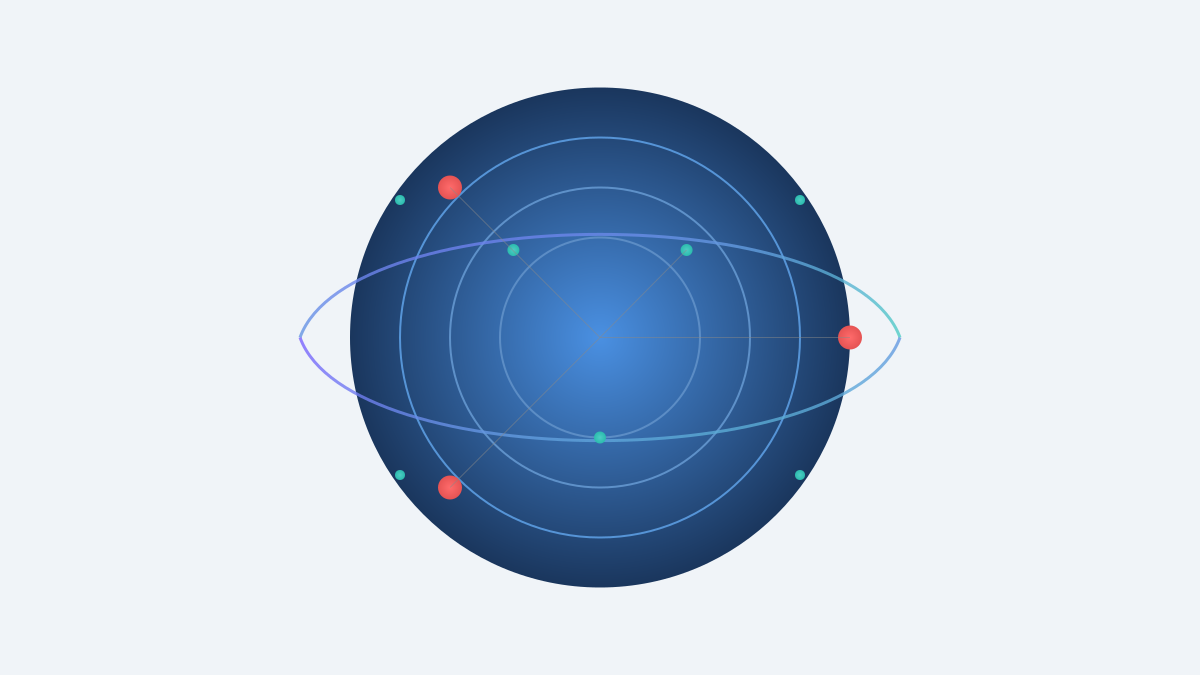
The volume of hyperbolic space grows exponentially with radius, making it naturally suitable for representing hierarchical structures. HyperbolicLCM uses the Poincaré ball model, which maps the infinite hyperbolic space into the interior of a unit ball. The closer to the boundary, the more stretched the space becomes, perfectly matching the characteristics of hierarchical structures where root nodes are sparse and leaf nodes are dense.

4

Section 04

Analysis of HyperbolicLCM's Core Technical Mechanisms

  1. Tangent space attention: Maps points in hyperbolic space to the tangent space (Euclidean space) for attention calculation, then returns to hyperbolic space via exponential/logarithmic mapping, balancing the advantages of hierarchical representation and mature attention mechanisms;
  2. Möbius transformation: As an isometric mapping in hyperbolic space, it preserves hyperbolic distance, ensuring that gradient updates do not destroy hierarchical relationships;
  3. Concept-level reasoning architecture: Input concepts are embedded into the Poincaré ball, processed through multiple layers of hyperbolic attention networks, and output reasoning-enhanced concept representations, which are end-to-end trainable.
5

Section 05

Experimental Validation and Performance Advantages

In benchmark tests such as WordNet hypernym prediction and hierarchical document classification, HyperbolicLCM significantly outperforms Euclidean baselines; in multi-step reasoning tasks (chain reasoning, multi-hop question answering), due to hyperbolic space's better preservation of distant concept associations, the problem of error propagation is effectively mitigated, resulting in stronger reasoning capabilities.

6

Section 06

Application Prospects and Research Significance

Application prospects include: knowledge graph completion (accurate prediction of missing relationships), semantic search (hierarchy-aware similarity calculation), recommendation systems (modeling users' hierarchical interests); it also provides new ideas for neuro-symbolic AI, combining geometric structures with neural computing to promote the development of interpretable and robust AI systems.

7

Section 07

Project Summary and Future Outlook

HyperbolicLCM is an important milestone in concept-level reasoning research. By combining hyperbolic geometry with deep learning, it provides a new perspective on the problem of hierarchical knowledge representation. We look forward to more AI applications based on hyperbolic geometry in the future, helping to build intelligent systems that understand the structure of the world.

