Zing Forum

Reading

Hippo-Pipeline: A New Distributed Large Model Inference Solution for Apple Silicon

The Hippo-Pipeline project enables model-parallel distributed inference by connecting two Mac Minis via Thunderbolt, bringing an efficient large language model (LLM) execution solution to the Apple Silicon ecosystem.

Apple Silicon分布式推理MLX模型并行Thunderbolt边缘计算Mac Mini大语言模型
Published 2026-04-26 09:37Recent activity 2026-04-26 09:51Estimated read 7 min
Hippo-Pipeline: A New Distributed Large Model Inference Solution for Apple Silicon
1

Section 01

[Introduction] Hippo-Pipeline: A New Distributed Large Model Inference Solution for Apple Silicon

Hippo-Pipeline is an open-source distributed large model inference project designed for the Apple Silicon ecosystem. It connects two Mac Minis via Thunderbolt high-speed interconnection technology and implements model parallelism based on Apple's MLX framework. This solves the memory and computing power bottlenecks when running large models on a single Mac device, providing an efficient and cost-friendly large model execution solution for edge computing, personal development, and other scenarios.


2

Section 02

Background: Challenges of Running Large Models on Apple Silicon in Edge Computing

As the parameter scale of large language models (LLMs) expands, efficiently running LLMs on resource-constrained edge devices has become a key challenge. Apple Silicon is favored by developers for its energy efficiency ratio, but a single Mac has limited memory and computing power. When the number of model parameters exceeds the capacity of a single device, traditional single-machine inference solutions are difficult to handle.

3

Section 03

Project Overview: Dual-Mac Collaborative Inference Solution Based on MLX and Thunderbolt

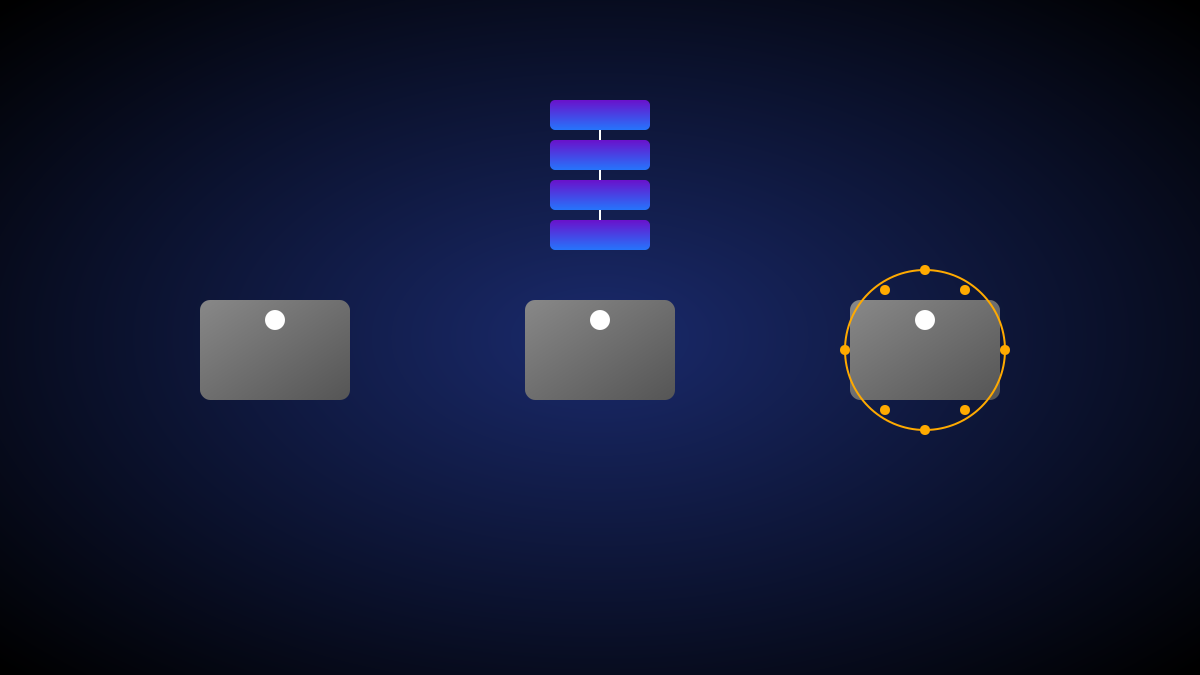
Hippo-Pipeline was developed by lawcontinue and built based on Apple's MLX framework. It connects two Mac Minis via Thunderbolt to form a collaborative computing cluster. The core design is model parallelism: distributing different layers of a large neural network across multiple devices, each responsible for part of the computation, and completing forward inference by transferring intermediate results through high-speed links.

4

Section 04

Technical Architecture: Thunderbolt Interconnection + MLX Optimization + Pipeline Parallelism

Advantages of Thunderbolt Interconnection

  • High bandwidth: Thunderbolt 4 provides 40Gbps bidirectional bandwidth, far exceeding Gigabit Ethernet
  • Low latency: Direct Memory Access (DMA) reduces data copy overhead
  • Plug-and-play: Direct connection via Thunderbolt cable requires no complex configuration

MLX Framework Adaptation

Leverages MLX's features such as unified memory model (CPU/GPU shared memory), automatic differentiation (supports gradient computation), and Python native API (lowers development threshold).

Pipeline Parallelism Strategy

Transformer model layers are evenly distributed across two devices. After the input tokens are computed through the first half of the layers on Device A, the hidden states are transferred to Device B via Thunderbolt to complete the second half. When the batch size is greater than 1, a micro-batch pipeline is used to overlap computation and communication, improving throughput.

5

Section 05

Application Scenarios: Practical Value in Personal, Edge, and Education Fields

Individual Developers and Small Teams

The total cost of two Mac Minis is lower than that of a high-end GPU workstation, yet it provides a larger memory capacity (unified memory up to 64GB+), offering high cost-effectiveness.

Edge Deployment Scenarios

Suitable for data-sensitive industries such as healthcare and finance: low-power 7x24 operation, silent (fanless Mac Mini), and local data processing meets privacy compliance requirements.

Research and Education

Provides an experimental platform for distributed machine learning. The dual-Mac configuration is accessible, allowing students to observe and understand the principles of model parallelism.

6

Section 06

Technical Challenges: Communication Latency, Load Balancing, and Fault Tolerance Issues

  1. Communication Overhead: Cross-device data transmission introduces latency, which may become a bottleneck for models with frequent inter-layer communication (e.g., sampling algorithms);
  2. Load Balancing: Different layers have different computational complexities; uniform splitting may not be optimal, so FLOPs and memory usage of each layer need to be considered;
  3. Fault Tolerance: In the current implementation, disconnection of a single device will interrupt the entire inference process.
7

Section 07

Ecological Significance and Outlook: Distributed Inference Potential of ARM Consumer Devices

Ecological Significance: Marks the further maturity of Apple Silicon in the AI inference field, breaking NVIDIA GPU's exclusive hold on distributed inference, and ARM consumer devices also have this capability.

Future Directions:

  • Expand to more nodes (e.g., 4-Mac cluster)
  • Support more flexible model splitting (e.g., splitting by attention heads)
  • Combine quantization technology to run larger models
  • Explore performance improvements with Thunderbolt 5 (80Gbps)

