Zing Forum

Reading

HeyClaude: A Resource Library of Skills and Configurations for AI Platforms like Claude, Codex, Cursor

HeyClaude is a searchable collection of pre-built AI skills, agents, MCP servers, and configurations, designed to enhance the capabilities of various agent workflow platforms such as Claude, Codex, Cursor, and OpenClaw.

AI技能MCP服务器ClaudeCodexCursorOpenClaw智能体配置开发工具开源资源
Published 2026-05-01 16:43Recent activity 2026-05-01 17:20Estimated read 5 min
HeyClaude: A Resource Library of Skills and Configurations for AI Platforms like Claude, Codex, Cursor
1

Section 01

HeyClaude: Guide to the AI Platform Skills and Configuration Resource Library

HeyClaude is an open-source searchable resource collection that brings together pre-built AI skills, agents, MCP servers, configurations, etc., aiming to enhance the capabilities of AI platforms like Claude, Codex, Cursor, and OpenClaw. It addresses the issues of large configuration differences across platforms and scattered high-quality resources without a unified index. Its core value is to make excellent AI configurations easily accessible and help users quickly find solutions suitable for their scenarios.


2

Section 02

Configuration Dilemmas in the Age of Agents

With the popularization of AI platforms like Claude and Codex, users face the dilemma of high configuration thresholds: different platforms have different configuration systems and extension mechanisms, leading to high learning costs; high-quality configurations are scattered across GitHub, blogs, etc., lacking a unified index, so users need to spend a lot of time searching and filtering.

3

Section 03

Overview of HeyClaude Resource Categories

HeyClaude organizes resources into clear categories:

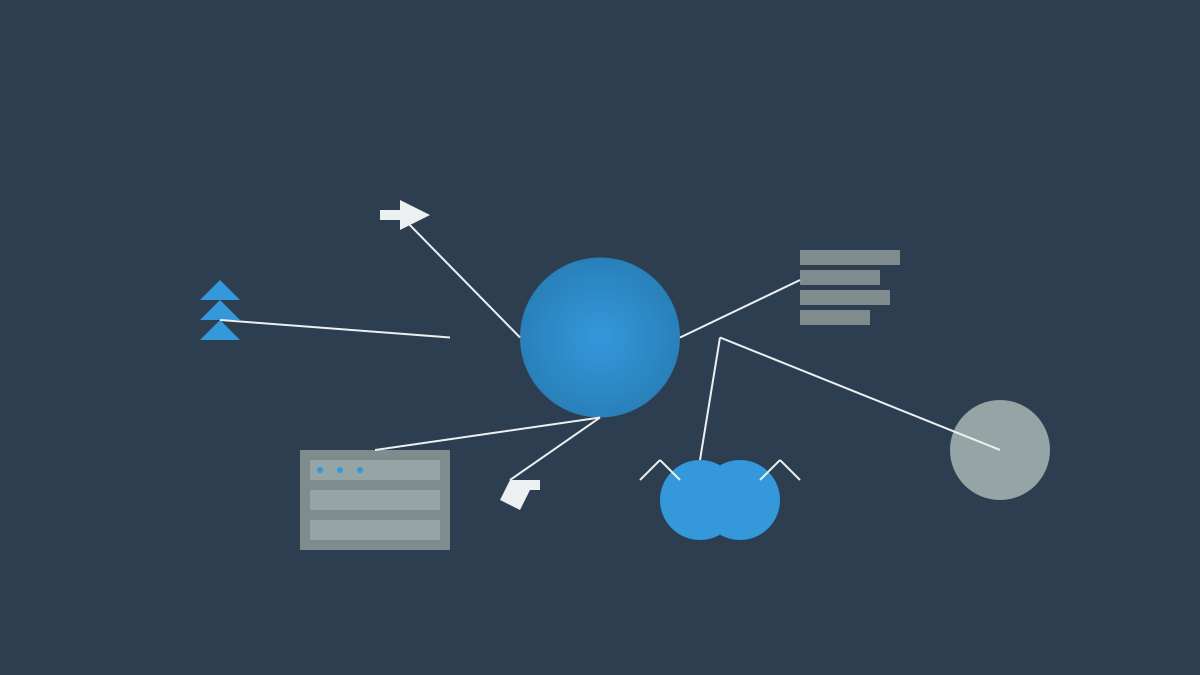
  • AI Skills: Reusable capability units (code review, writing assistance, etc.) with supported platforms labeled;
  • Agent Configurations: Complex autonomous systems (research assistants, project management, etc.);
  • MCP Servers: Standardized interaction between AI and external tools (file systems, development tools, etc.);
  • Configurations & Themes: Aesthetic and efficiency configurations (status bars, themes, shortcuts, etc.).
4

Section 04

Technical Implementation and Community Mechanisms

In terms of technical implementation, HeyClaude has a structured resource index (including metadata, tags, links, etc.) that supports search and filtering; the community contribution process includes submitting new resources, updating information, writing reviews, etc.; it also explores deep integration (one-click installation, version management, compatibility detection, etc.).

5

Section 05

Usage Scenarios and Best Practices

Usage scenarios and best practices:

  • New Users: From basic configuration → core skills → extended agents → custom optimization;
  • Teams: Unified configuration, knowledge precipitation, new employee training, continuous improvement;
  • Advanced Users: Combinatorial innovation, platform migration, performance optimization, open-source contribution.
6

Section 06

Ecological Significance and Future Outlook

HeyClaude reflects the trend of AI tools from single-point tools to composable platforms, building infrastructure for new AI applications, lowering thresholds, and accelerating the spread of best practices. Future directions include AI-native curation, interactive configuration generation, real-time collaborative editing, deep IDE integration, etc.

7

Section 07

Conclusion

In today's era of rapid development of agent technology, HeyClaude is not only a resource directory but also a community knowledge base and a hub for best practices. For users of platforms like Claude and Codex, it is worth bookmarking as a quick starting point to add AI capabilities and optimize workflows.

