Zing Forum

Reading

Helix-Lite: Long Context Inference Optimization Scheme on Dual RTX 3090

Helix-Lite is a long context inference project optimized for consumer-grade hardware. It enables inference of the Qwen2.5-7B-1M model with 128K context on two RTX 3090 GPUs and supports EM-LLM RAG retrieval augmentation for documents exceeding 128K tokens.

长上下文推理RTX 3090模型量化AWQ稀疏注意力RAGKV缓存压缩消费级GPU
Published 2026-05-12 00:43Recent activity 2026-05-12 00:51Estimated read 6 min
Helix-Lite: Long Context Inference Optimization Scheme on Dual RTX 3090
1

Section 01

Introduction: Helix-Lite—Long Context Inference Optimization Scheme on Dual RTX 3090

Helix-Lite is a long context inference project optimized for consumer-grade hardware. It enables inference of the Qwen2.5-7B-1M model with 128K context on two RTX 3090 GPUs and supports EM-LLM RAG retrieval augmentation for documents exceeding 128K tokens. This article will cover its background, technical solutions, performance, application scenarios, and other aspects.

2

Section 02

Background: Hardware Challenges of Long Context Inference

Extending the context length of large language models brings capabilities like whole-book summarization and large codebase understanding, but memory consumption increases with sequence length and inference speed decreases. Even with quantization techniques, consumer-grade hardware like RTX 3090 (24GB memory) still faces memory bottlenecks when running 7B models to process 128K context. The Helix-Lite project explores an efficient solution for dual RTX 3090 GPUs to address this challenge.

3

Section 03

Technical Approach: Multi-Layer Optimization Strategy

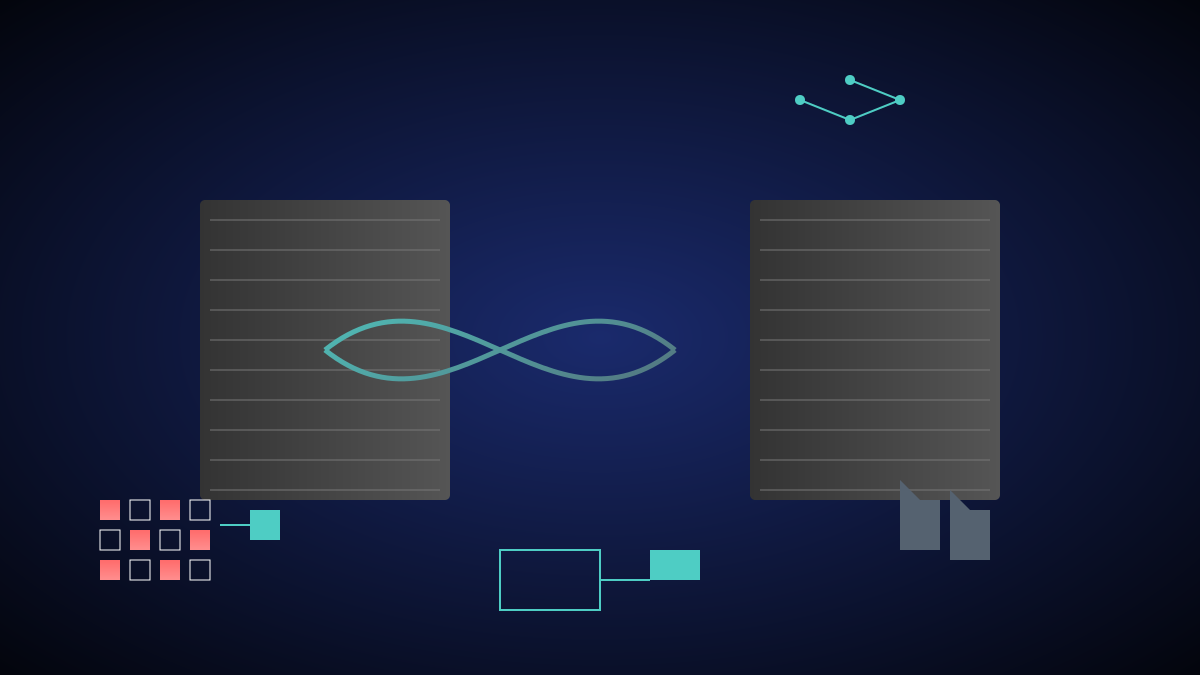
Model Quantization: AWQ INT4

Adopts Activation-Aware Weight Quantization (AWQ) to compress the 7B model weights from FP16 (≈14GB) to INT4 (≈3.5GB), saving memory for KV cache and long context.

KV Cache Compression: nuq4

Compresses KV cache using a non-uniform quantization strategy, allocating more levels to frequent value ranges while preserving key attention information.

Attention Optimization: Quest top-K

Uses query-guided sparse attention, focusing only on the most relevant K historical positions, reducing computational complexity from O(n²) to O(n×K).

Ultra-Long Document Support: EM-LLM RAG

Splits ultra-long documents into chunks and builds a hierarchical index. During inference, it retrieves the most relevant chunks and handles cross-chunk dependencies via an evidence fusion mechanism.

Hot-Cold Data Exchange

Active context is kept in GPU memory, while historical context is swapped to CPU/disk and loaded on demand.

Custom Triton Kernels

Optimizes key operators like nuq4 dequantization, Quest attention, and EM-LLM retrieval to leverage Tensor Core performance.

4

Section 04

Performance Evidence: Performance on Dual RTX 3090

In the 2x RTX 3090 configuration:

  • Model: Qwen2.5-7B-1M @ AWQ INT4
  • Maximum context: 128K tokens
  • Memory usage: ~40-44GB (distributed across two GPUs)
  • Documents exceeding 128K tokens can be processed via EM-LLM RAG mode, at the cost of retrieval and fusion overhead.
5

Section 05

Application Scenarios: Long Text Processing on Consumer-Grade Hardware

Applicable to:

  • Long document Q&A (whole books, legal documents, etc.)
  • Codebase analysis (cross-file dependencies, architecture review)
  • Multi-turn conversation history (maintaining full context)
  • Long video script analysis
  • Scientific literature review (cross-literature comprehensive analysis)
6

Section 06

Limitations and Considerations

  • Quantization loss: INT4 quantization introduces precision loss; precision-sensitive scenarios need verification.
  • Sparse attention limitations: Quest top-K may affect long-distance dependency capture.
  • RAG overhead: EM-LLM mode has higher latency than direct inference.
  • Hardware requirements: Dual RTX 3090 is a high-end configuration; single-card setups need to reduce context length.
7

Section 07

Future Development Directions

  • Support more long-context models (e.g., Llama3.1 405B's 128K version)
  • Optimize single-card performance to lower hardware barriers
  • Integrate technologies like FlashAttention-3 and Ring Attention
  • Support multi-modal long context (images, videos)
8

Section 08

Conclusion: Reference Value of Long Context Inference on Consumer-Grade Hardware

Helix-Lite achieves long-sequence inference capabilities on consumer-grade hardware through a combination of quantization, compression, sparse attention, and RAG optimization. It provides valuable references for local deployment of long-context LLMs and is worth researching and trying by developers.


