Zing Forum

Reading

Hangman Arena: Play Word Guessing Games with Large Models to Measure Real Language Reasoning Ability

A high-performance CLI tool developed in Go that systematically evaluates the language reasoning ability of large language models through classic word guessing games, supporting concurrent battles between multiple models and detailed performance analysis.

大语言模型基准测试Go语言猜词游戏推理能力模型评估并发测试开源工具
Published 2026-05-06 12:10Recent activity 2026-05-06 12:20Estimated read 9 min
Hangman Arena: Play Word Guessing Games with Large Models to Measure Real Language Reasoning Ability
1

Section 01

【Main Floor】Hangman Arena: Evaluate Large Model Language Reasoning Ability via Word Guessing Games

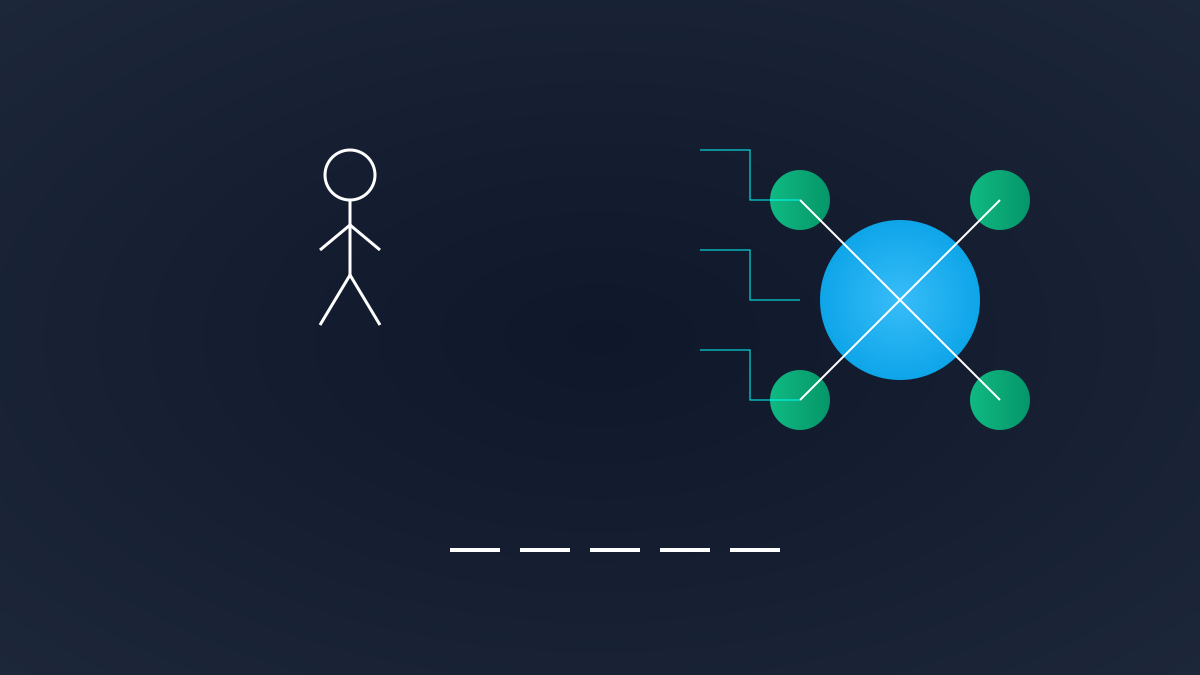
Hangman Arena is a high-performance CLI tool developed in Go. It systematically evaluates the language reasoning ability of large language models through classic word guessing games, supporting concurrent battles between multiple models and detailed performance analysis. This project aims to address the problem that traditional benchmark tests struggle to intuitively reflect the performance of models in real language reasoning scenarios, providing intuitive and quantifiable test results in a concise manner.


2

Section 02

Project Background: Why Can Word Guessing Games Measure Large Model Reasoning Ability?

Project Background: Why Use Word Guessing Games to Test Large Models

Evaluating the capabilities of large language models (LLMs) is a core issue in the AI field. Traditional benchmarks like MMLU and HumanEval have wide coverage but struggle to intuitively reflect performance in real language reasoning scenarios. Hangman Arena chooses word guessing games as the test carrier because, despite their simple rules, they simulate human reasoning processes under incomplete information. Models need multiple abilities such as vocabulary knowledge, probabilistic reasoning, pattern recognition, and strategic planning—this is a direct test of a model's ability to "think like a human."

3

Section 03

Technical Architecture: High-Performance Testing System Built with Go

Technical Architecture: High-Performance Testing Platform Built with Go

Hangman Arena is developed in Go, using its Goroutine concurrency model to implement parallel battles between multiple models. Its efficient memory management ensures stability in large-scale tests. The core architecture modules include:

Game Engine: Responsible for word selection, guess verification, state management, and outcome determination. It supports custom word libraries to flexibly configure test difficulty and domains; Model Adaptation Layer: Encapsulates mainstream large models (OpenAI GPT, Anthropic Claude, Google Gemini, etc.) and local open-source models (Llama, Qwen, etc.) with a unified interface, handling API call details; Concurrency Scheduler: Efficiently distributes tasks via Go's channel and select mechanisms, supporting simultaneous operation of dozens of game instances and result aggregation; Analysis Module: Collects game data (number of guesses, thinking time, error rate, etc.) and generates visual reports to help understand model behavior patterns.

4

Section 04

Testing Dimensions: Multi-Angle Evaluation of Model Reasoning Ability

Testing Dimensions: Understanding Model Reasoning Ability Through Word Guessing

Hangman Arena designs detailed testing dimensions:

Vocabulary Breadth: Tests the mastery of words of different lengths, difficulty levels, and domains. Short words test high-frequency vocabulary, while long words challenge technical terms and rare words; Reasoning Strategy: Observes how models adjust strategies based on feedback (e.g., prioritizing high-frequency letters, inferring word patterns), reflecting metacognitive levels; Error Recovery: The ability of models to quickly correct strategies after wrong guesses, reflecting self-correction ability; Efficiency Indicator: Average number of guesses at the same accuracy rate, measuring information acquisition efficiency.

5

Section 05

Practical Cases: Performance Comparison of Mainstream Models in Word Guessing Games

Practical Cases: Performance Differences Between Different Models

Actual tests reveal interesting phenomena:

  • GPT-4: Balanced vocabulary breadth and reasoning strategy, showing strong pattern association ability when facing rare words (e.g., "XENOPHOBIA");
  • Claude series: Outstanding error recovery—after consecutive wrong guesses, it actively adjusts strategies through root and affix analysis, leading to higher success rates on difficult words;
  • Open-source models (Llama3, Qwen2.5): Good performance on basic vocabulary, but gaps exist in technical terms and long words. Targeted fine-tuning can significantly improve their performance.
6

Section 06

Application Scenarios: Practical Value and Implementation Directions of Word Guessing Tests

Application Scenarios: From Game to Practical Implementation

The methodology of Hangman Arena extends to multiple scenarios:

Model Selection: Enterprises can quickly compare the reasoning abilities of candidate models through standardized tests to assist procurement decisions; Capability Diagnosis: Identify the root causes of poor model performance in tasks (insufficient vocabulary, weak reasoning, or improper strategy); Training Monitoring: Regularly test and monitor progress during fine-tuning to detect overfitting or degradation; Educational Research: Provide scholars with a controllable and repeatable experimental environment to support cognitive ability research.

7

Section 07

Summary and Outlook: Future Significance of Specialized Evaluation Tools

Summary and Outlook

Hangman Arena balances the standardization and practicality of large model evaluation in a concise way, focusing on core language reasoning abilities and providing intuitive and quantifiable results. For developers, it is a plug-and-play tool; for researchers, it is a platform to explore model cognitive mechanisms; for enthusiasts, it is a window to observe how models "think." As large model technology develops, such specialized evaluation tools will become more important—helping to understand the boundaries of model capabilities and promoting the safe and effective application of AI.