Zing Forum

Reading

GSD-Forge: A Multi-Agent AI Workflow Orchestrator in VS Code

GSD-Forge is a VS Code extension that transforms the editor into a self-organizing AI development cluster, supporting multi-agent parallel collaboration, streaming chat, and automated workflows, allowing developers to complete complex development tasks without leaving the editor.

VS Code扩展AI编程助手多智能体工作流自动化流式聊天OpenAIClaude开发工具
Published 2026-06-13 07:15Recent activity 2026-06-13 07:23Estimated read 7 min
GSD-Forge: A Multi-Agent AI Workflow Orchestrator in VS Code
1

Section 01

GSD-Forge: VS Code's Multi-Agent AI Workflow Orchestrator (Main Guide)

GSD-Forge (also known as Rokket-Orchestra) is a VS Code extension that transforms the editor into a self-organizing AI development cluster. It supports multi-agent parallel collaboration, streaming chat, and automated workflows, allowing developers to complete complex tasks without leaving the editor. Maintained by jayasuriyaa-bit, the project is hosted on GitHub (https://github.com/jayasuriyaa-bit/Rokket-Orchestra) and was released on June 12, 2026. Its core goal is to break the single-threaded limitation of most AI coding tools and enable parallel, collaborative AI-assisted development.


2

Section 02

Background: Limitations of Single-Threaded AI Coding Tools

Most current AI coding tools are limited to single-threaded code completion—you write code, and the AI suggests additions. However, real software development involves multiple parallel tasks: refactoring backend code, writing frontend components, validating database schemas, and getting real-time advice. GSD-Forge addresses this gap by providing a multi-agent system where specialized AI agents work in parallel, each with independent memory, tool sets, and API connections (OpenAI or Claude).

3

Section 03

Key Features of GSD-Forge

GSD-Forge offers several key features:

  • Parallel Work Architecture: Supports up to 10 independent AI agents running in parallel without blocking the main workflow.
  • Streaming Chat & Real-Time Reasoning: Exposes the AI's thinking process (intermediate steps, tool calls) via a streaming interface, making it transparent.
  • GSD Protocol Support: Native integration with GSD-2/GSD-PI models for token-efficient, code-optimized completions.
  • Smart Context Injection: Automatically shares current file, selection, and workspace structure with agents, no manual prompts needed.
  • Workflow Automation: Definable reusable pipelines (e.g., lint → test → document → deploy) executed by agents in sequence or parallel.
  • Multi-Language Support: Works with 15+ languages including Python, JavaScript, TypeScript, Rust, Go, Java, and C++.
  • API-Agnostic Backend: Supports OpenAI GPT-4, Claude Opus, or local models via GSD-PI, configurable per project or agent.
4

Section 04

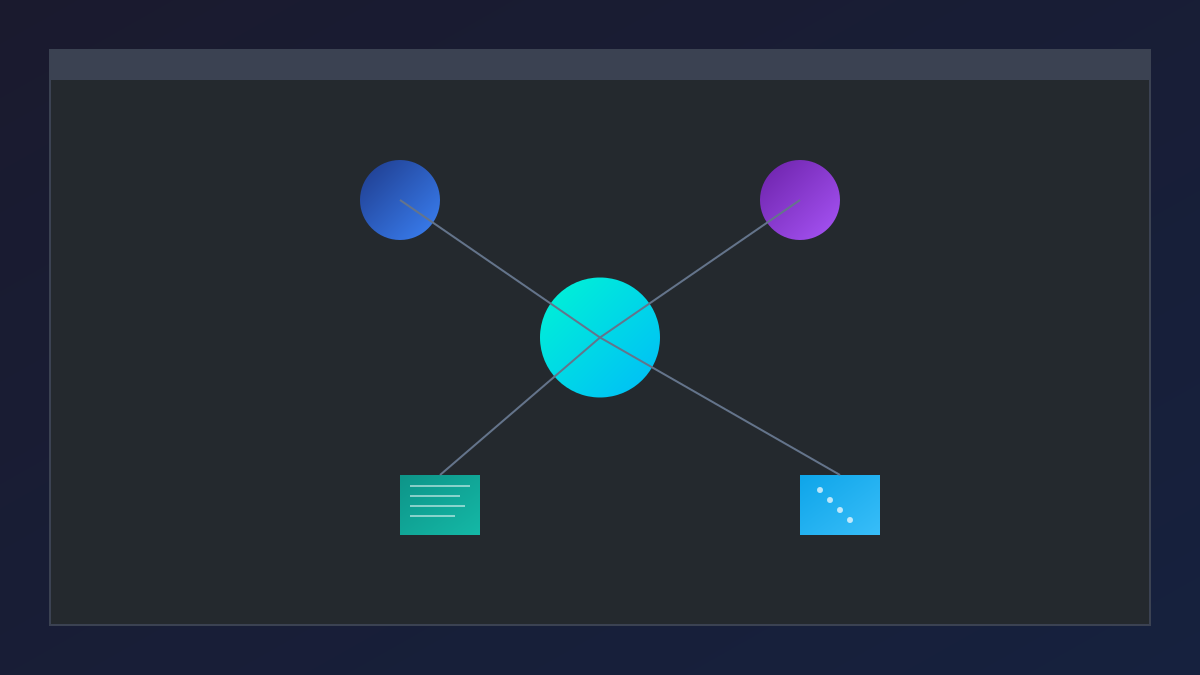
Architecture & Agent Collaboration Flow

The architecture of GSD-Forge involves:

  1. VS Code Extension UI → Orchestrator Engine
  2. Orchestrator splits into Work Pool Manager (manages agents) and Chat Stream Manager (handles streaming)
  3. Work Pool Manager controls multiple agents (Agent1 to AgentN)
  4. Agents connect to OpenAI/Claude APIs
  5. Response Aggregator merges agent outputs
  6. Chat Stream Manager sends results to the editor panel

Example: When you input 'refactor this module and write unit tests', the orchestrator creates two agents—one to analyze the module and another to generate tests. Their outputs are merged into a single streaming chat in the editor.

5

Section 05

Configuration & CLI Integration

Agent Configuration: Create gsd-forge.json in .vscode to define agents (e.g., Senior Python Backend Engineer, React Component Designer) with model, tools, and system prompts.

CLI Usage: Use terminal commands for CI/CD or batch tasks:

  • gsd run: Execute tasks with specific agents (e.g., "Senior Python Backend Engineer")
  • gsd chat: Start interactive sessions

OS Compatibility: Supported on Windows10+ (x64/ARM64), macOS13+ (Intel/Apple Silicon), Ubuntu22.04+ (x64/ARM64), Fedora38+ (x64), Debian12+ (x64/ARM64), Arch Linux (x64), and Alpine Linux3.18+ (limited testing). It works in WSL2, Docker containers, and remote SSH sessions.

6

Section 06

API Integration & Cost Optimization

API Support:

  • OpenAI: GPT-4 Turbo, GPT-4, GPT-3.5 Turbo (supports function calls, streaming, vision)
  • Claude: Opus, Sonnet, Haiku (extended thinking mode, auto JSON tool use)
  • Hybrid Mode: Assign different backends to agents (e.g., Claude for design, GPT-4 for refactoring)

Cost Optimization: Enable gsd.compression.enabled to reduce token costs by up to 40% without losing quality (2026 tip).

7

Section 07

Impact on Development Workflow & Conclusion

GSD-Forge shifts the AI-assisted development paradigm:

  1. From code completion to multi-agent collaboration
  2. From passive tool to active team member
  3. From single-threaded to parallel task execution
  4. From black-box AI to transparent reasoning

For developers (data scientists, DevOps, indie devs), this means moving from writing code to commanding an AI team. AI becomes a collaborative partner rather than just a tool, enabling more efficient complex development tasks.

