Zing Forum

Reading

GroundCortex: Local Continuous LoRA Fine-Tuning Service with File Monitoring and Hot Update

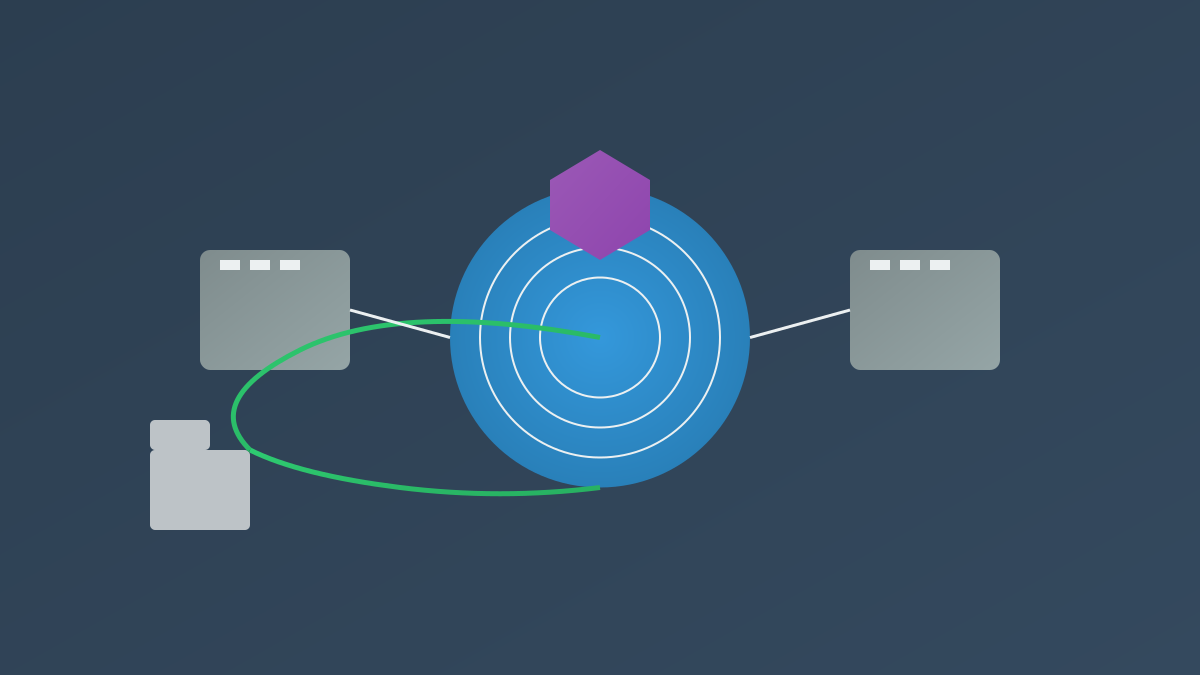
GroundCortex is an innovative local LoRA fine-tuning service framework that supports automatic retraining by monitoring source file changes, hot-swapping adapters to OpenAI-compatible inference endpoints, and pipeline control via the MCP protocol.

LoRA微调大语言模型本地部署OpenAIMCP持续训练热更新
Published 2026-05-25 07:42Recent activity 2026-05-25 07:49Estimated read 6 min
GroundCortex: Local Continuous LoRA Fine-Tuning Service with File Monitoring and Hot Update
1

Section 01

GroundCortex: Local Continuous LoRA Fine-Tuning Service with Hot Update

GroundCortex is an open-source local LoRA (Low-Rank Adaptation) fine-tuning service framework developed by huss-mo, hosted on GitHub. It addresses key pain points in LLM fine-tuning workflows by integrating file change monitoring, automatic retraining, hot-swappable adapters for OpenAI-compatible inference endpoints, and pipeline control via the MCP (Model Context Protocol). Its core goal is to enable near-real-time model iteration like code hot-reloading.


2

Section 02

Background: Limitations of Traditional LLM Fine-Tuning Workflows

Traditional LLM fine-tuning involves discrete steps: data preparation, training initiation, waiting for completion, model export, and service replacement. This batch processing workflow significantly slows down development cycles. GroundCortex aims to transform this into a continuous integration experience, allowing models to update automatically as data or configurations change.

3

Section 03

Core Mechanisms & Technical Implementation

File Monitoring & Change Detection

GroundCortex monitors file system changes (data files, configs, code) to trigger automatic retraining (incremental or full) — similar to front-end hot module replacement (HMR).

Continuous LoRA Fine-Tuning

Uses LoRA to inject low-rank matrices into original model weights, reducing resource needs. Training is integrated into the development process, not offline batch tasks.

Hot Swap & OpenAI-Compatible Endpoints

New adapters are loaded without service interruption (zero downtime). The OpenAI-compatible API works with existing SDKs (e.g., OpenAI, LangChain) and tools like LlamaIndex.

MCP Protocol Support

Enables pipeline control: receiving external training commands, exposing model status, and integrating with other AI tools.

4

Section 04

Engineering Architecture & Deployment Options

  • Containerization: Supports Docker (via Dockerfile) for easy deployment across environments and Kubernetes integration.
  • CI/CD Workflows: Includes GitHub Actions configurations for automated testing, image building, and releases.
  • Examples & Documentation: Provides usage examples (examples directory) and detailed docs (DOCS.md) for installation, configuration, and advanced use cases.
5

Section 05

Application Scenarios & Practical Value

  • Rapid Prototyping: Frequent model iterations with instant feedback on data changes.
  • Domain Customization: Local vertical model building for enterprises, evolving with business data without relying on cloud services.
  • Privacy-Sensitive Use Cases: Local training/inference avoids data leakage risks.
  • Edge Deployment: Lightweight LoRA adapters and hot swap suit resource-constrained edge devices.
6

Section 06

Technical Highlights & Innovations

GroundCortex innovates by combining mature technologies in novel ways:

  1. Applying front-end HMR concepts (file monitoring) to ML training.
  2. Making LoRA fine-tuning accessible on consumer hardware via local deployment.
  3. Balancing hot swap functionality with OpenAI ecosystem compatibility.
  4. Adopting MCP protocol for future-proof toolchain integration.

These are not just feature堆砌 but are organically integrated around continuous iteration.

7

Section 07

Community & Open Source Ecosystem

GroundCortex is open-source on GitHub with clear project structure. It includes:

  • Tests Directory: For quality assurance.
  • Sig Directory: Type signatures for better code reliability.

It serves as a reference implementation for developers interested in LoRA fine-tuning, local model services, or continuous integration workflows for LLMs.

8

Section 08

Conclusion & Future Outlook

GroundCortex represents a shift from batch to continuous LLM training, enhancing development efficiency and enabling deeper model-business integration. As LLM tech becomes widespread, more MLOps tools will adopt software engineering best practices (CI/CD, hot reload) to bridge traditional software development and AI application development gaps.

