Zing Forum

Reading

Groove: Architecture and Practice of a Decentralized Large Model Inference Network

Groove is an open-source decentralized LLM inference network that allows users to aggregate computing resources from multiple machines into a distributed inference cluster. This article provides an in-depth analysis of its architectural design, communication protocols, and deployment practices.

去中心化推理分布式LLM模型并行边缘计算开源项目AI基础设施
Published 2026-04-21 05:44Recent activity 2026-04-21 05:48Estimated read 5 min
Groove: Architecture and Practice of a Decentralized Large Model Inference Network
1

Section 01

Groove: Decentralized LLM Inference Network Overview

Groove is an open-source decentralized LLM inference network that aggregates computing resources from multiple machines into a distributed cluster. This post will break down its architecture, communication protocols, deployment practices, and application prospects.


2

Section 02

Project Background & Motivation

With the growing scale of large language models (LLMs), single-machine inference faces dual bottlenecks of memory and computing power. Groove proposes an innovative solution: using a decentralized network to aggregate resources from multiple machines for distributed model inference. This reduces reliance on high-performance hardware and opens new possibilities for edge computing scenarios.

3

Section 03

Core Architecture Design

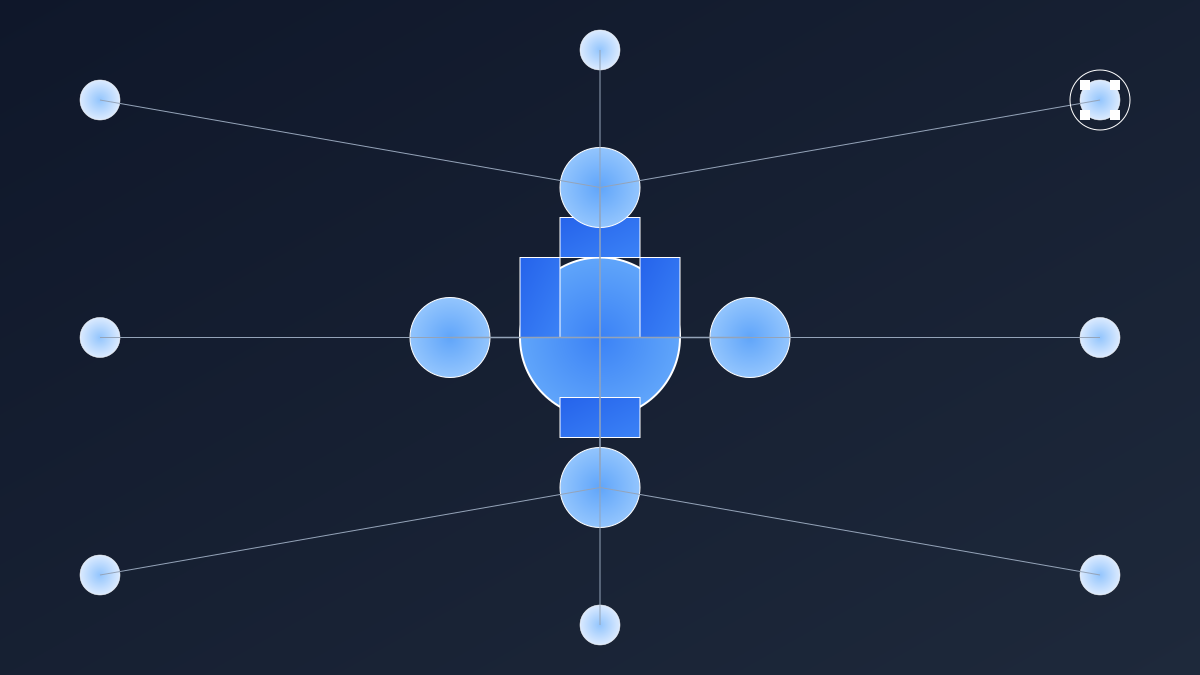
Groove uses a three-layer architecture:

  1. Relay Layer: Coordination center for routing and task distribution, bound to port 0.0.0.0:8770, with centralized coordination and distributed execution (only relay exposes ports).
  2. Compute Node Layer: Work units executing inference, loading partial model layers (via --layers parameter, e.g., 0-11 for Qwen2.5-0.5B), supporting CPU, CUDA, MPS backends.
  3. Consumer Layer: Client initiating inference requests, abstracting model distribution details for scalability.
4

Section 04

Communication Protocol & Data Transfer

Groove implements custom Wire Protocol v2 (msgpack serialization, envelope routing) addressing distributed challenges:

  • Tensor transfer optimization for model weights/activations.
  • KV cache management for multi-turn dialogues.
  • Optional speculative decoding for acceleration. All traffic routes via relay (no direct node communication), simplifying security (only protect relay port; nodes can be behind NAT/firewall).
5

Section 05

Deployment & Usage Flow

Deployment steps:

  1. Env prep: bash setup.sh to install virtual env and dependencies.
  2. Start relay: Activate env and run relay service.
  3. Start compute nodes: Launch nodes with specified layers and relay address.
  4. Initiate inference: Use consumer client to send requests. Auxiliary functions: --status (health check), --test (test suite), --smoke (light model test), --info MODEL (model info & layer split recommendations).
6

Section 06

Technical Highlights & Innovation

Key technical choices:

  • Model parallelism: Unlike data parallel training, Groove uses model parallelism for inference (distribute different layers to nodes, suitable for sequential forward propagation).
  • Zero-config network: Compute nodes only make outbound connections (no port forwarding/firewall complexity).
  • Cross-platform support: Works on Linux, macOS, Windows; supports CPU, CUDA, MPS backends.
7

Section 07

Application Scenarios & Prospects

Groove is ideal for:

  • Edge computing clusters (aggregate edge devices into inference pools).
  • Heterogeneous hardware utilization (mix GPU servers and CPU workstations).
  • Privacy-sensitive scenarios (local data processing, no cloud upload).
  • Model-as-service (build decentralized inference markets).
8

Section 08

Conclusion

Groove provides a lightweight, easy-to-deploy solution for distributed LLM inference. Though in early stages, its clear architecture and practical engineering choices are noteworthy. It's a valuable reference implementation for developers/researchers exploring decentralized AI infrastructure.

