Zing Forum

Reading

Enterprise Content Operations System: A Practical Guide to Multi-Agent Workflows Based on Google ADK 2.0

An enterprise-level content operations system that demonstrates all core features of Google ADK 2.0, building a complete multi-agent workflow deployable to Vertex AI Agent Engine through modes like SequentialAgent, ParallelAgent, LoopAgent, and Skills.

Google ADK多智能体系统Multi-Agent内容运营SequentialAgentParallelAgentLoopAgentVertex AILLM人工智能
Published 2026-06-02 15:16Recent activity 2026-06-02 15:21Estimated read 5 min
Enterprise Content Operations System: A Practical Guide to Multi-Agent Workflows Based on Google ADK 2.0
1

Section 01

Enterprise Content Operations System: Introduction to Multi-Agent Workflow Practice Based on Google ADK 2.0

The Enterprise Content Ops project introduced in this article is an enterprise-level content operations system built on Google ADK 2.0. It demonstrates all core features of ADK 2.0 (modes like SequentialAgent, ParallelAgent, LoopAgent, and Skills), and constructs a complete multi-agent workflow that can be deployed to Vertex AI Agent Engine. It aims to solve problems such as time-consuming processes and inconsistent quality in traditional content operations, and improve efficiency and output quality through multi-agent collaboration.


2

Section 02

Background: Why Do We Need Multi-Agent Workflows?

Traditional content operations processes (topic research, draft writing, multi-format adaptation, etc.) are time-consuming and labor-intensive, making it difficult to ensure consistency and quality. A single AI assistant cannot handle complex enterprise needs (coordinating multiple roles, parallel tasks, iterative optimization, etc.). Multi-agent systems provide a more powerful and flexible content operations engine by breaking down complex tasks into collaborative processes among specialized agents.

3

Section 03

Methodology: Architecture Design and Core Workflow

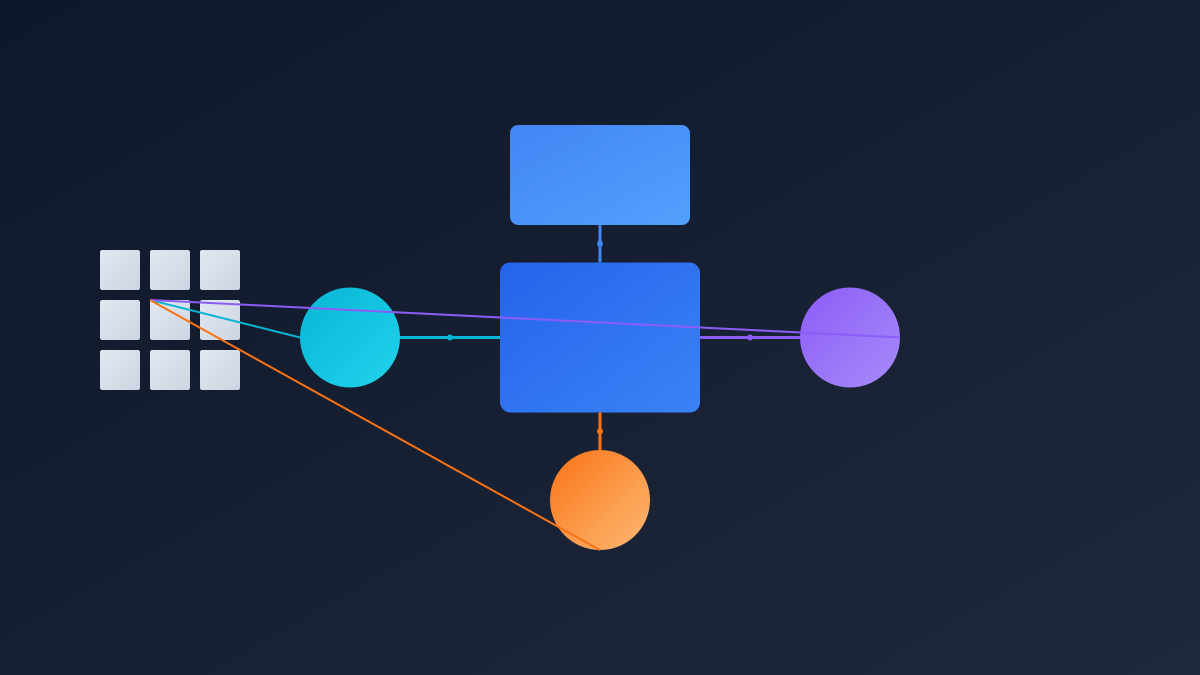
The project adopts a four-layer agent collaboration system: Root Orchestrator (routes requests) + Sequential Pipeline (research → drafting → review), Parallel Multi-format Generation (parallel output of blogs/social media/emails, etc.), Loop Quality Refinement (writing → critique → rewriting cycle), and Skills System (three-level loading strategy: list query/on-demand loading/resource acquisition, supporting inline, file, and meta-skills). ADK 2.0 features cover all major multi-agent modes, ensuring modularity and scalability.

4

Section 04

Application and Deployment: Practical Usage and Cloud-Native Capabilities

The project provides 7 typical query examples (e.g., writing a medical AI article triggers the Sequential process, converting omnichannel content triggers the Parallel process, etc.). It supports one-click deployment to Vertex AI Agent Engine, with steps including local verification and GCP project deployment, requiring GCP authentication and API activation. Applicable scenarios include marketing teams (multi-format content generation), content operations (process automation), and technical teams (ADK 2.0 learning reference).

5

Section 05

Summary and Outlook

This project is not only a fully functional content operations system but also a reference textbook for multi-agent application development, providing validated architecture patterns, practical skill management strategies, complete deployment paths, and rich examples. As multi-agent technology matures, such architectures will become the mainstream of enterprise AI applications, and the ADK 2.0 ecosystem will provide the technical foundation for them.

