Zing Forum

Reading

Goinfer: A DevOps-Friendly Solution for Securely Connecting Local Large Models to the Internet

Goinfer solves the security and network challenges of exposing local LLMs to the public internet via a reverse connection architecture, enabling secure remote inference access without VPN or port forwarding.

Goinfer本地LLM大模型部署反向代理DevOpsllama.cppGGUF远程推理网络安全GPU共享
Published 2026-04-13 08:42Recent activity 2026-04-13 08:47Estimated read 6 min
Goinfer: A DevOps-Friendly Solution for Securely Connecting Local Large Models to the Internet
1

Section 01

Goinfer: Introduction to a DevOps-Friendly Solution for Securely Connecting Local Large Models to the Internet

Goinfer is a DevOps-friendly solution that addresses the problem of securely exposing local large models to the internet. Its core uses a reverse connection architecture, allowing GPU clients to actively connect to static IP servers, enabling secure remote inference access without VPN or port forwarding. This article will cover aspects such as background, core architecture, technical implementation, deployment and operation, application scenarios, etc.


2

Section 02

Three Dilemmas of Exposing Local LLMs to the Internet

For users running large language models locally, exposing the models to the internet faces multiple challenges:

  1. Security Risks: Directly exposing llama-server or ollama instances is vulnerable to malicious use, leading to resource occupation or system intrusion;
  2. Network Topology Restrictions: Home routers block inbound connections, and dynamic IP increases the complexity of remote access;
  3. Privacy Concerns: Third-party relay services violate the privacy初衷 of local deployment. Existing tools like llamactl and VPN either require opening ports or are complex to configure, with high usage thresholds.
3

Section 03

Core Innovation: Disruptive Design of Reverse Connection Architecture

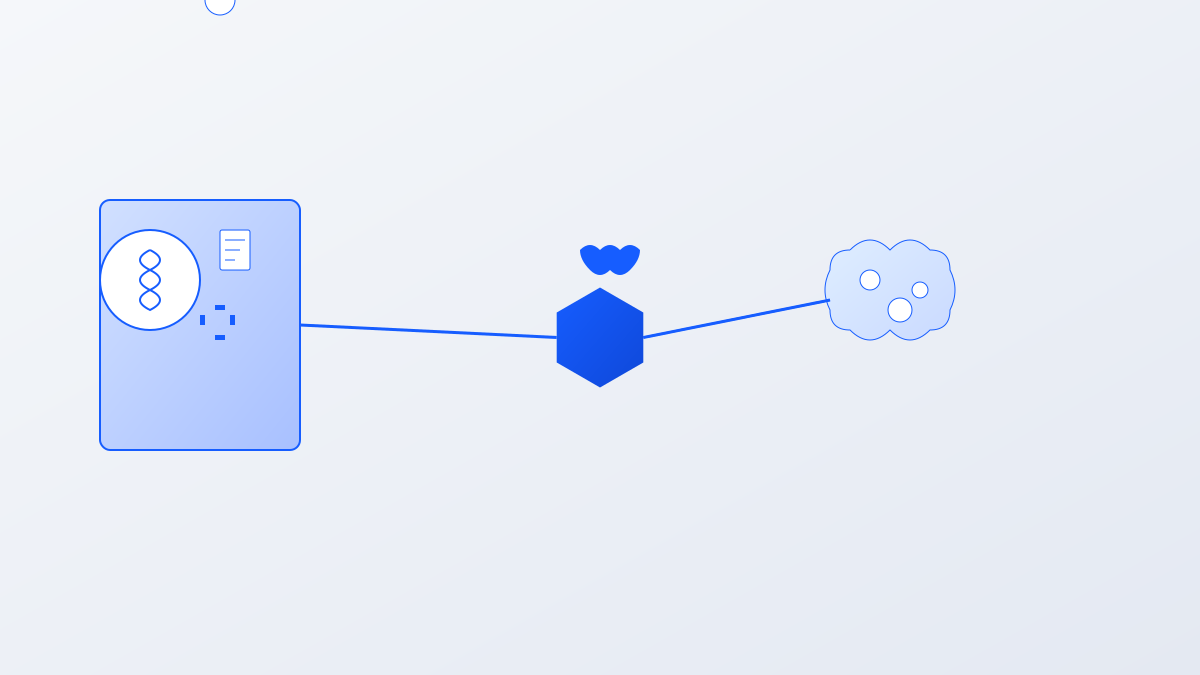
Goinfer adopts a reverse connection architecture, reversing the traditional connection direction: GPU clients actively initiate outbound secure connections to static IP servers, and the server forwards inference requests back to the client. The advantages of this architecture:

  • No need to open inbound ports, avoiding home network restrictions;
  • End-to-end encryption to ensure communication security;
  • Elegant reconnection mechanism to handle network fluctuations.
4

Section 04

Technical Implementation and Feature Analysis

Goinfer is built based on llama.cpp and llama-swap, with features including:

  • Model Management: Supports loading multiple GGUF models and dynamic switching, adjustable inference parameters (temperature, top_p, etc.);
  • API Compatibility: Supports OpenAI-compatible HTTP API (/v1/chat/completions) and llama.cpp native API, streaming response output;
  • Security Design: API key authorization, CORS control, independent of ISP IP to ensure service continuity.
5

Section 05

DevOps-Friendly Deployment and Operation Solution

Goinfer's DevOps-friendly design:

  • Automation Scripts: clone-pull-build-run.sh one-click clones and builds llama.cpp, automatically discovers GGUF models to generate configurations;
  • Containerized Deployment: Provides Containerfile, built based on NVIDIA images, optimizing GPU performance;
  • Layered Configuration: goinfer.ini controls service parameters, models.ini defines model presets, separate management.
6

Section 06

Three Typical Application Scenarios of Goinfer

Goinfer is suitable for the following scenarios:

  1. Home AI Workstation: Home GPU desktop runs the client, cloud server runs the server, enabling secure remote access;
  2. Enterprise Intranet GPU Sharing: Idle GPUs deploy clients, employees access via a unified server entry, improving resource utilization;
  3. Development and Testing Environment: Build API-compatible inference services locally for application development and testing.
7

Section 07

Conclusion: A Bridge Connecting Private Computing Power and Distributed Access

Goinfer solves the classic problem of exposing local LLMs to the public internet through a reverse connection architecture, balancing security, ease of use, and functionality. Its DevOps-friendly design simplifies deployment and operation, providing a practical solution for local AI enthusiasts and enterprise users. As the demand for local large models grows, Goinfer will become an important bridge connecting private computing power and distributed access.

