Zing Forum

Reading

GLQ: In-depth Analysis of LLM Weight Quantization Technology Based on E8 Lattice Codebook

This article provides an in-depth analysis of the GLQ project, explaining how it uses the E8 lattice codebook to achieve efficient quantization of large language model (LLM) weights, supports 2/3/4 bits per weight (bpw) configurations, and integrates Triton fused inference kernels for hardware acceleration.

LLM量化E8格点向量量化Triton内核模型压缩边缘推理GPU加速
Published 2026-04-01 06:10Recent activity 2026-04-01 06:19Estimated read 6 min
GLQ: In-depth Analysis of LLM Weight Quantization Technology Based on E8 Lattice Codebook
1

Section 01

In-depth Analysis of GLQ Technology: E8 Lattice Quantization + Triton Acceleration for Efficient LLM Deployment

Addressing the high deployment cost of LLMs, the GLQ project’s core innovation lies in using the E8 lattice codebook to achieve efficient weight quantization, supporting 2/3/4 bits per weight (bpw) configurations, and integrating Triton fused inference kernels for hardware acceleration. It balances compression ratio and model accuracy, providing a feasible path for efficient LLM deployment.


2

Section 02

Background and Core Challenges of LLM Quantization

The growing parameter scale of large language models (LLMs) leads to high deployment costs. Model quantization technology reduces memory and computational overhead by lowering precision, but traditional methods face a dilemma: low bit-widths (2/3 bits) offer high compression ratios but significant accuracy loss, while high bit-widths (8 bits) maintain high accuracy but struggle to meet resource constraints of edge devices. There is an urgent need for solutions that preserve high accuracy at extremely low bit rates.

3

Section 03

Core Method of GLQ: Innovative Application of E8 Lattice Codebook

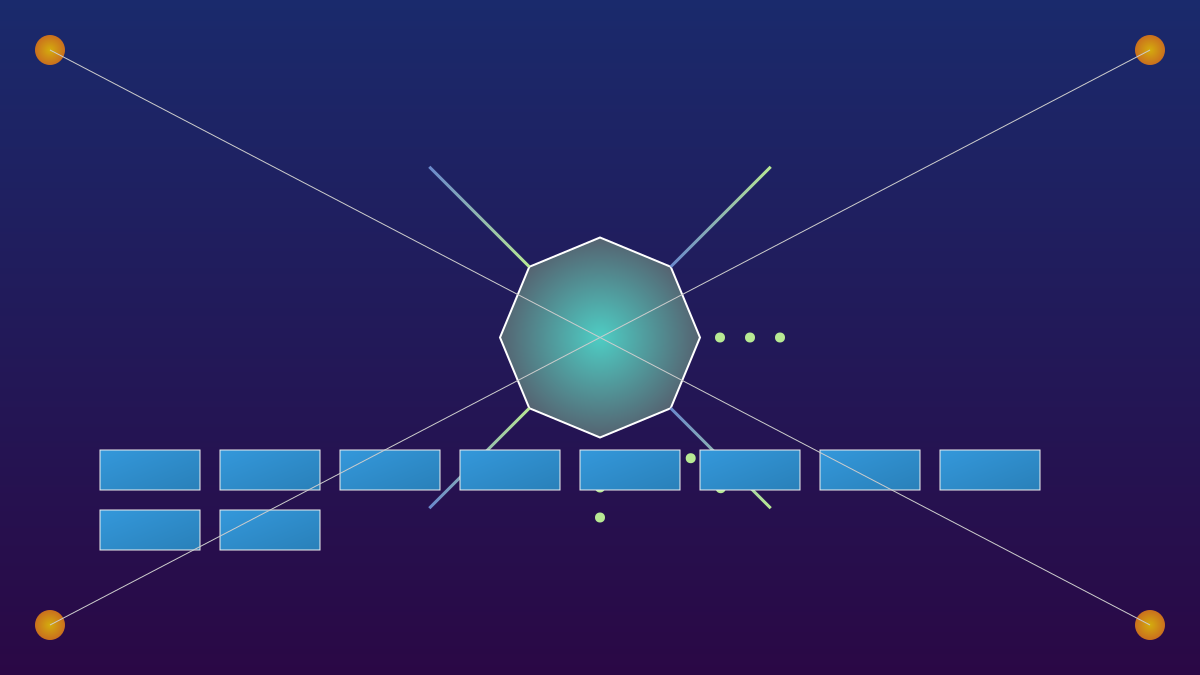
GLQ uses the E8 lattice (an 8-dimensional optimal sphere packing structure) as the codebook. Its symmetric structure ensures uniform distribution of quantized weights and reduces error accumulation, and nearest neighbor search can be done via look-up tables. Weights are divided into 8-dimensional vector groups and mapped to E8 lattice points. Grouped vector quantization better captures weight correlations than element-wise scalar quantization, reducing reconstruction errors.

4

Section 04

Flexible Bit-Width Configuration: Adaptive Strategy for Different Scenarios

GLQ supports 2/3/4 bpw configurations: 2bpw for extreme compression (model size reduced to 1/16, suitable for edge devices), 3bpw for balanced trade-off (reduced to 3/8, ideal for mobile devices), and 4bpw for near-lossless compression (reduced to 1/2, recommended for production environments). It also supports mixed-precision quantization, where different layers dynamically select bit-widths to optimize the accuracy-efficiency trade-off.

5

Section 05

Triton Fused Kernels: Key Implementation for Hardware Acceleration

GLQ uses the Triton language to write fused inference kernels, integrating quantization decoding, dequantization, and matrix multiplication to reduce GPU memory access and kernel overhead. The workflow is: read compressed weights → parallel dequantization in shared memory → direct matrix multiplication. It leverages GPU shared memory and Tensor Cores for acceleration, supports dynamic batching and sequence parallelism, and achieves high computational efficiency on Ampere/Hopper architecture GPUs.

6

Section 06

Application Scenarios and Deployment Recommendations for GLQ

Application scenarios: Cloud (4bpw reduces cost by 50%), mobile (3bpw enables running billion-parameter models), edge (2bpw for local speech understanding). Deployment recommendations: Prioritize quantization-aware training (QAT) to improve accuracy, select calibration data similar to the scenario distribution, and perform performance benchmarking on actual hardware.

7

Section 07

Technical Limitations and Future Outlook of GLQ

Limitations: Currently only quantizes weights; activation quantization remains challenging. Future directions: Extend E8 lattice to activation quantization, optimize codebooks (adaptive learning, non-uniform grids, customization), and migrate to new AI accelerators like TPU/NPU.

8

Section 08

Conclusion: GLQ Advances the Democratization of AI

By combining E8 lattice mathematical theory with Triton engineering practice, GLQ provides a technical path for efficient LLM deployment. Amid growing model scales and resource constraints, it helps bring the capabilities of powerful language models to a wider range of scenarios and user groups.

