Zing Forum

Reading

GhostAgent MCP: Introducing Adversarial Supervision Agent Swarm for LLMs, Creating the "Voice in the Head" for Code Review

GhostAgent MCP is a supervision framework based on the Model Context Protocol (MCP). By deploying multiple specialized "ghost" agents, it provides real-time adversarial review for LLM-generated code, architecture design, and documentation writing.

MCPGhostAgentAI审查代码质量多智能体LLM监督Model Context Protocol
Published 2026-04-06 22:40Recent activity 2026-04-06 22:49Estimated read 7 min
GhostAgent MCP: Introducing Adversarial Supervision Agent Swarm for LLMs, Creating the "Voice in the Head" for Code Review
1

Section 01

GhostAgent MCP: Core Overview

GhostAgent MCP: Introducing Adversarial Supervision Agents for LLM Code Review

Core Idea: GhostAgent MCP is a Model Context Protocol (MCP)-based supervision framework that deploys multiple specialized "ghost" agents to provide real-time adversarial review for LLM-generated code, architecture design, and documentation. It aims to solve the problem where human reviewers struggle to keep up with the speed of AI-generated code.

Key Metaphor: The system acts as a "voice in the head" for LLMs—similar to how human developers self-criticize while coding, GhostAgent provides structured, external self-criticism for LLMs.


2

Section 02

Project Background & Design Philosophy

Project Background & Design Philosophy

Problem: As LLM capabilities grow (code writing, architecture design, docs), human code reviewers can't keep up with AI-generated code speed.

Core Concept: The "voice in the head" metaphor—GhostAgent provides a structured self-criticism mechanism for LLMs.

Protocol Basis: Built on Anthropic's Model Context Protocol (MCP), an open standard for AI-tool interactions. This allows seamless integration into MCP-supported AI programming assistants or IDEs as part of the development workflow.

3

Section 03

Multi-Agent Architecture: Six Specialized Ghosts

Multi-Agent Architecture: Six Specialized Ghosts

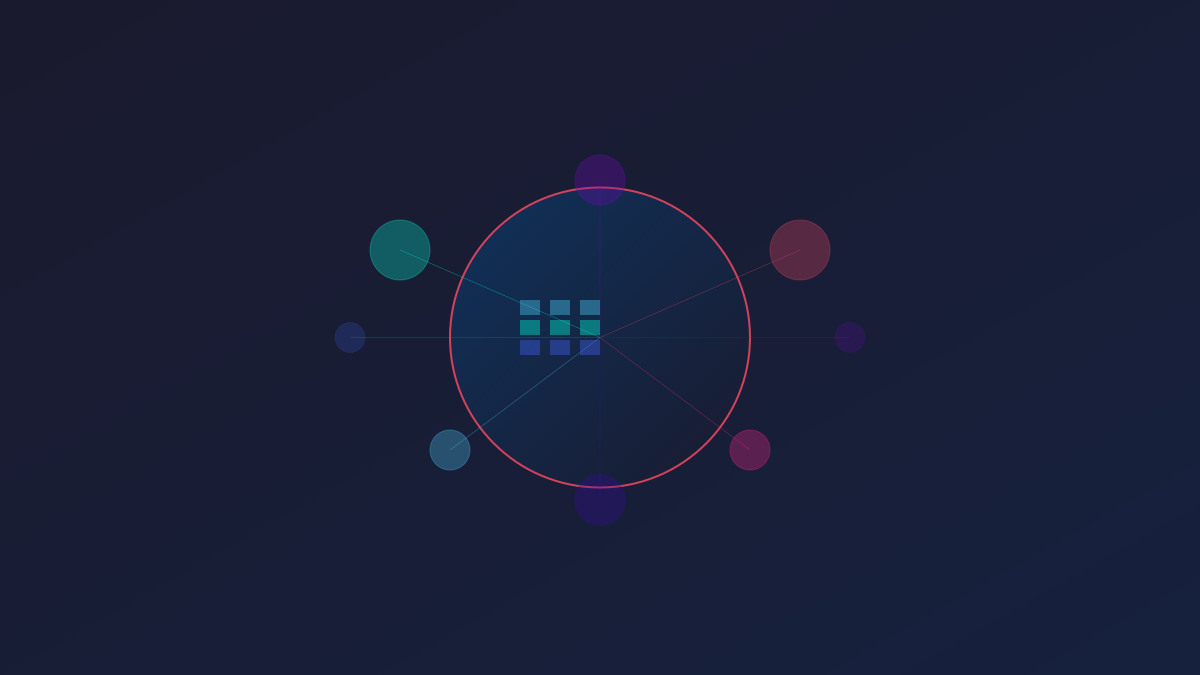
GhostAgent MCP uses six specialized "ghost" agents for multi-dimensional review:

  • ghost-sec: Focuses on code security (injection vulnerabilities, permission bypasses, unsafe dependencies).
  • ghost-arch: Evaluates architecture design (module division, interface design, scalability).
  • ghost-logic: Verifies business logic correctness (boundary conditions, state management issues).
  • ghost-perf: Analyzes performance (algorithm complexity, resource leaks).
  • ghost-style: Ensures compliance with coding standards and best practices.
  • ghost-research: Suggests alternative implementation schemes and tech stack choices.

This mimics human expert team reviews but is faster and free from fatigue/attention issues.

4

Section 04

Dynamic Routing & Flexible Configuration

Dynamic Routing & Flexible Configuration

GhostAgent supports flexible review modes via presets:

  • silence_is_golden: Minimal intervention (only critical issues).
  • this_guy_again: Medium intensity (daily development).
  • oh_my_gosh: High intensity (no detail missed).
  • just_do_it: Fast pass (prototyping).
  • guardian_angel: Full protection (all ghosts enabled).

Each preset can be adjusted with 1-5 intensity levels. Custom configurations are also supported for team-specific ghost combinations.

5

Section 05

Cost Management & ROI Tracking

Cost Management & ROI Tracking

Budget Control: GhostAgent uses high-level models (GPT-4, Claude3 Opus) so it includes fine-grained budget management: each session has a cost limit, real-time tracking, warnings when approaching limits, and auto-pause on overrun.

Metrics: The ghostagent_metrics tool provides detailed ROI data to evaluate the relationship between review investment and code quality improvements.

6

Section 06

Integration & Use Cases

Integration & Use Cases

Integration: Uses stdio transport layer (MCP-compliant) to integrate with tools like Claude Desktop, Cursor, GitHub Copilot.

Typical Scenarios:

  1. Real-time code review (feedback while coding).
  2. Pre-submit check (deep review before code submission).
  3. Architecture evaluation (multi-dimensional assessment of design documents).
  4. Config validation (check YAML/JSON syntax and logic errors).
7

Section 07

Limitations & Future Outlook

Limitations & Future Outlook

Current Limitations:

  • Early version (v0.1.0) with a brief README, lacking detailed documentation and examples.
  • Review effectiveness depends on underlying LLM quality (biases or knowledge gaps affect results).

Future Directions:

  • Advance multi-agent system research.
  • Improve reliability of AI self-criticism and self-improvement capabilities.
8

Section 08

Conclusion & Vision

Conclusion & Vision

GhostAgent MCP represents a new AI collaboration paradigm: main LLM handles creative generation, while ghost agents act as strict reviewers—complementing each other to produce higher-quality code.

For teams aiming to improve code quality and reduce technical debt, it's a promising solution. The vision is to make AI systems with self-criticism a norm in future human-AI collaboration.

