Zing Forum

Reading

fw-multi-agent: A Multi-Agent Collaboration System for Firmware Development

A Claude Code-based multi-agent system for firmware development that automates the entire process of planning, development, and testing through role division among PM, RD, QA, and supervisor roles

多智能体系统固件开发Claude Code嵌入式开发AI协作ESP32STM32代码审查DevOps
Published 2026-03-30 13:46Recent activity 2026-03-30 13:54Estimated read 8 min
fw-multi-agent: A Multi-Agent Collaboration System for Firmware Development
1

Section 01

Introduction: fw-multi-agent - Core Introduction to the Multi-Agent Collaboration System for Firmware Development

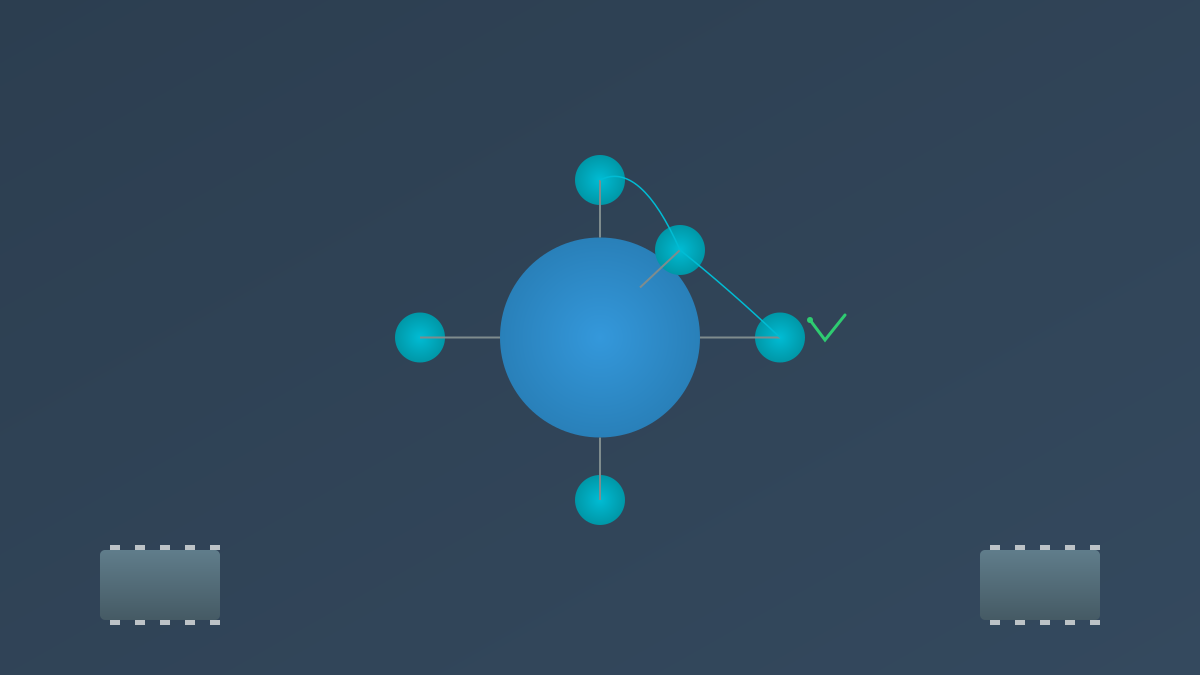
This article introduces the fw-multi-agent system, a Claude Code-based multi-agent collaboration system for firmware development. Through role division among Coordinator (facilitator), PM (product manager), RD (R&D engineer), QA (quality assurance), and Team Monitor (team supervisor), it automates the entire process of planning, development, and testing, aiming to solve problems such as complexity, resource constraints, and the talent supply-demand gap in firmware development.


2

Section 02

Complexity Challenges in Firmware Development and the Background of AI Demand

Firmware development is a highly challenging engineering practice in the embedded field, requiring compliance with multiple constraints such as real-time performance, resource limitations, and reliability, covering multiple stages including requirement analysis, architecture design, and code implementation. The traditional process relies on senior engineers, leading to knowledge bottlenecks and progress limitations. The explosive growth of IoT devices has exacerbated the contradiction between firmware development demand and the shortage of embedded engineers, spurring the need to reconstruct the development process using AI and realize large-scale replication of capabilities.

3

Section 03

Multi-Agent Architecture Design and Role Division

fw-multi-agent draws on human team division models and decomposes complex tasks into different professional agents:

  • Coordinator: Responsible for task distribution, progress tracking, and conflict arbitration (project manager role);
  • PM: Understands requirements, writes documents, formulates plans, and converts high-level requirements into technical tasks;
  • RD: Undertakes architecture design, code implementation, debugging, and optimization;
  • QA: Designs test cases, executes tests, reports defects, and verifies fixes;
  • Team Monitor: Monitors the output of other agents, records decision-making processes, and corrects when necessary.
4

Section 04

Technical Implementation and Toolchain Details

The system is built on Claude Code and follows the modular principle:

  • Agents directory: Defines role configurations for each agent (responsibility boundaries, capability scope, collaboration protocols);
  • Commands directory: Implements a slash command system (e.g., /build, /test, /deploy) to lower the usage threshold;
  • Skills directory: Contains professional skill modules such as ESP32/STM32 development, code review, and debugging techniques;
  • Rules directory: Defines code standards and workflows (code style, Git workflow, embedded development guidelines, etc.);
  • Templates directory: Provides L2 system templates to support rapid startup of new projects. The tech stack includes Claude Code, PowerShell, ESP32/STM32, JIRA API, and Slack API.
5

Section 05

Enterprise-Grade Toolchain Integration Capabilities

The system deeply integrates enterprise toolchains:

  • JIRA integration: Automatically creates, updates, and tracks work orders (e.g., FWP-704, FWP-731), integrating with existing project management processes;
  • Slack integration: Agents report progress, request clarification, or issue alerts to human teams via Slack, enabling human-machine collaboration;
  • Build and flashing automation: Supports STM32 and ESP32 platforms, automatically compiles firmware, generates binary files, and executes flashing to improve iteration efficiency.
6

Section 06

Innovations in AI Collaboration Mode

Innovations of the system in AI collaboration mode:

  • Sub-agent review mechanism: Each agent's output must be reviewed by other agents, simulating human code review processes to reduce error rates;
  • Memory system: A file-based memory mechanism maintains context continuity between sessions, allowing agents to review decisions, reuse solutions, avoid redundant work, and is suitable for long-cycle firmware projects.
7

Section 07

Practical Value and Application Prospects

Practical value of fw-multi-agent:

  • For firmware teams: Acts as a virtual member to take on repetitive tasks (requirement documentation, code implementation, test case generation), freeing up engineers' creativity;
  • For novice developers: Provides skill modules and best practice templates to accelerate capability growth;
  • Paradigm exploration: Proves that complex engineering tasks can be automated through collaboration of professional agents, representing the direction of AI engineering deepening into professional fields (divide-and-conquer strategy).
8

Section 08

Limitations and Improvement Suggestions

Limitations of the system and areas for improvement:

  • Platform support: Currently mainly for ESP32 and STM32, needs to expand to RISC-V, ARM Cortex-A, and other architectures;
  • Collaboration protocols: Existing protocols are relatively simple, need optimization to handle highly complex concurrent tasks;
  • AI review quality: Limited by training data, safety-critical firmware (e.g., automotive ECUs, medical devices) still requires final review by human experts.

