Zing Forum

Reading

FusionNet-Scratch: A Multi-Modal Diagnostic Fusion Solution to Break Medical AI's 'Data Silos'

Addressing the prevalent single-modal limitations of medical AI tools, the open-source project FusionNet-Scratch proposes an end-to-end multi-modal fusion architecture. This system integrates multi-source data such as imaging, lab tests, and medical records, using custom feature extractors and a full-stack web architecture to provide practical AI solutions for telemedicine and specialist diagnosis.

多模态融合医疗AI深度学习远程医疗影像诊断DjangoReact临床决策支持
Published 2026-04-12 17:32Recent activity 2026-04-12 18:23Estimated read 5 min
FusionNet-Scratch: A Multi-Modal Diagnostic Fusion Solution to Break Medical AI's 'Data Silos'
1

Section 01

FusionNet-Scratch: Open-Source Multi-Modal Fusion Solution for Medical AI

FusionNet-Scratch is an open-source project addressing the single-modal limitations of current medical AI tools and breaking 'data silos'. It proposes an end-to-end multi-modal fusion architecture integrating images, lab tests, medical records, etc. With custom feature extractors and full-stack web architecture (Django + React), it provides practical AI solutions for remote medical care and specialist diagnosis.


2

Section 02

Background: Single-Modal AI Tools and Data Silos

Medical diagnosis inherently relies on multi-modal information (images, lab results, symptoms, history). However, most existing medical AI tools are single-modal (focusing on images, lab data, or text alone), leading to fragmented 'data silos' where AI modules cannot integrate cross-modal information like human doctors.

3

Section 03

Method: End-to-End Multi-Modal Fusion Design

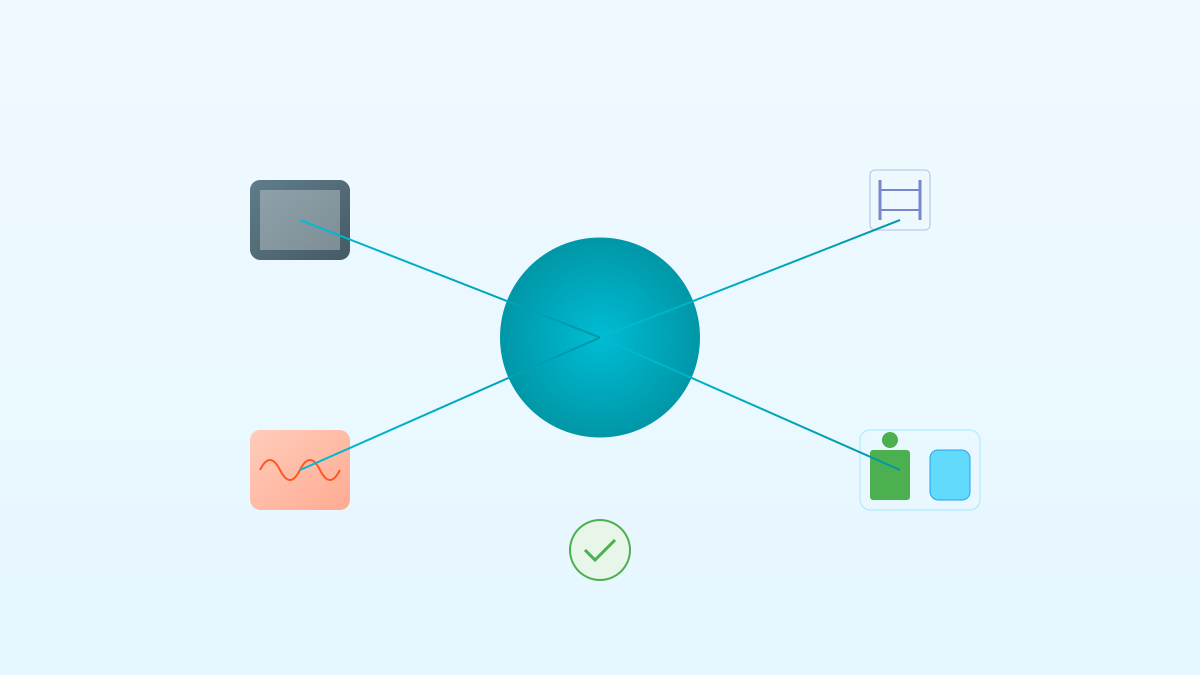
FusionNet-Scratch uses custom feature extractors: CNN for images, fully connected networks for lab data, NLP models for text records. These features are mapped to the same semantic space. Instead of simple concatenation, it uses attention mechanisms to dynamically adjust the weight of each modality based on the case (e.g., higher weight on images for lung diseases, lab data for metabolic diseases).

4

Section 04

Method: Full-Stack Web Architecture for Accessibility

FusionNet-Scratch provides a complete full-stack solution: Django backend (stable, secure, scalable, with database abstraction and permission management) and React frontend (intuitive UI for doctors to upload data and view suggestions). The web architecture supports remote access, making it suitable for telemedicine scenarios.

5

Section 05

Solving Real Clinical Pain Points

  1. Data integration: Standard interfaces for importing data from PACS (imaging), LIS (lab), EMR (medical records). 2. Specialist adaptation: Modular architecture allows training for specific departments (radiology, cardiology). 3. Interpretability: Provides visual explanations (attention heatmaps, key feature annotations) to help doctors understand AI decisions.
6

Section 06

Technical Highlights: Custom Scratch Architecture

Choosing to build from scratch instead of using pre-trained models has advantages: 1. Domain adaptability: Tailored to medical data (DICOM format, device noise, medical patterns). 2. Efficiency: Optimized for resource-limited environments (e.g., primary hospitals). 3. Maintainability: Transparent code for easy iteration and bug fixes based on clinical feedback.

7

Section 07

Application Value in Remote Medical Care

In telemedicine, FusionNet-Scratch acts as a 'digital替身' for remote doctors by integrating patient data (images, lab results, symptoms). For resource-poor areas, it helps primary institutions get expert-level AI assistance, reducing patient travel and improving access to care.

8

Section 08

Limitations and Future Outlook

Limitations: 1. Data privacy: Needs stronger encryption and access control for production. 2. Regulatory compliance: Requires certification as medical devices in many regions. 3. Generalization: May lack generalization ability to unseen diseases or devices. Future: Combine custom architecture with pre-trained models to balance domain adaptability and generalization.

