Zing Forum

Reading

Forge: An LLM Workflow Orchestration Framework for Individual Developers

This article introduces how the Forge project, through its distinct workflow design and multi-perspective collaboration mechanism, helps individual developers better harness LLM capabilities in vibe coding scenarios, enabling the transformation from vague intentions to clear outputs.

vibe codingLLM编排AI辅助编程工作流多智能体代码生成单开发者Forge
Published 2026-06-04 12:15Recent activity 2026-06-04 12:21Estimated read 5 min
Forge: An LLM Workflow Orchestration Framework for Individual Developers
1

Section 01

Forge: An LLM Workflow Orchestration Framework for Individual Developers

Introduction: This article introduces the Forge project on GitHub. Targeting the pain points of individual developers in vibe coding scenarios, it helps developers transform vague intentions into high-quality code outputs and improve the efficiency and quality of AI-assisted development through distinct workflow design, multi-perspective collaboration mechanism (Council), and framework-agnostic features.


2

Section 02

Background: Orchestration Needs in the Vibe Coding Era

With the popularization of AI-assisted programming, "vibe coding" (generating code from natural language intent descriptions) has become an emerging model. However, there are issues such as LLMs struggling to understand complex requirements, and difficulty ensuring consistency and quality during iteration. The Forge project aims to provide an orchestration layer between developers' intentions and AI outputs to address these challenges.

3

Section 03

Core Design and Workflow Mechanism

Forge's design philosophy is "Sharp intent in, coherent result out". Key principles include: 1. Distinct workflows (built-in best practices, standardizing common scenarios); 2. Multi-perspective collaboration (Boards & Council); 3. Framework-agnostic (supports switching to any LLM model). The workflow is divided into four stages: Requirement Clarification (guided questions to clarify needs) → Solution Design (generate multiple candidate solutions and analyze pros and cons) → Code Generation (generate code that complies with architectural specifications based on context) → Review and Iteration (automated quality checks and fixes).

4

Section 04

Featured Council Mechanism: Simulating Team Collaboration Reviews

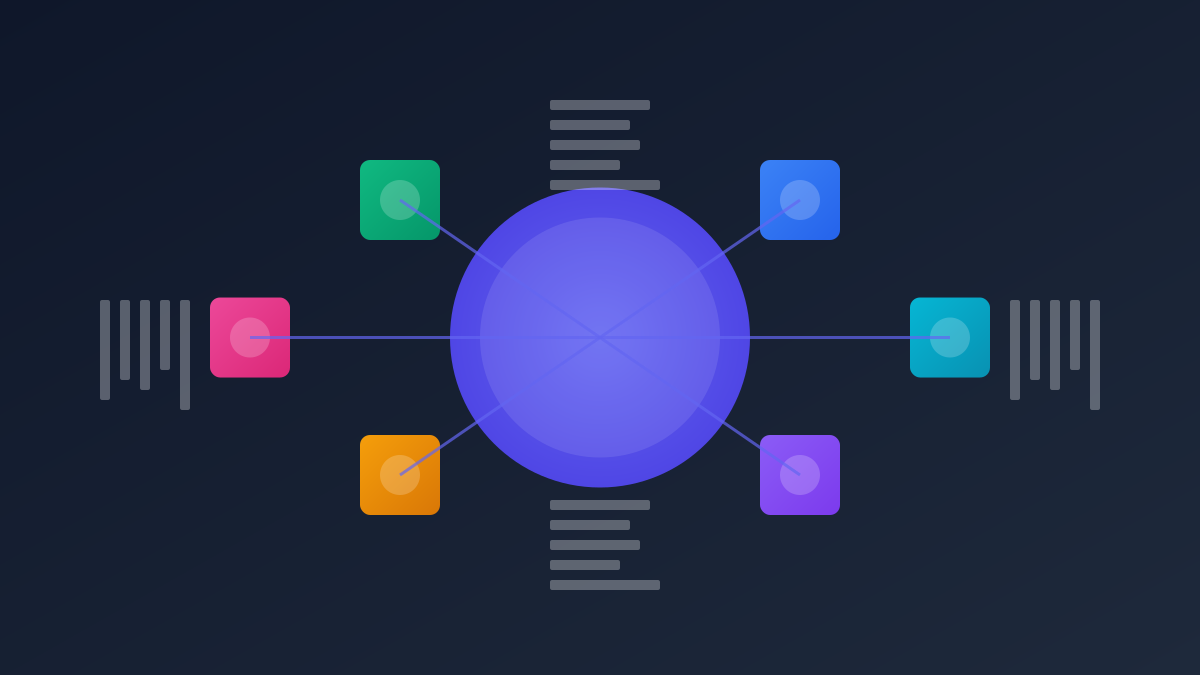
Forge's Council mechanism simulates collaboration among multiple expert roles: Architect (focuses on structure and maintainability), Security Expert (identifies risks and vulnerabilities), Performance Engineer (evaluates efficiency and scalability), and Test Engineer (suggests test coverage). Each role reviews code in parallel, summarizes feedback reports, and helps developers iterate and optimize.

5

Section 05

Value in Single Developer Scenarios

Forge is positioned as a tool for single developers, with value reflected in: Reducing cognitive load (structured workflows eliminate the need to repeatedly think about steps); Improving code quality (built-in reviews detect easily overlooked issues); Accelerating the learning curve (mastering best practices through multi-perspective feedback); Maintaining consistency (helping quickly resume project context after a long time).

6

Section 06

Comparison with Existing Tools

Compared to Cursor/GitHub Copilot: Forge focuses on workflow orchestration rather than code completion; it does not replace IDE tools but coordinates LLM calls and tool usage. Compared to LangChain/LlamaIndex: Forge is more focused on code generation scenarios, with built-in workflows and role designs centered around software development best practices.

7

Section 07

Future Outlook

As LLM capabilities improve, vibe coding is expected to replace more traditional coding scenarios. Orchestration frameworks like Forge mark the evolution of this field toward structured and engineering practices. For independent developers looking to improve the efficiency of AI-assisted development, Forge is a choice worth exploring.

