Zing Forum

Reading

Fluxbee: A New Paradigm of Human-AI Collaboration in Autonomous AI Cluster Operating Systems

This article provides an in-depth analysis of the Fluxbee project, an autonomous AI cluster operating system that runs AI agents, humans, and deterministic workflows as collaborative nodes in a hive architecture, with routing, identity, policy, memory, and time built in as first-class citizen primitives.

AI集群自主系统智能体协作人机共生蜂巢架构分布式AI
Published 2026-04-13 02:45Recent activity 2026-04-13 02:53Estimated read 7 min
Fluxbee: A New Paradigm of Human-AI Collaboration in Autonomous AI Cluster Operating Systems
1

Section 01

Fluxbee: Introduction to the New Paradigm of Human-AI Collaboration in Autonomous AI Cluster Operating Systems

Fluxbee is an autonomous AI cluster operating system whose core is to run AI agents, human users, and deterministic workflows as collaborative nodes in a hive architecture, with routing, identity, policy, memory, and time as first-class citizen primitives. It aims to build a human-AI symbiotic ecosystem, going beyond the request-response tool mode of traditional LLM applications to enable AI agents to collaborate autonomously like a bee colony.


2

Section 02

Background and Vision: Transition from Tool to Ecosystem

Current large language model applications mostly stay at the tool level (request-response mode) and do not fully unleash AI potential. Fluxbee's vision is to enable AI agents to collaborate autonomously like a bee colony, forming an organic ecosystem that integrates AI, humans, and workflows as collaborative nodes to achieve a new paradigm of human-AI symbiosis.

3

Section 03

Core Concepts and System Architecture

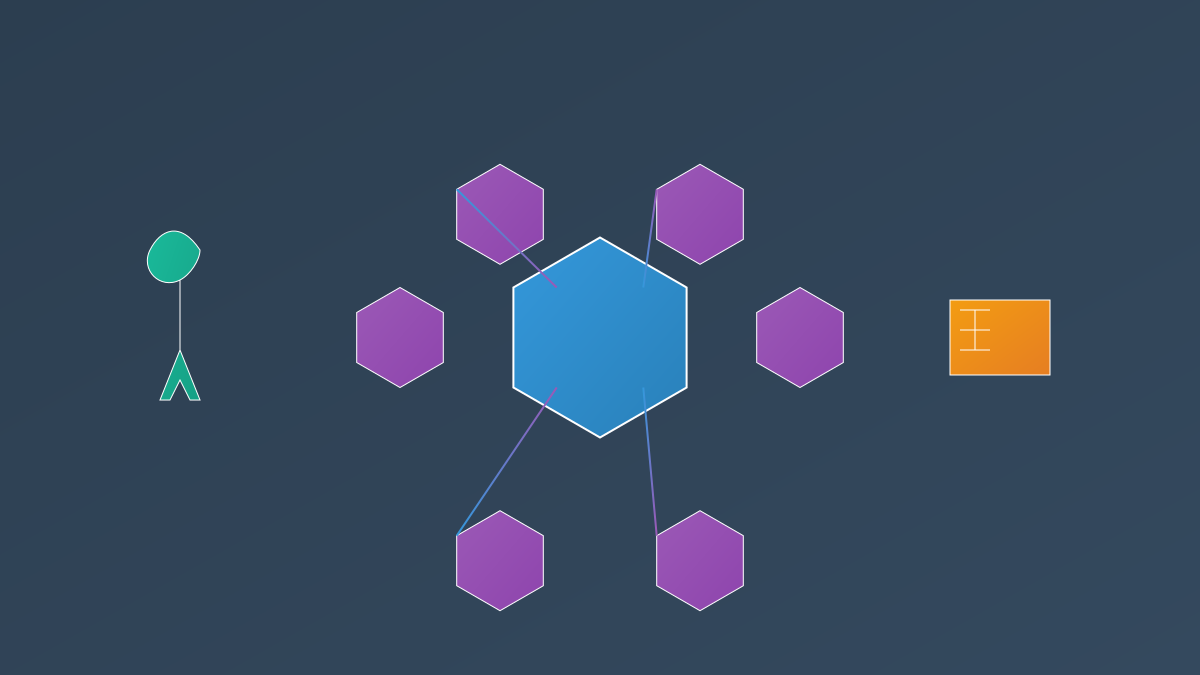
Hive Metaphor: Inspired by bee society, emphasizing role division, collective behavior, information transmission, and adaptability. First-Class Citizen Primitives: Routing (intelligent distribution of tasks/information), Identity (verifiable identity and permissions), Policy (dynamically configured behavior drivers), Memory (distributed collective intelligence), Time (temporal reasoning and scheduling). Node Types: AI agents (autonomous decision-making, collaborative learning), Humans (guidance and supervision, professional contributions), Deterministic workflows (standardized processes, consistent results). Architecture Layers: Unit (tightly collaborative node group) → Hive (multi-unit cluster) → Apiary (cross-hive deployment). Communication Protocol: Drawing on bee dance, message types include task requests, status broadcasts, etc., with routing based on content, load, capability matching, and priority.

4

Section 04

Core Mechanisms: Balance Between Autonomy and Collaboration

Autonomous Decision-Making: Nodes make local decisions within policy boundaries; multi-node negotiation reaches consensus, and escalates when unresolved. Memory and Learning: Distributed memory (local + shared), collective learning (experience dissemination, failure avoidance). Policy-Driven: Security, resource, collaboration, business, and other policies, supporting runtime dynamic adjustments. Time Primitive: Temporal awareness (event ordering, pattern recognition), scheduling coordination (task scheduling, clock synchronization), historical prediction (trend analysis, time-travel debugging).

5

Section 05

Application Scenarios: From Concept to Practice

  • Enterprise Automation: Coordinate AI to handle complex processes, manual review at key nodes, learn to optimize efficiency, and ensure compliance.
  • Scientific Research Collaboration: AI assists in literature analysis, humans provide insights, automate repetitive tasks, and accumulate domain knowledge.
  • Intelligent Customer Service: AI handles routine queries, escalates complex issues to humans, multi-agent collaboration, and continuous learning to improve quality.
  • Creative Industry: AI generates drafts, humans refine and review, automate copyright publishing, and team collaborative creation.
6

Section 06

Limitations and Challenges

  • Complexity Management: Distributed system debugging is difficult, requiring new operation and maintenance tools, and a steep learning curve.
  • Coordination Overhead: Communication latency, consensus cost, consistency maintenance overhead.
  • Security Boundaries: Prevent malicious nodes, control the scope of autonomous behavior, and ensure human final control.
7

Section 07

Future Outlook and Conclusion

Technological Evolution: Smarter routing, efficient distributed learning, natural human-AI interaction, stronger reasoning and planning. Ecosystem Construction: Development tool SDKs, pre-built node templates, community configurations, case libraries. Cross-Domain Applications: IoT edge computing, blockchain DApps, scientific computing simulations, game virtual worlds. Conclusion: Fluxbee represents a system design concept of human-AI symbiosis. AI is no longer an isolated tool but a member of the collaborative ecosystem, enhancing human capabilities rather than replacing them. It provides a reference framework for the next generation of AI applications, connecting human and machine intelligence to address complex challenges.

